

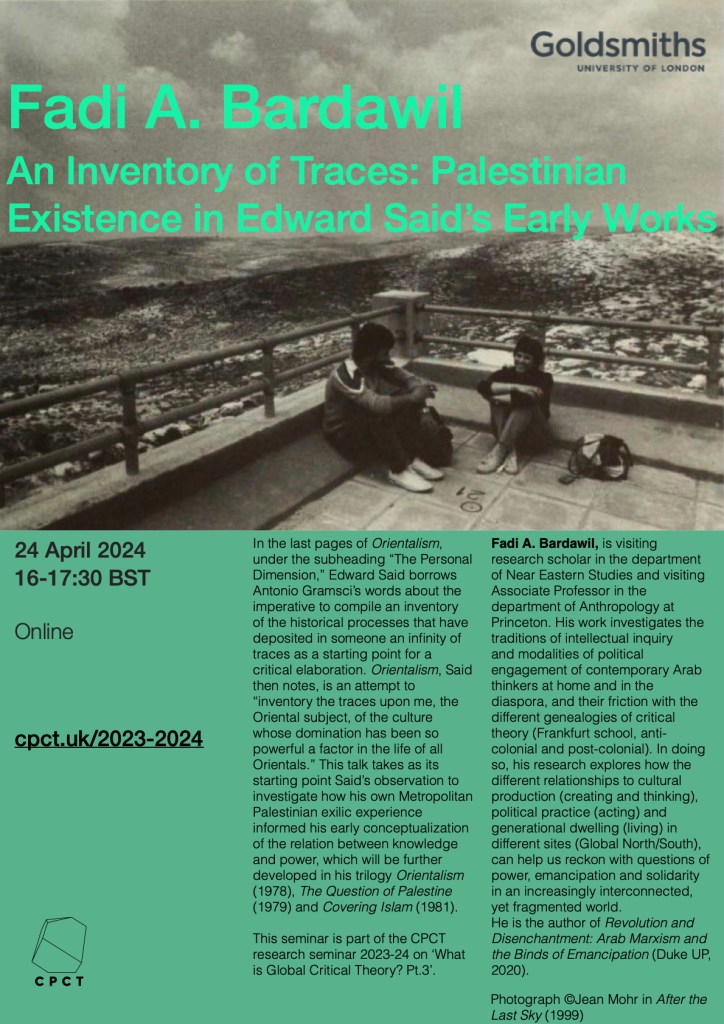
An Inventory of Traces:
Palestinian Existence in Edward Said’s Early Works
Fadi A. Bardawil (Princeton University)
24 April 2024
16:00 – 17:30 BST
Online
REGISTER HERE for the zoom link
Contact: s.bromberg[@] gold.ac.uk
This seminar is part of the 23/24 CPCT research seminar series on ‘What is Global Critical Theory? Pt.3’ [link].
About the talk
In the last pages of Orientalism, under the subheading “The Personal Dimension,” Edward Said borrows Antonio Gramsci’s words about the imperative to compile an inventory of the historical processes that have deposited in someone an infinity of traces as a starting point for a critical elaboration. Orientalism, Said then notes, is an attempt to “inventory the traces upon me, the Oriental subject, of the culture whose domination has been so powerful a factor in the life of all Orientals.” This talk takes as its starting point Said’s observation to investigate how his own Metropolitan Palestinian exilic experience informed his early conceptualization of the relation between knowledge and power, which will be further developed in his trilogy Orientalism (1978), The Question of Palestine (1979) and Covering Islam (1981).
About the speaker
Fadi A. Bardawil, is visiting research scholar in the department of Near Eastern Studies and visiting Associate Professor in the department of Anthropology at Princeton.
His work investigates the traditions of intellectual inquiry and modalities of political engagement of contemporary Arab thinkers at home and in the diaspora, and their friction with the different genealogies of critical theory (Frankfurt school, anti-colonial and post-colonial). In doing so, his research explores how the different relationships to cultural production (creating and thinking), political practice (acting) and generational dwelling (living) in different sites (Global North/South), can help us reckon with questions of power, emancipation and solidarity in an increasingly interconnected, yet fragmented world.
His recent Arabic and English writings have appeared in American Ethnologist, boundary 2; Comparative Studies of South Asia, Africa and the Middle East; The Journal for Palestine Studies (Arabic edition); al-Jumhuriya; The Immanent Frame; Megaphone; Political and Legal Anthropology Review Online; South Atlantic Quarterly; and World Records Journal.
He is the author of Revolution and Disenchantment: Arab Marxism and the Binds of Emancipation (Duke UP, 2020).
 The Centre for Philosophy and Critical Thought, Goldsmiths University of London