The Centre for Philosophy and Critical Thought, Goldsmiths University of London

Research Centre run jointly between the Departments of Sociology and English and Comparative Literature at Goldsmiths University, London


Leave a comment

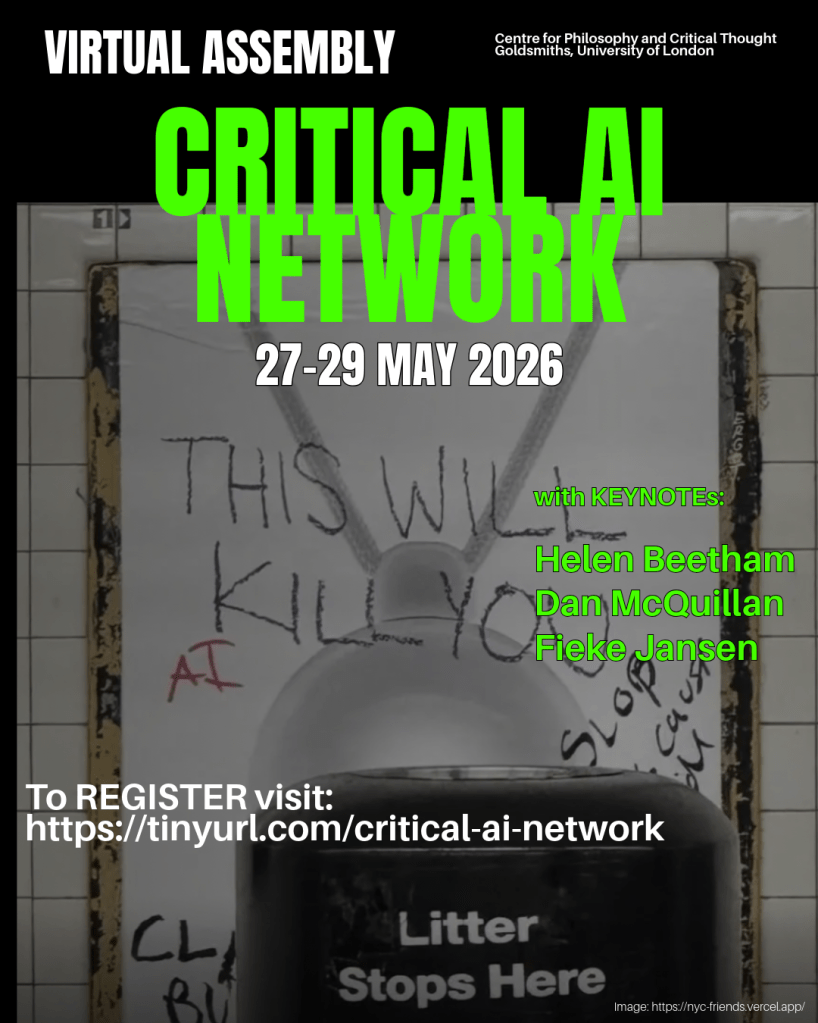
CfP: “How do we break something that is already broken?” Virtual Assembly of the Critical AI Network, CPCT (27-29 May 2026)

How do we break something that is already broken?

Virtual Assembly of the Critical AI Network, 27-29 May 2026
Centre for Philosophy and Critical Thought, Goldsmiths, University of London

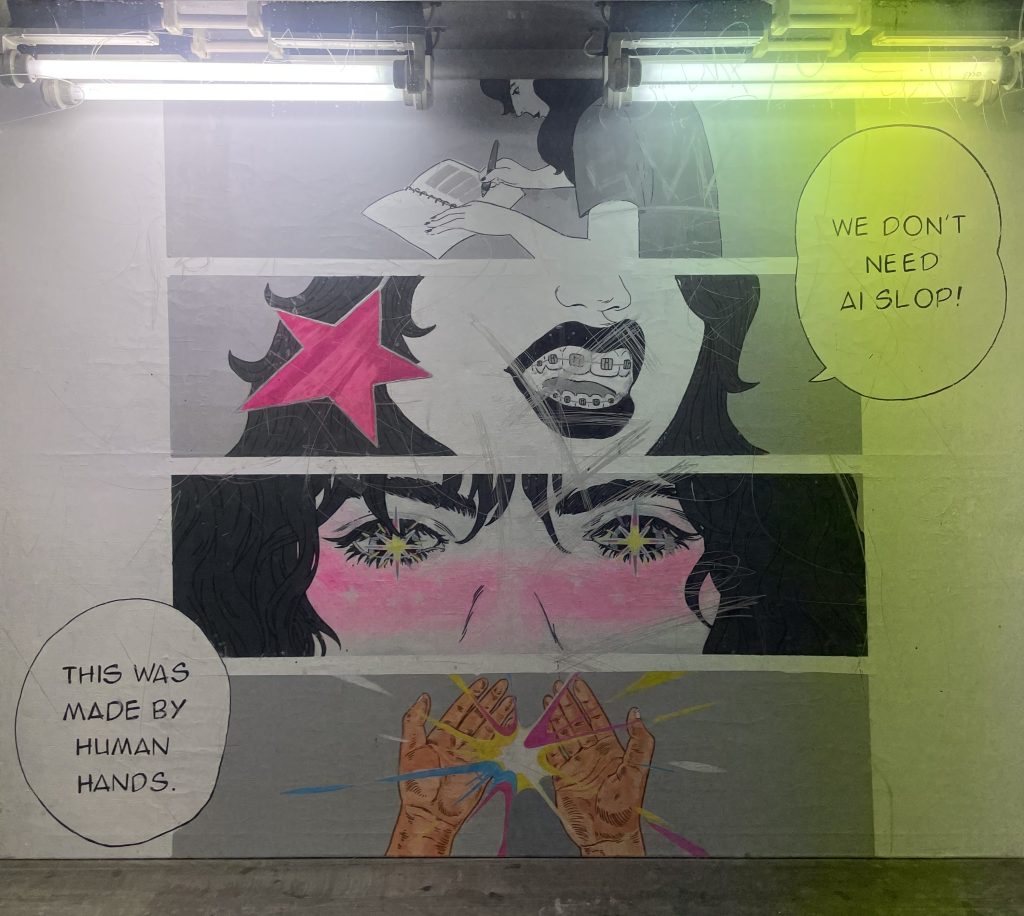
Let us begin with our premise: AI is a broken technology. Despite the many hubristic claims made by its proprietary owners and amplified by the media, AI has no way to deliver on its promises to bring about societal benefits for all by increasing productivity, lowering costs, and accelerating innovation. Yet the rhetoric that surrounds AI’s incursions into our worlds of work and life has acted persuasively to cover for widespread precaritisation. Meanwhile, AI’s shoddy predictions and slop production further harm the marginalised and its immense resource demands hasten the destruction of the environment. Might we therefore not speculate that AI’s purpose is actually to break things by virtue of its very brokenness, not least any irksome movements towards racial, gender, class, or climate justice? 

AI may not be the cause of our current polycrisis but it condenses the forces that brought them about, which it then amplifies, intensifies, and adds to. A critical approach to AI rejects the inevitability of this state of affairs. Instead, a critical approach recognises AI as merely the latest broken product of an already broken system, peddled under a techno-utopian guise in a desperate attempt to persuade us that energy-guzzling machine gods are our only hope out of our predicament. We therefore posit that the entangled dynamics of AI are useful diagrams of the economic, political, and ideological syndromes that lie beneath. AI’s stuttering operations dredge up misshapen philosophies, colonial dreams and a reactionary contempt for relations of care, and put them on full display. Our approach to AI asks how we break this brokenness. How can we who are forced to inhabit the dysfunction that AI names resist AI, recompose liveable lives from within the wreckage of computational nihilism, and craft its distortions into infrastructures for the common good?

Open Call for Participants: Critical AI Virtual Assembly

This assembly is an initiative of the Critical AI Network and our email list will be the main communication channel for it. If you are interested in taking part, either as a contributor or a participant, please sign up to the list here:  https://jiscmail.ac.uk/CPCT-CRITICALAINETWORK.

The virtual assembly will take place online on 27, 28 and 29 May 2026 from 4-8pm (UK). For this inaugural event, we have identified three domains of inquiry to explore as a first step: 

A. AI in Education, AI as Education — Wednesday, 27 May 2026

How has AI been insinuated into education, and in what ways has AI been taken for education itself, overtaking, eliminating, or usurping the civic and/or intellectual purposes of formal and informal learning? What are some of your case studies of local policy and examples of lived experience we might learn from? How might we formulate the most effective counterarguments – and organizing – against the integration of AI into our curricula and delivery that address local policy and financial conditions? 

B. AI in and as Law, Governance, and Politics — Thursday, 28 May 2026

As AI creeps into normalised deployment in legal practice, policy articulation, and decision making in the guise of efficiency and accuracy, questions have yet to be posed about the impact on labour conditions and labour law, the status of evidence, the right to refuse, and the rights of those affected by AI-facilitated decisions, to name just a few. Moreover, the extent to which AI is being used to manipulate democratic elections via data harvesting, psychographic profiling, and micro-targeting, amongst other strategies, has raised seemingly unanswerable questions about the future of democracy. Indeed, is politics even possible in the age of AI? How might we set about articulating and answering some of these questions? How might we question the role of governance, whether of the state or of the institution, in mediating and facilitating the introduction of AI into all facets of our lives? 

C. The Ecology of AI, AI and the Environment — Friday, 29 May 2026

Guided by the premise that under the hood, AI is simply the same technology whether it is being introduced into education or other domains of life, we ask how we might articulate and analyze the relations forged by AI between vastly different areas that hitherto appeared to be unconnected. What insights might be gained from situating AI within an ecology? How does AI compete with others in this ecology for natural resources, and what can be done to mitigate, contain, or reverse this impact? If, as we propose, AI should be evaluated not as a tool with a use value but rather as the latest symptom of misused infrastructures, how might we articulate the counterproductivity that AI adoption represents within its ecology for any green policy? 

Our hope is to collect and publish a record of our discussions in a new blog we will be setting up for the network. 

How do I participate?

Our working premise is that by virtue of having our data mined and colluding with the training of models with or without remuneration or consent, **we are all data workers in the age of AI**. Anyone who is a data worker in this sense is invited to participate. 

There are three ways in to be a part of this assembly: 

(i) We invite you to contribute short (10 minute) position papers falling within one of the domains above. We welcome and value ‘non-academic’ contributions such as local case studies, reflections on personal experience, reports from activists, amongst others. We especially encourage submissions from underrepresented voices. In order to maximize accessibility, papers will be precirculated and panel speakers will present them briefly, followed by discussion. Papers have the option of being published on our blog. 

(ii) We invite non-presenting attendees to consider participating as a note-taker at one of the sessions, with your notes published afterwards in a distilled and narrative form on our blog. 

(iii) We invite you to attend any number of our panels as a discussant

If you would like to be a part of the assembly, please fill out the form at https://forms.gle/McxCu65qz2ymBepS8 to send us: 

  1. Your preferred mode of participation ((i) presenter; (ii) note-taker; (iii) discussant). 
  2. If you selected (i) or (ii), please indicate which domain (A. AI in Education, AI as Education (27 May 2026); B. AI in and as Law, Governance, and Politics (28 May 2026); C. The Ecology of AI, AI and the Environment (29 May 2026)) you would like to either present or take notes in.
  3. If you selected (i), please include a max. 250w abstract of the paper you would like to present.
  4. Finally, for all participants, please include a brief 100w bio that includes your (academic or non-academic) institutional affiliation and position (e.g., student, professor, IT worker, curator, etc.). 

The submission deadline is Friday, 13 March 2026 at 11:59pm

How do I join the Critical AI network?

If you have received this CFP and are not already a member of our network, but would like to join and participate in the assembly, please subscribe to our mailing list at https://jiscmail.ac.uk/CPCT-CRITICALAINETWORK

Who do I contact if I have questions?

If you have questions, feel free to get in touch with the organisers: 

Dan Mcquillan (Computing) d.mcquillan [at] gold.ac.uk
Julia Ng (Literary Studies) j.ng [at] gold.ac.uk
Andres Saenz de Sicilia (Sociology) a.saenzdesicilia [at] gold.ac.uk 
Deirdre Daly (CALL) d.daly [at] gold.ac.uk
Jenny Doussan (Visual Cultures) d.doussan [at] gold.ac.uk 


Leave a comment

BOOK DISCUSSION — Resisting Erasure: Capital, imperialism, and race in Palestine — with authors Adam Hanieh and Rafeef Ziadah (11 Dec, in person)


The Centre for Philosophy and Critical Thought at Goldsmiths cordially invites you to

Resisting Erasure: Capital, imperialism, and race in Palestine (Verso 2025) 


A book discussion with authors Adam Hanieh and Rafeef Ziadah in conversation with Luca di Mambro

Thursday, 11 December 2025
3:00-5:30pm GMT 
Ben Pimlott Lecture Theatre, Goldsmiths 

[Please book here to give us an idea of numbers: https://www.eventbrite.co.uk/e/resisting-erasure-in-palestine-tickets-1972565174537?aff=oddtdtcreator&lang=en-gb&locale=en_GB&status=30&view=listing]

Why has Palestine become a defining fault line of contemporary politics? Challenging mainstream narratives that reduce Palestine to ancient hatreds, humanitarian tragedy, or legal abstractions, Resisting Erasure places Israeli settler-colonialism within the broader historical arc of imperialism, race, and fossil capitalism in the Middle East. Resisting Erasure is a succinct and far-reaching critique of the socio-economic and political forces that sustain the Israeli settler-colonial project. An essential introduction for anyone looking to understand what Palestine reveals about the world – and what it demands of us today.

Join us for this book launch with authors Adam Hanieh (Exeter) and Rafeef Ziadah (King’s College London) in conversation with Luca di Mambro (student organiser and former Goldsmiths Students’ Union President). 

Chair: Sara Farris (Sociology / CPCT)

The event is organised in collaboration with members of the Sociology Department and the Centre for Philosophy and Critical Thought at Goldsmiths University of London.

Free and open to the public; all welcome. 

Contact: s.farris [at] gold.ac.uk 


Leave a comment

Arun Saldanha (U Minnesota; CPCT Visiting Professor): Sexuation and the ontology of race: notes towards a Darwin after Fanon (21 November 2025 @5pm; hybrid)


The Centre for Philosophy and Critical Thought (CPCT), Goldsmiths, cordially invites you to


Arun Saldanha (U Minnesota; CPCT Visiting Professor)

Sexuation and the ontology of race: notes towards a Darwin after Fanon

Friday, 21 November 2025 from 5-7 pm GMT
RHB 137a and online

[Click here for the Zoom registration]

Psychoanalytical theory has done systematic work to ontologize sex as the irrepressibly insistent question spurring human existence. But is there only one such question? While for obvious ethico-political reasons Lacanian theorists of race relegate it entirely to the symbolic register and to modernity, perhaps the fact bodies become objects of such strongly racialized desires indexes a second profound ontological compulsion. Perhaps, as Darwin speculates with his theory of sexual selection, the aesthetic and psychic economies of sex itself necessitate a sensitivity to phenotype. Both sexuality and kinship remain riddled by lack and misinterpretation. It is important to stress that as subset of phenotypical variation “race” is entirely contingent on European colonization and capital. The talk will end by addressing the implications of the immanent critique of evolutionary theory for a renewed politics of universality. 

About the speaker

Arun Saldanha is Professor in the School of Geography, Environment & Society at the University of Minnesota (Twin Cities) as well as Visiting Professor at CPCT in Autumn 2025. The author of Space after Deleuze (Bloomsbury, 2017) and Psychedelic White: Goa Trance and the Viscosity of Race (U of Minnesota Press, 2007) as well as co-editor of books on sexual difference, Deleuze studies, and food geographies, he is currently working on a new book tentatively titled Phenotypically: A Materialist Theory of Race, which seeks a critical “return to” Darwin after Fanon in light of a resurgence of far-right fantasies around human biology.

Contact: j.ng [at] gold.ac.uk


Leave a comment

Welcome to CPCT’s Visiting Professor for Autumn 2025, Prof. Arun Saldanha (U Minnesota, Twin Cities)

We’re pleased to welcome Professor Arun Saldanha as a Visiting Professor at the Centre for Philosophy and Critical Thought in the Autumn term of 2025. Arun Saldanha is Professor in the Department of Geography, Environment, and Society at the University of Minnesota. He is the author or editor of books on race, music, and continental philosophy. At CPCT, he will be working on a new book tentatively titled Phenotypically: A Materialist Theory of Race, which seeks a critical “return to” Darwin after Fanon in light of a resurgence of far-right fantasies around human biology. Professor Saldanha will deliver a talk at CPCT on the basic questions driving his book on Friday 21 November 2025 from 17:00-19:00 in RHB 137a. To receive a notification about this event, please consider subscribing to our mailing list here.

Professor Saldanha will also be leading a session of CPCT’s Research Seminar on “Music and Philosophy” around a piece he published on the October 7 rave massacre. The session will take place on Wednesday, 26 November 2025 from 16:00-18:00 in RHB 139 and online. For details including registration link for hybrid attendance, please visit https://cpct.uk/2025-26/.


Leave a comment

CPCT Research Seminar 2025-26: ‘Music and Philosophy’

Image: Georges Braque, “Guitare et Verre” (1921)

We’re pleased to announce the commencement of our Research Seminar this year, which is devoted to the topic ‘Music and Philosophy.’ We’re holding this in a hybrid format so you can join us either in RHB 139 or online via Zoom. Please visit https://cpct.uk/2025-26/ for more details, including a detailed seminar plan, links to the readings, and the Zoom registration link. Free and open to the public as per usual.


Leave a comment

Jodi Dean, Capital’s Grave: A Forum (26 June 2025; hybrid)

The Centre for Philosophy and Critical Thought (CPCT), Goldsmiths, cordially invites you to

Jodi Dean

Capital’s Grave: A Forum 

Thursday, 26 June 2025, 4–6pm BST 
RHB 137a and online (hybrid)  

With responses from: 
Svenja Bromberg (CPCT)
Peter Hallward (CRMEP)
James Martel (San Francisco State) 

(Register here for Zoom link)

Jodi Dean and three of her readers, Svenja Bromberg (CPCT Goldsmiths), Peter Hallward (CRMEP) and James Martel (San Francisco State), will be discussing her claims that capitalism is giving way to something that is arguably worse than capitalism itself: a form of neofeudalism that combines the worst elements of both capitalism and feudalism and adds terrible new features of its own. In this conversation, Dean and her interlocutors will discuss both the argument itself as well as its implications for resistance as we move into unprecedented and unparallelled times.  

About the speaker
Jodi Dean teaches and organizes in upstate New York. Her books include The Communist Horizon (2012), Crowds and Party (2016), Comrade: An Essay on Political Belonging (2019), and Capital’s Grave: Neofeudalism and the New Class Struggle (2025).

Contact: j.ng [at] gold.ac.uk 


Leave a comment

Your Feedback

Dear Friends of CPCT,

We are appealing to you as friends of the Centre for Philosophy and Critical Thought (CPCT) at Goldsmiths, University of London for your feedback about our activities in recent years. The impetus of this exercise is twofold: a) we would like to understand your experience of CPCT by creating a structured space for you to give us feedback; and b) we would like to incorporate your feedback into an upcoming review of research centres at the university. 

We’d be very grateful if you could take the time to fill out the survey below. It should only take around 10 minutes of your time.

Go to the survey: https://forms.gle/wPGcBkAtYHX5XvUD6

We would be especially grateful for responses that arrive by Thursday, 29 May 2025.

Many thanks for your participation! 

Very best wishes,
CPCT 


Leave a comment

New partnership with Shakespeare in Philosophy (ShiP), Symposium on “Shakespeare and the Slovenian School of Philosophy and Psychoanalysis” (14 June 2025)


Dear Friends of CPCT,

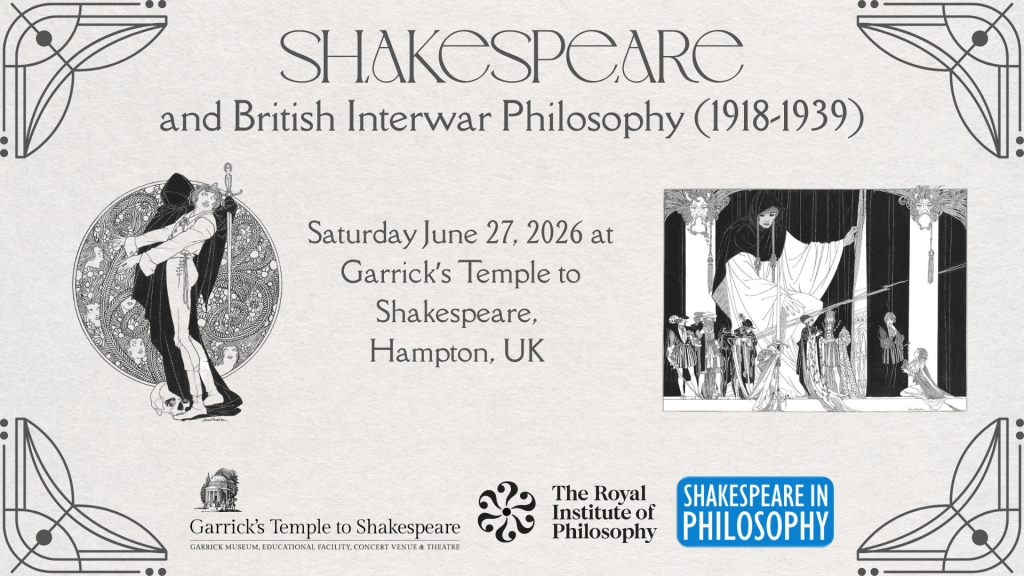
We’re pleased to announce a new partnership with Shakespeare in Philosophy (ShiP), a non-profit symposium series exploring the relation between Shakespeare and the philosophical work that has taken inspiration from his oeuvre. Its goal is to create a space for dialogue and discussion involving Shakespeare scholarship, wider philosophical and socio-political issues, and the general public. Events are held in collaboration with Garrick’s Temple to Shakespeare at the Temple built by the pre-eminent actor David Garrick beside the Thames in 1755.

ShiP’s next event is on 14 June 2025 on ‘Shakespeare and the Slovenian School of Philosophy and Psychoanalysis’—for booking, please register here.

Continue reading


Leave a comment

NEW PUBLICATION: “Singularity’s -Abilities,” a Special Dossier on Samuel Weber, Modern Language Notes: Comparative Literature Issue 139.5 (December 2024)


Dear Friends of CPCT,

We’re pleased to announce the publication of “Singularity’s -Abilities,” a Special Dossier of the Modern Language Notes: Comparative Literature Issue 139.5 (December 2024), which has just been made openly accessible on Project Muse. The dossier collects reworked versions of most of the talks that were delivered at a conference at CPCT (online) and co-organized with Northwestern University in December 2020 in celebration of Samuel Weber’s 80th birthday and in honor of his distinguished career and far-reaching influence on several generations of critical theorists now spread around the globe. The dossier also includes a new piece by Sam entitled “Transference: A Cliché?”.

Continue reading


Leave a comment

Samir Haddad (Fordham): ‘Derrida on Restructuring the University’ (30 April 2025)

‘Derrida on Restructuring the University’
Samir Haddad (Philosophy, Fordham)

a special session of 
‘On Truth and Lies in the Extramoral University’

CPCT Research Seminar 2024-25

Time: Wednesday, 30 April 2025, 4:00-6:00 pm UK time.
Venue: RHB 138 and online

Zoom registration: https://gold-ac-uk.zoom.us/meeting/register/m-qsXjg-SrG5HmiIdhzcNA 

Readings

René Haby, “Pour une modernisation du système éducatif” (esp. pp.1-10) [PDF]; Jacques Derrida, “Divided Bodies: Responses to La Nouvelle Critique” [PDF]; Jacques Derrida, “The Age of Hegel” [PDF]; Jacques Derrida, Jacques Bouveresse, Catherine Malabou, et al., “Report of the Committee on Philosophy and Epistemology (1990)” [PDF]

About the session

In the 1970s and 1980s, Derrida was heavily involved in debates on the place of philosophy in education in France. In this seminar we will read a selection of texts related to two of Derrida’s interventions in this period, with an eye to how they might speak to challenges we now face, several decades later and in different national contexts. The first intervention was precipitated by proposals made in 1974 by the French Minister of Education, René Haby, who sought to “modernize” the curriculum in the lycée. Among Haby’s proposals were calls for more emphasis on the sciences and social sciences over the humanities, greater interdisciplinarity, and the need to better train future workers in the face of rapidly changing technology and systems of communication. In response, Derrida and others sought to rethink the role that philosophy should play in a student’s education, and made various counter-proposals for reform of their own. The second intervention dates to 1989, when Derrida was asked by Pierre Bourdieu and François Gros, themselves charged by the Minister of Education at that time, to co-chair with Jacques Bouveresse a Committee on Philosophy and Epistemology as a part of a larger project aiming to reform French education as a whole. The resulting report develops further the ideas first raised in the 1970s, and constitutes Derrida’s most detailed vision for transforming the teaching of philosophy in France.

About the session leader

Samir Haddad is Associate Professor of Philosophy at Fordham University. He specializes in 20th century and contemporary continental philosophy, particularly French philosophy and deconstruction, and in the philosophy of education. He is the author of Derrida and the Inheritance of Democracy (Indiana, 2013) and is currently working on two research projects, one focused on Derrida’s work on education, and the other on the roles that translation and multilingualism might play in philosophical pedagogy.  


* * * 
About the seminar

CPCT’s annual research seminar meets on a regular basis and is open to centre members, graduate affiliates, and other interested staff and students at Goldsmiths and beyond. It aims to serve as a forum for philosophical work and critical conversation at Goldsmiths.

Taking its inspiration from the title of the famous essay by Friedrich Nietzsche, our research seminar this year poses the following question: what is the contemporary university for? By definition “extramoral” in the sense that it is premised on the pursuit of knowledge without the interference of power and authority—the classical loci of which were Church and State—the modern university nevertheless exists in a world driven by profit, riddled with war, and beset with an ever-unfolding polycrisis of environmental, racial, economic, technological, and geopolitical dimensions. What, then, is the role of the university vis-à-vis its extramorality or, indeed, its moral purpose? We wish in particular to interrogate the university’s role in truth-telling and truth-making, inter alia in relation to the era of post-truth, alt-facts, and now AI technologies that seem to have deeply unsettled classical definitions of knowing, certainty, and consciousness, and to questions of whose truth, when and where truth is that emergent pluricentric views of the world have opened up. “Extramoral” is, of course, also a play on the word “extramural,” and we wish to recall the 2010 student-led debates on the university’s purpose when tuition fees were first introduced. 

Convened by Julia Ng (j.ng[at]gold.ac.uk), Svenja Bromberg (s.bromberg[at]gold.ac.uk), and Sultan Doughan (s.doughan[at]gold.ac.uk).


This year’s sessions will be hybrid; to participate online, please register at the links below each session on the detailed session plan, where you will also find links to the readings. Free and open to the public.