The Centre for Philosophy and Critical Thought, Goldsmiths University of London

Research Centre run jointly between the Departments of Sociology and English and Comparative Literature at Goldsmiths University, London


Leave a comment

BOOK DISCUSSION — Resisting Erasure: Capital, imperialism, and race in Palestine — with authors Adam Hanieh and Rafeef Ziadah (11 Dec, in person)


The Centre for Philosophy and Critical Thought at Goldsmiths cordially invites you to

Resisting Erasure: Capital, imperialism, and race in Palestine (Verso 2025) 


A book discussion with authors Adam Hanieh and Rafeef Ziadah in conversation with Luca di Mambro

Thursday, 11 December 2025
3:00-5:30pm GMT 
Ben Pimlott Lecture Theatre, Goldsmiths 

[Please book here to give us an idea of numbers: https://www.eventbrite.co.uk/e/resisting-erasure-in-palestine-tickets-1972565174537?aff=oddtdtcreator&lang=en-gb&locale=en_GB&status=30&view=listing]

Why has Palestine become a defining fault line of contemporary politics? Challenging mainstream narratives that reduce Palestine to ancient hatreds, humanitarian tragedy, or legal abstractions, Resisting Erasure places Israeli settler-colonialism within the broader historical arc of imperialism, race, and fossil capitalism in the Middle East. Resisting Erasure is a succinct and far-reaching critique of the socio-economic and political forces that sustain the Israeli settler-colonial project. An essential introduction for anyone looking to understand what Palestine reveals about the world – and what it demands of us today.

Join us for this book launch with authors Adam Hanieh (Exeter) and Rafeef Ziadah (King’s College London) in conversation with Luca di Mambro (student organiser and former Goldsmiths Students’ Union President). 

Chair: Sara Farris (Sociology / CPCT)

The event is organised in collaboration with members of the Sociology Department and the Centre for Philosophy and Critical Thought at Goldsmiths University of London.

Free and open to the public; all welcome. 

Contact: s.farris [at] gold.ac.uk 


Leave a comment

Arun Saldanha (U Minnesota; CPCT Visiting Professor): Sexuation and the ontology of race: notes towards a Darwin after Fanon (21 November 2025 @5pm; hybrid)


The Centre for Philosophy and Critical Thought (CPCT), Goldsmiths, cordially invites you to


Arun Saldanha (U Minnesota; CPCT Visiting Professor)

Sexuation and the ontology of race: notes towards a Darwin after Fanon

Friday, 21 November 2025 from 5-7 pm GMT
RHB 137a and online

[Click here for the Zoom registration]

Psychoanalytical theory has done systematic work to ontologize sex as the irrepressibly insistent question spurring human existence. But is there only one such question? While for obvious ethico-political reasons Lacanian theorists of race relegate it entirely to the symbolic register and to modernity, perhaps the fact bodies become objects of such strongly racialized desires indexes a second profound ontological compulsion. Perhaps, as Darwin speculates with his theory of sexual selection, the aesthetic and psychic economies of sex itself necessitate a sensitivity to phenotype. Both sexuality and kinship remain riddled by lack and misinterpretation. It is important to stress that as subset of phenotypical variation “race” is entirely contingent on European colonization and capital. The talk will end by addressing the implications of the immanent critique of evolutionary theory for a renewed politics of universality. 

About the speaker

Arun Saldanha is Professor in the School of Geography, Environment & Society at the University of Minnesota (Twin Cities) as well as Visiting Professor at CPCT in Autumn 2025. The author of Space after Deleuze (Bloomsbury, 2017) and Psychedelic White: Goa Trance and the Viscosity of Race (U of Minnesota Press, 2007) as well as co-editor of books on sexual difference, Deleuze studies, and food geographies, he is currently working on a new book tentatively titled Phenotypically: A Materialist Theory of Race, which seeks a critical “return to” Darwin after Fanon in light of a resurgence of far-right fantasies around human biology.

Contact: j.ng [at] gold.ac.uk


Leave a comment

Welcome to CPCT’s Visiting Professor for Autumn 2025, Prof. Arun Saldanha (U Minnesota, Twin Cities)

We’re pleased to welcome Professor Arun Saldanha as a Visiting Professor at the Centre for Philosophy and Critical Thought in the Autumn term of 2025. Arun Saldanha is Professor in the Department of Geography, Environment, and Society at the University of Minnesota. He is the author or editor of books on race, music, and continental philosophy. At CPCT, he will be working on a new book tentatively titled Phenotypically: A Materialist Theory of Race, which seeks a critical “return to” Darwin after Fanon in light of a resurgence of far-right fantasies around human biology. Professor Saldanha will deliver a talk at CPCT on the basic questions driving his book on Friday 21 November 2025 from 17:00-19:00 in RHB 137a. To receive a notification about this event, please consider subscribing to our mailing list here.

Professor Saldanha will also be leading a session of CPCT’s Research Seminar on “Music and Philosophy” around a piece he published on the October 7 rave massacre. The session will take place on Wednesday, 26 November 2025 from 16:00-18:00 in RHB 139 and online. For details including registration link for hybrid attendance, please visit https://cpct.uk/2025-26/.


Leave a comment

CPCT Research Seminar 2025-26: ‘Music and Philosophy’

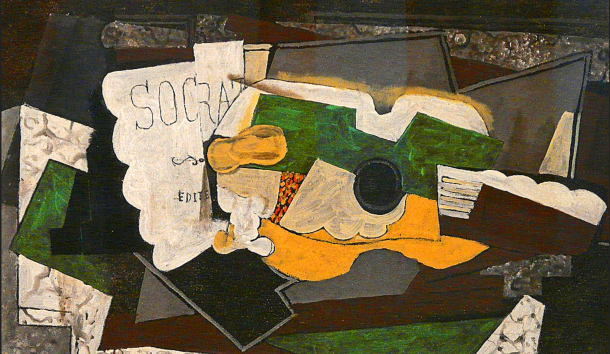
Image: Georges Braque, “Guitare et Verre” (1921)

We’re pleased to announce the commencement of our Research Seminar this year, which is devoted to the topic ‘Music and Philosophy.’ We’re holding this in a hybrid format so you can join us either in RHB 139 or online via Zoom. Please visit https://cpct.uk/2025-26/ for more details, including a detailed seminar plan, links to the readings, and the Zoom registration link. Free and open to the public as per usual.


Leave a comment

Jodi Dean, Capital’s Grave: A Forum (26 June 2025; hybrid)

The Centre for Philosophy and Critical Thought (CPCT), Goldsmiths, cordially invites you to

Jodi Dean

Capital’s Grave: A Forum 

Thursday, 26 June 2025, 4–6pm BST 
RHB 137a and online (hybrid)  

With responses from: 
Svenja Bromberg (CPCT)
Peter Hallward (CRMEP)
James Martel (San Francisco State) 

(Register here for Zoom link)

Jodi Dean and three of her readers, Svenja Bromberg (CPCT Goldsmiths), Peter Hallward (CRMEP) and James Martel (San Francisco State), will be discussing her claims that capitalism is giving way to something that is arguably worse than capitalism itself: a form of neofeudalism that combines the worst elements of both capitalism and feudalism and adds terrible new features of its own. In this conversation, Dean and her interlocutors will discuss both the argument itself as well as its implications for resistance as we move into unprecedented and unparallelled times.  

About the speaker
Jodi Dean teaches and organizes in upstate New York. Her books include The Communist Horizon (2012), Crowds and Party (2016), Comrade: An Essay on Political Belonging (2019), and Capital’s Grave: Neofeudalism and the New Class Struggle (2025).

Contact: j.ng [at] gold.ac.uk 


Leave a comment

Your Feedback

Dear Friends of CPCT,

We are appealing to you as friends of the Centre for Philosophy and Critical Thought (CPCT) at Goldsmiths, University of London for your feedback about our activities in recent years. The impetus of this exercise is twofold: a) we would like to understand your experience of CPCT by creating a structured space for you to give us feedback; and b) we would like to incorporate your feedback into an upcoming review of research centres at the university. 

We’d be very grateful if you could take the time to fill out the survey below. It should only take around 10 minutes of your time.

Go to the survey: https://forms.gle/wPGcBkAtYHX5XvUD6

We would be especially grateful for responses that arrive by Thursday, 29 May 2025.

Many thanks for your participation! 

Very best wishes,
CPCT 


Leave a comment

New partnership with Shakespeare in Philosophy (ShiP), Symposium on “Shakespeare and the Slovenian School of Philosophy and Psychoanalysis” (14 June 2025)


Dear Friends of CPCT,

We’re pleased to announce a new partnership with Shakespeare in Philosophy (ShiP), a non-profit symposium series exploring the relation between Shakespeare and the philosophical work that has taken inspiration from his oeuvre. Its goal is to create a space for dialogue and discussion involving Shakespeare scholarship, wider philosophical and socio-political issues, and the general public. Events are held in collaboration with Garrick’s Temple to Shakespeare at the Temple built by the pre-eminent actor David Garrick beside the Thames in 1755.

ShiP’s next event is on 14 June 2025 on ‘Shakespeare and the Slovenian School of Philosophy and Psychoanalysis’—for booking, please register here.

Continue reading


Leave a comment

NEW PUBLICATION: “Singularity’s -Abilities,” a Special Dossier on Samuel Weber, Modern Language Notes: Comparative Literature Issue 139.5 (December 2024)


Dear Friends of CPCT,

We’re pleased to announce the publication of “Singularity’s -Abilities,” a Special Dossier of the Modern Language Notes: Comparative Literature Issue 139.5 (December 2024), which has just been made openly accessible on Project Muse. The dossier collects reworked versions of most of the talks that were delivered at a conference at CPCT (online) and co-organized with Northwestern University in December 2020 in celebration of Samuel Weber’s 80th birthday and in honor of his distinguished career and far-reaching influence on several generations of critical theorists now spread around the globe. The dossier also includes a new piece by Sam entitled “Transference: A Cliché?”.

Continue reading


Leave a comment

Samir Haddad (Fordham): ‘Derrida on Restructuring the University’ (30 April 2025)

‘Derrida on Restructuring the University’
Samir Haddad (Philosophy, Fordham)

a special session of 
‘On Truth and Lies in the Extramoral University’

CPCT Research Seminar 2024-25

Time: Wednesday, 30 April 2025, 4:00-6:00 pm UK time.
Venue: RHB 138 and online

Zoom registration: https://gold-ac-uk.zoom.us/meeting/register/m-qsXjg-SrG5HmiIdhzcNA 

Readings

René Haby, “Pour une modernisation du système éducatif” (esp. pp.1-10) [PDF]; Jacques Derrida, “Divided Bodies: Responses to La Nouvelle Critique” [PDF]; Jacques Derrida, “The Age of Hegel” [PDF]; Jacques Derrida, Jacques Bouveresse, Catherine Malabou, et al., “Report of the Committee on Philosophy and Epistemology (1990)” [PDF]

About the session

In the 1970s and 1980s, Derrida was heavily involved in debates on the place of philosophy in education in France. In this seminar we will read a selection of texts related to two of Derrida’s interventions in this period, with an eye to how they might speak to challenges we now face, several decades later and in different national contexts. The first intervention was precipitated by proposals made in 1974 by the French Minister of Education, René Haby, who sought to “modernize” the curriculum in the lycée. Among Haby’s proposals were calls for more emphasis on the sciences and social sciences over the humanities, greater interdisciplinarity, and the need to better train future workers in the face of rapidly changing technology and systems of communication. In response, Derrida and others sought to rethink the role that philosophy should play in a student’s education, and made various counter-proposals for reform of their own. The second intervention dates to 1989, when Derrida was asked by Pierre Bourdieu and François Gros, themselves charged by the Minister of Education at that time, to co-chair with Jacques Bouveresse a Committee on Philosophy and Epistemology as a part of a larger project aiming to reform French education as a whole. The resulting report develops further the ideas first raised in the 1970s, and constitutes Derrida’s most detailed vision for transforming the teaching of philosophy in France.

About the session leader

Samir Haddad is Associate Professor of Philosophy at Fordham University. He specializes in 20th century and contemporary continental philosophy, particularly French philosophy and deconstruction, and in the philosophy of education. He is the author of Derrida and the Inheritance of Democracy (Indiana, 2013) and is currently working on two research projects, one focused on Derrida’s work on education, and the other on the roles that translation and multilingualism might play in philosophical pedagogy.  


* * * 
About the seminar

CPCT’s annual research seminar meets on a regular basis and is open to centre members, graduate affiliates, and other interested staff and students at Goldsmiths and beyond. It aims to serve as a forum for philosophical work and critical conversation at Goldsmiths.

Taking its inspiration from the title of the famous essay by Friedrich Nietzsche, our research seminar this year poses the following question: what is the contemporary university for? By definition “extramoral” in the sense that it is premised on the pursuit of knowledge without the interference of power and authority—the classical loci of which were Church and State—the modern university nevertheless exists in a world driven by profit, riddled with war, and beset with an ever-unfolding polycrisis of environmental, racial, economic, technological, and geopolitical dimensions. What, then, is the role of the university vis-à-vis its extramorality or, indeed, its moral purpose? We wish in particular to interrogate the university’s role in truth-telling and truth-making, inter alia in relation to the era of post-truth, alt-facts, and now AI technologies that seem to have deeply unsettled classical definitions of knowing, certainty, and consciousness, and to questions of whose truth, when and where truth is that emergent pluricentric views of the world have opened up. “Extramoral” is, of course, also a play on the word “extramural,” and we wish to recall the 2010 student-led debates on the university’s purpose when tuition fees were first introduced. 

Convened by Julia Ng (j.ng[at]gold.ac.uk), Svenja Bromberg (s.bromberg[at]gold.ac.uk), and Sultan Doughan (s.doughan[at]gold.ac.uk).


This year’s sessions will be hybrid; to participate online, please register at the links below each session on the detailed session plan, where you will also find links to the readings. Free and open to the public.


Leave a comment

LECTURE: Ian Balfour (York, Ca.) — ‘Extreme Austen’ (12 March 2025 @4pm, RHB 138 and online)

Ian Balfour (York, Canada)

Extreme Austen

Wednesday, 12 March 2025
RHB 138 and online

Register here for the Zoom link.

With responses from:
Rowan Boyson (KCL)
Paul Hamilton (QMUL)


About the talk

With all the attention lavished on Jane Austen’s fiction with an eye to narrative technique, irony, the marriage plot(s), class and gender relations, and more, a certain aspect of her rhetoric – or that of her characters – tends to be overlooked. Her body of fiction is generally known for its texture and ethos of decorum and propriety and yet the novels feature, on inspection, a pronounced, punctual rhetoric of excess. This talk asks: what is this excessive rhetoric doing? What do we make of it?

About the speakers

Ian Balfour is Professor emeritus of English at York University in Canada. His interests include Romantic poetry and prose, contemporary theory and criticism, and 18th-century literature and philosophy (especially aesthetic theory and philosophy of language). He is the author of Northrop Frye (1988), The Rhetoric of Romantic Prophecy (2002) and of essays on the Romantics (Wordsworth, Blake, Godwin, Inchbald), Walter Benjamin, Paul de Man, and on topics in popular culture (music, TV, film). He co-edited with Atom Egoyan, Subtitles: On the Foreignness of Film, and with Eduardo Cadava, And Justice For All?: The Claims of Human Rights (SAQ), and is the sole editor of a collection called Late Derrida (SAQ). 

Rowan Boyson is Reader in Eighteenth-Century and Romantic Literature at King’s College London, where she specialises in environmental humanities, history of philosophy and political thought, and critical theory and aesthetics. She is currently working on a project entitled The Shared Air: Atmosphere and the Right to Breathe in Enlightenment Britain

Paul Hamilton is Professor emeritus of English at Queen Mary University of London. He specialises in Enlightenment and Romantic thought and the relations between philosophy, political theory, and literature. His monographs include Metaromanticism (Chicago, 2003) which explored historical transformations of the Romantic aesthetic; Coleridge and German Philosophy: The Poet in the Land of Logic (2007); Realpoetik: European Romanticism and Literary Politics (2013), which compares the writings of some major German, French, and Italian Romantics with an eye to their differences from British Romanticism.

Free and open to the public.

Contact: j.ng [at] gold.ac.uk

Handout