The Centre for Philosophy and Critical Thought at Goldsmiths, University of London cordially invites you to its Lecture Series 20/21 on “Critiquing Violence Today”:
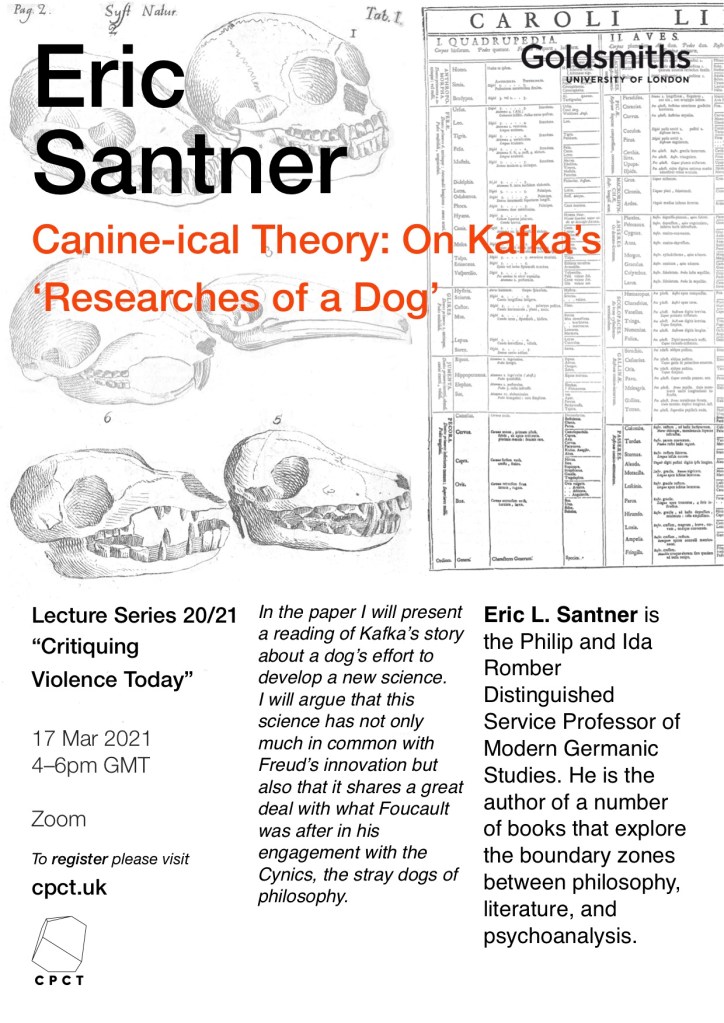
Canine-ical Theory: On Kafka’s ‘Researches of a Dog’
In the paper I will present a reading of Kafka’s story about a dog’s effort to develop a new science. I will argue that this science has not only much in common with Freud’s innovation but also that it shares a great deal with what Foucault was after in his engagement with the Cynics, the stray dogs of philosophy.
Eric L. Santner is the Philip and Ida Romber Distinguished Service Professor of Modern Germanic Studies. He is the author of a number of books that explore the boundary zones between philosophy, literature, and psychoanalysis.
The Centre for Philosophy and Critical Thought at Goldsmiths, University of London cordially invites you to its Lecture Series 20/21 on “Critiquing Violence Today”:
On Debt: Neoliberal Coloniality in the Colony of Puerto Rico
Debt functions as a form of coloniality in the colony of Puerto Rico. It operates not only as an apparatus of capture and predation, intensifying a neoliberalism reconfigured by the financial crisis. It also operates as a form of coloniality, actualizing a race/gender norm installed and updated throughout an ongoing colonial history. Placing in conversation Marxist approximations to financial neoliberal capitalism, decolonial thought, and decolonial feminism in Puerto Rico, this talk considers the work of debt in updating modalities of gender and racial, particularly antiblack, violence.
Rocío Zambrana is Associate Professor of Philosophy at Emory University. She is the author of Hegel’s Theory of Intelligibility (U Chicago Press, 2015) and Colonial Debts: The Case of Puerto Rico (Duke UP, forthcoming), as well as numerous articles on German Idealism, Marxism, and Critical Theory. She is the co-editor of Hypatia: A Journal of Feminist Philosophy and a columnist for 80grados.
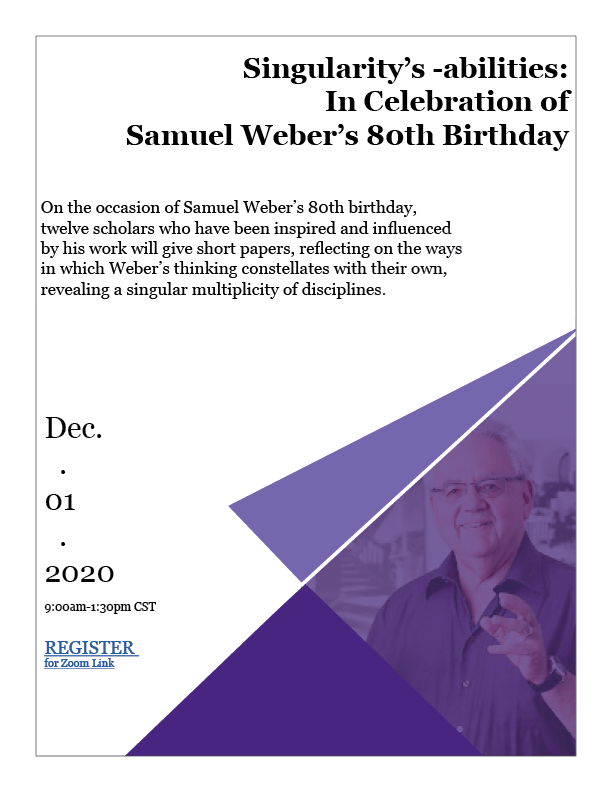
Please join us for Singularity’s -abilities: In Celebration of Samuel Weber’s 80th Birthday this Tuesday December 1st at 9am CST. Speakers, agenda, and registration info below.
Presentations will be in English and German. All times are local to Chicago, USA.
Speakers:
9:00am – 10:00am — Singularity’s Inscriptions
Isabelle Alfandary – Learning to Read with Sam Weber Julia Ng – Whistling Lillabullero Hans-Jörg Rheinberger – Schreiben und Experimentieren Bernard Geoghegan – Theatricality and AI (Moderator: James Martel)
10:15am – 11:15am — Singularity’s Philosophy
Peter Fenves – Singularity, Again Astrid Deuber-Mankowsky – The Ever New Angel Diego Rosello – The Task of Thanking: Thanking as Thinking with Samuel Weber Laura Chiesa – tba (Moderators: James Martel, Julia Ng)
11:45am-12:45pm — Singularity’s Politics
Marian Hobson – How can classification be violent? Weber and Derrida Javier Burdman – Sam Weber’s Response to Lyotard’s Just Gaming and the Elusive Link between Deconstruction and Politics James Martel – Singularity and the Commandment: another form of law Héctor Castaño – Singularity in Translation and the Economy of Cultural Difference (Moderator: Julia Ng)
1:00pm – 1:30pm Response by Samuel Weber
Organized by Jörg Kreienbrock, James Martel, Julia Ng, and generously co-sponsored by Northwestern University, San Francisco State University, and the Centre for Philosophy and Critical Thought at Goldsmiths, University of London
NB: DUE TO UNFORESEEN CIRCUMSTANCES, THIS TALK HAS BEEN CANCELLED
The Centre for Philosophy and Critical Thought at Goldsmiths, University of London cordially invites you to its Lecture Series 20/21 on “Critiques of Violence”:
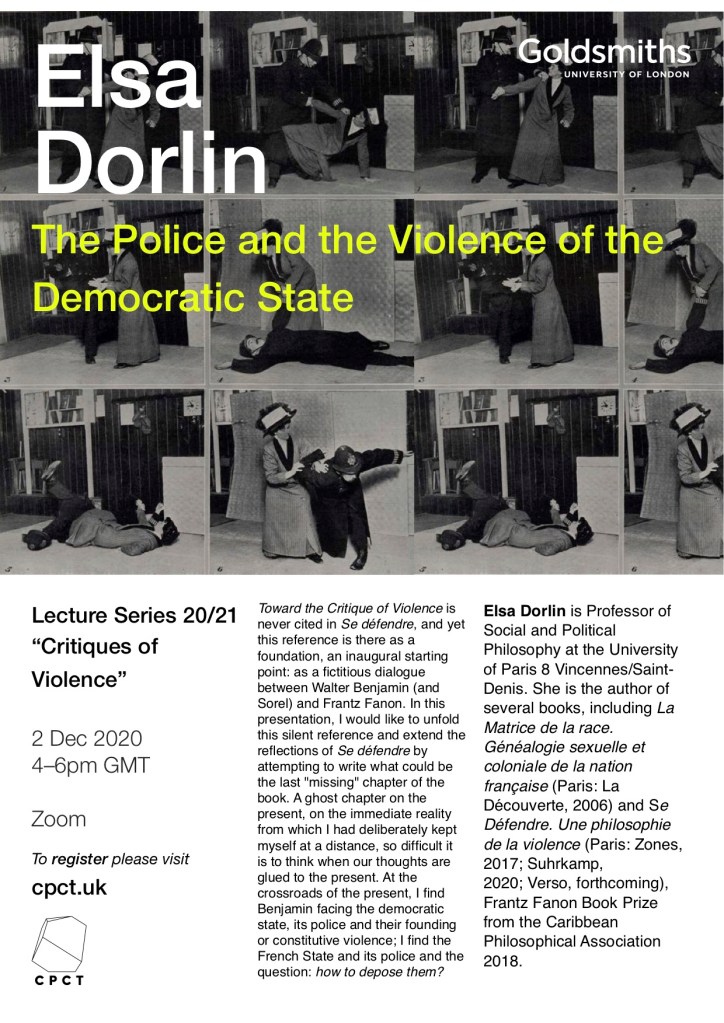
The Police and the Violence of the Democratic State
In my book Se défendre. Une philosophie de la violence (Defending Oneself: A Philosophy of Violence), a major reference is missing: Walter Benjamin’s text, Toward the Critique of Violence (1921). Not that the text was not relevant, nor that Benjamin’s work and the thought were not familiar to me. It was by following the theses On the Concept of History that I initiated my genealogical approach to the notion of constellated time; but it was by tacitly shadowing Benjamin, grasping in the breaches of history for what belongs to an ontology of divine violence – of which revolutionary violence is like the replica and imprint – that I made explicit my intention to turn to muscle rather than law in order to think self-defense, because “there is something rotten in the law”.
Toward the Critique of Violence is never cited in Se défendre, and yet this reference is there as a foundation, an inaugural starting point: all of its tragic protagonists – the state, natural law, positive law, the working class, the concept of property, the critique of the contract, life and death, the revolution, but also the mystical part of the carnal gesture that saves – are reanimated in the book I wanted to write. As a hidden reference, it is the fictitious dialogue between Walter Benjamin (but also Sorel) and Frantz Fanon that is deployed there. The critique of state violence, of the state itself – of right, of law, of the legal contract – and of their attendant mythologies is at the heart of my reflection.
In this presentation, I would like to unfold this silent reference and extend the reflections of Se défendre by attempting to write what could be the last “missing” chapter of the book. A ghost chapter on the present, on the immediate reality from which I had deliberately kept myself at a distance, so difficult it is to think when our thoughts are glued to the present. At the crossroads of the present, I find Benjamin facing the democratic state, its police and their founding or constitutive violence; I find the French State and its police and the question: how to depose them?
About the speaker:
Elsa Dorlin is Professor of Social and Political Philosophy at the University of Paris 8 Vincennes/Saint-Denis. She is the author of several books, including La Matrice de la race. Généalogie sexuelle et coloniale de la nation française (Paris: La Découverte, 2006) and Se Défendre. Une philosophie de la violence (Paris: Zones, 2017; Suhrkamp, 2020; Verso, forthcoming), Frantz Fanon Book Prize from the Caribbean Philosophical Association 2018.
** N.B.: IN LIGHT OF THE COVID-19 SITUATION THE CONFERENCE WILL BE POSTPONED TO AY2020-21, LIKELY EARLY DECEMBER 2020. DETAILS WILL BE ANNOUNCED WHEN FINAL DATES HAVE BEEN CONFIRMED. PLEASE CONTINUE TO SEND US YOUR ABSTRACTS; THE DEADLINE FOR SUBMISSIONS HAS NOW BEEN EXTENDED TO 1 SEPTEMBER 2020.**
3-4 June 2020
Centre for Philosophy and Critical Thought
Goldsmiths, University of London
Deadline for submissions: 1 April 2020**New deadline: 1 September 2020
CONFIRMED SPEAKERS
Tina Chanter (University of Newcastle)
Rebecca Comay (University of Toronto)
Jeremy Matthew Glick (Hunter College)
Bonnie Honig (Brown University)
Miriam Leonard (University College London)
Manfred Posani Löwenstein (Istituto Italiano per gli Studi Storici)
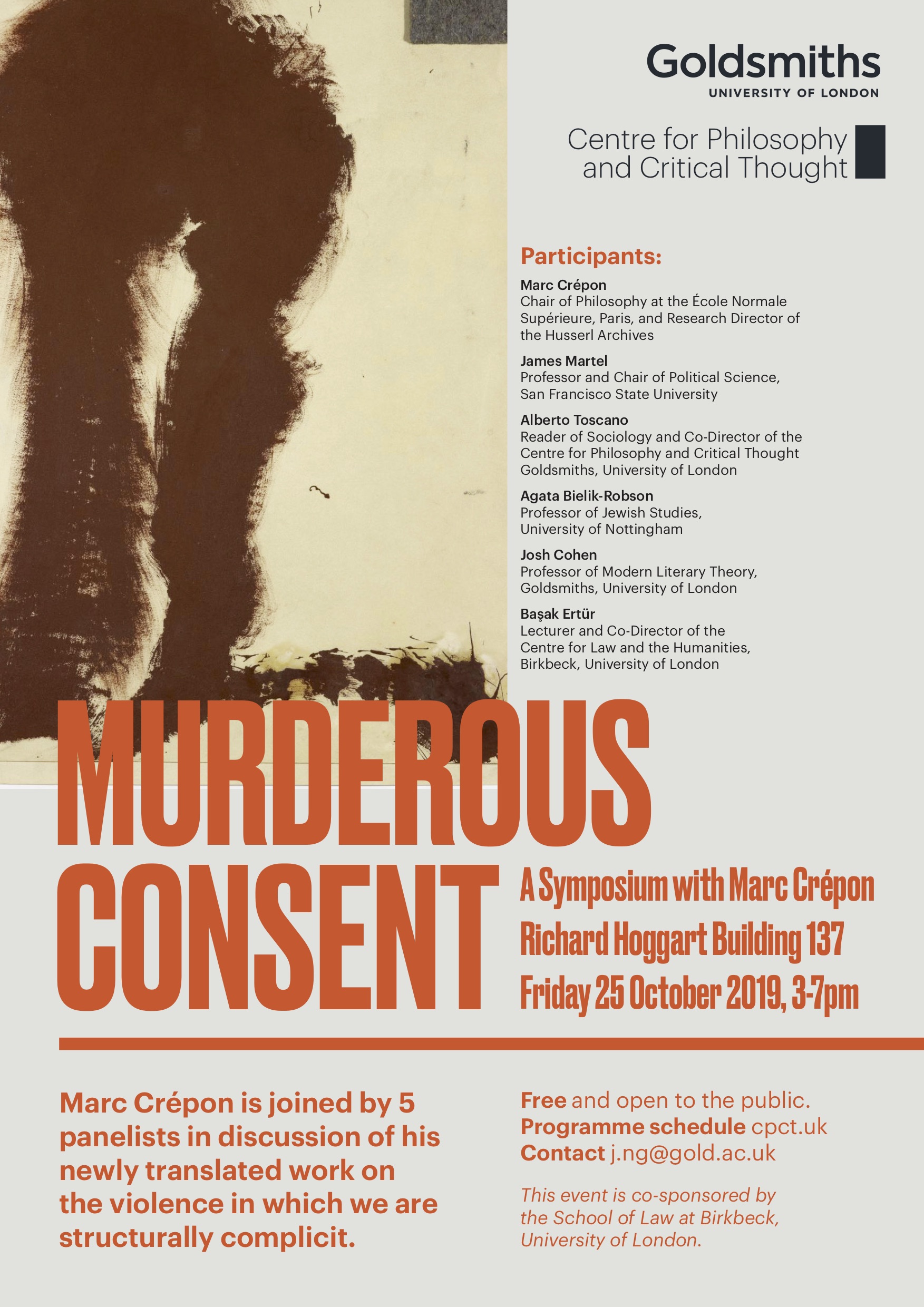
Marc Crépon (École Normale Supérieure, Paris) is joined by 5 panelists in discussion of his newly translated work on the violence in which we are structurally complicit.
[please note the venue change from a previous announcement]
PRIMITIVISM NOW is a one-day workshop featuring speakers from a range of disciplines, from literary theory to philosophy, politics to art history. They will consider whether it is possible to think anew about primitivism, a field whose theoretical underpinnings have largely lain dormant since the poststructural and postcolonial critiques of primitivism in the 1980s and 90s.Continue reading →
An international conference supported by the British Society of Aesthetics and organised by the Centre for Philosophy and Critical Thought
Goldsmiths, University of London, 5-6 June 2019
Charles Baudelaire is a pivotal reference for debates on modernity, criticism and poetics, though in the domains of philosophy and critical theory his work is often approached solely through the prism of contemporary commentary. Taking Baudelaire’s own references to philosophy seriously, this conference will also explore the complexity of the relation between the received understanding of Baudelaire as a prophet of modernity and his opposition to any idea of progress that would reduce poetic beauty to a vehicle for social and moral development. Baudelaire and Philosophy aims to do justice to the richness, complexity and ambiguity of Baudelaire’s critical and poetic writing, to explore his relation to philosophy and the philosophical, and to interrogate his place as a synonym for a certain idea of modernity.