The Centre for Philosophy and Critical Thought, Goldsmiths University of London

Research Centre run jointly between the Departments of Sociology and English and Comparative Literature at Goldsmiths University, London


Leave a comment

Giorgio Agamben’s Political Paradigm. Notes on Stasis.

A Contribution by Alberto Toscano (based on CPCT’s “The Ends of Homo Sacer” event from November 2015) to Homo Sacer: A Blog Series at Stanford University Press. 


Read the full article here

Excerpt: From the vantage of the overall montage of the Homo Sacer series, the slim volume Stasis: Civil War as a Political Paradigm would appear to be at once peripheral and interstitial. Unlike any of the other volumes, it consists of two public lectures, rather than a newly crafted text. These lectures were delivered in October 2001 at Princeton, giving their reference to global terrorism a curiously diffracted and belated, though topical, echo. Stasis is situated between State of Exception (2.1) (a concept that is explicitly, if briefly, tied to civil war), and The Sacrament of Language (2.3) and a decimal point away from The Kingdom and the Glory (2.4), with which it entertains more tenuous links: its treatment of the thresholds between oikos and polis prepare possible interrogations on what becomes of these with the Patristic introduction of oikonomia, of divine management, while the tantalising foray into Hobbesian eschatology opens up a different avenue into a critique of the theocratic imagination, and resonates with a passing mention of Hobbes on the oath in Sacrament. Stasis was also published in Italian a few months after the final volume with which Agamben “abandons” the project, The Use of Bodies.


Leave a comment

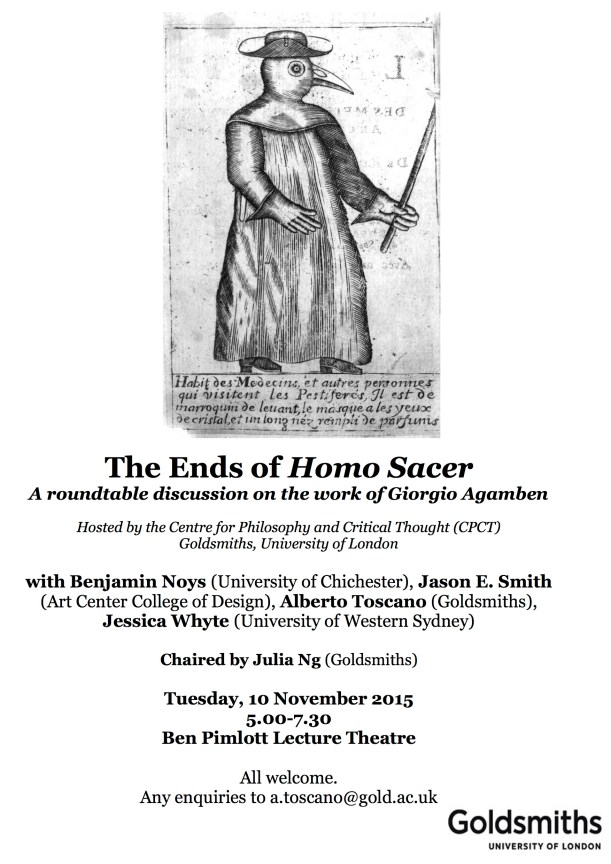
The Ends of Homo Sacer.

A review in Postmodern Culture of a Roundtable discussion on the work of Giorgio Agamben.

By Christopher Law (CCS/CPCT, graduate affiliate) 


Read the full article here

Excerpt: On November 10, 2015 a group of four scholars of Giorgio Agamben’s work gathered at Goldsmiths, University of London for a roundtable organized by the college’s recently formed Centre for Philosophy and Critical Thought (CPCT). Contributing to the event, and representing a diverse array of interests in Agamben’s work, were Jessica Whyte, Benjamin Noys, Jason E. Smith and Alberto Toscano (who, alongside the roundtable chair Julia Ng, acts as co-director of the CPCT). The event was dubbed “The Ends of Homo Sacer,” a title whose most obvious motivation was the recent publication of Agamben’s Stasis: Civil War as a Political Paradigm and of L’uso dei corpi (recently published in English as The Use of Bodies). The former book, originally delivered as two lectures in October 2001, slots into an earlier position in Agamben’s nine-book Homo Sacer series, whilst the latter marks its ostensible termination, if not its completion. As is well known, the series has been published out of the order envisioned by Agamben himself (a confusion to which the delayed publication of Stasis adds, since it displaces a spot previously accorded to The Kingdom and the Glory). Both the elusive ordering of the project and the question of its conclusion provided food for thought throughout the evening; neither problem, needless to say, attained definitive closure.


Leave a comment

The Ends of Homo Sacer – A Roundtable Discussion on the Work of Giorgio Agamben

Nov10Agamben.jpg

Giorgio Agamben is an Italian philosopher best known for his work investigating the concepts of the state of exception, form-of-life (borrowed from Ludwig Wittgenstein) and homo sacer.

10 Nov 2015
5:00pm – 7:30pm
Lecture Theatre, Ben Pimlott Building

With the publication of L’uso dei corpi (The Use of Bodies) and the short volume Stasis, Giorgio Agamben’s Homo Sacer series, comprising 9 books, has been brought to a close – if not, by his own lights, an actual completion. This roundtable will take up the task of an initial critical assessment of this remarkably influential project by homing in on a number of salient and thorny themes across its multiple volumes, with a particular focus on the interweaving and displacement of politics, ontology and anthropology in Agamben’s work. Among the themes under consideration will be the question of “(global)civil war,” the place of slavery in Agamben’s understanding of biopolitics, the “apocalyptic tone” in his philosophy, and the figure of surplus populations.

With Benjamin Noys (University of Chichester), Jason E. Smith (Art Center College of Design), Alberto Toscano (Goldsmiths), Jessica Whyte (University of Western Sydney)

For more information on the Centre for Philosophy and Critical Thought, please visit our web page:http://www.gold.ac.uk/cpct/


Leave a comment

Werner Hamacher – “Image and Time” (Walter Benjamin London Research Network)

hamacher_poster_mail.jpg

One of the world’s seminal readers of Walter Benjamin inaugurates new philosophy research network with a workshop on Benjamin’s understanding of the image.

23 Oct 2015
10:00am – 5:00pm
Room D111, Granary Building, Central Saint Martins

The day will be split into four sessions, each devoted to a selection of short texts and excerpts. Texts under discussion will be distributed ahead of the workshop in German and English.

Participation in the workshop is limited. Please register your interest by sending a letter of intent and (in the case of PhD students) a thesis abstract by Oct 5, 2015 to j.ng [at] gold.ac.uk, j.cohen [at] gold.ac.uk, and a.benjamin [at] kingston.ac.uk.

Werner Hamacher is a professor emeritus of comparative literature at the Goethe-Universität Frankfurt am Main, and a professor of Philosophy and Literary Theory at the European Graduate School in Saas-Fee, Switzerland. (Frankfurt am Main) http://www.egs.edu/faculty/werner-hamacher/biography/

The Centre for Philosophy and Critical Thought (CPCT) at Goldsmiths, University of London collaborates with the Department of English and Comparative Literature at Goldsmiths, the London Graduate School at Kingston University, and Central Saint Martins, University of the Arts London, in a network of research and scholarly exchange related to the work of Walter Benjamin. The network brings together scholars and research students in the London area, and facilitates the exchange of advanced, philosophical and literary-theoretical research on Benjamin between the UK, other parts of Europe, and around the world. The network is co-chaired by Julia Ng (co-director of CPCT), Josh Cohen (English and Comparative Literature), and Andrew Benjamin (LGS Kingston / Monash).

The network hosts an annual lecture series; and text-based workshops that intersperse short formal presentations and close textual analysis of one or several key writings by Benjamin along a chosen theme.


The Centre for Philosophy and Critical Thought (CPCT) is a new centre for philosophical inquiry at Goldsmiths. For further information please visit http://www.gold.ac.uk/sociology/research-centres/cpct/

To sign up for announcements of upcoming events, please subscribe to our mailing list at:http://www.jiscmail.ac.uk/cpct-announce
?

www.gold.ac.uk/…/walter-benjamin/


1 Comment

Werner Hamacher: “Now: Time” (Walter Benjamin London Research Network)

hamacher_poster_mail.jpg

One of the world’s seminal readers of Walter Benjamin inaugurates new philosophy research network with a talk on Benjamin’s idea of historical time.

22 Oct 2015
5:00pm – 7:00pm
137a, Richard Hoggart Building

Werner Hamacher is a professor emeritus of comparative literature at the Goethe-Universität Frankfurt am Main, and a professor of Philosophy and Literary Theory at the European Graduate School in Saas-Fee, Switzerland. (Frankfurt am Main) http://www.egs.edu/faculty/werner-hamacher/biography/

The Centre for Philosophy and Critical Thought (CPCT) at Goldsmiths, University of London collaborates with the Department of English and Comparative Literature at Goldsmiths, the London Graduate School at Kingston University, and Central Saint Martins, University of the Arts London, in a network of research and scholarly exchange related to the work of Walter Benjamin. The network brings together scholars and research students in the London area, and facilitates the exchange of advanced, philosophical and literary-theoretical research on Benjamin between the UK, other parts of Europe, and around the world. The network is co-chaired by Julia Ng (co-director of CPCT), Josh Cohen (English and Comparative Literature), and Andrew Benjamin (LGS Kingston / Monash).

The network hosts an annual lecture series; and text-based workshops that intersperse short formal presentations and close textual analysis of one or several key writings by Benjamin along a chosen theme.

The Centre for Philosophy and Critical Thought (CPCT) is a new centre for philosophical inquiry at Goldsmiths. For further information please visit http://www.gold.ac.uk/sociology/research-centres/cpct/

To sign up for announcements of upcoming events, please subscribe to our mailing list at:http://www.jiscmail.ac.uk/cpct-announce

www.gold.ac.uk/…/walter-benjamin/


Leave a comment

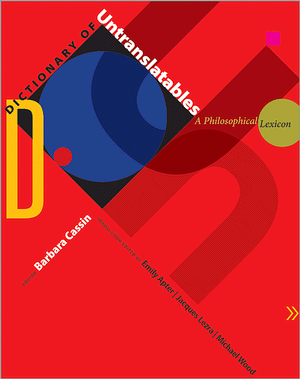
Dictionary of Untranslatables: A Philosophical Lexicon

June 26.gif

A discussion and launch of Dictionary of Untranslatables: A Philosophical Lexicon, edited by Barbara Cassin (Princeton University Press, 2014)

26 Jun 2015
5:00pm – 8:00pm
137a, Richard Hoggart Building

Barbara Cassin
Étienne Balibar (Kingston)
Lucie Campos (Institut Français)
Jacques Lezra (NYU, co-editor of the English translation)

The Dictionary of Untranslatables is an encyclopedic dictionary of close to 400 important philosophical, literary, and political terms and concepts that defy easy—or any—translation from one language and culture to another. Drawn from more than a dozen languages, terms such as Dasein (German), pravda (Russian), saudade (Portuguese), and stato (Italian) are thoroughly examined in all their cross-linguistic and cross-cultural complexities. Spanning the classical, medieval, early modern, modern, and contemporary periods, these are terms that influence thinking across the humanities. The entries, written by more than 150 distinguished scholars, describe the origins and meanings of each term, the history and context of its usage, its translations into other languages, and its use in notable texts. The dictionary also includes essays on the special characteristics of particular languages–English, French, German, Greek, Italian, Portuguese, Russian, and Spanish.

Originally published in French, this one-of-a-kind reference work is now available in English for the first time, with new contributions from Judith Butler, Daniel Heller-Roazen, Ben Kafka, Kevin McLaughlin, Kenneth Reinhard, Stella Sandford, Gayatri Chakravorty Spivak, Jane Tylus, Anthony Vidler, Susan Wolfson, Robert J. C. Young, and many more.The result is an invaluable reference for students, scholars, and general readers interested in the multilingual lives of some of our most influential words and ideas.

Organised by Filippo Del Lucchese (Brunel) & Alberto Toscano (Co-Director, CPCT)


Leave a comment

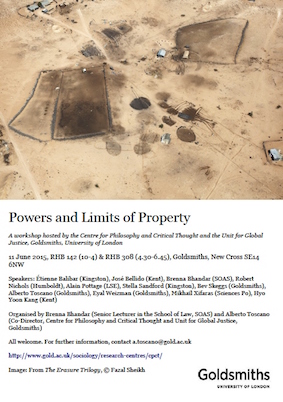
Powers and Limits of Property

June 11b.jpg

A day workshop on philosophy, legal theory and the question of property

11 Jun 2015
10:00am – 6:45pm
142 and 308, Richard Hoggart Building

Contemporary philosophy has undertaken sustained interrogations of its relationship to law and, to a lesser extent, capital. This has been less true of its questioning of its relationship to the crucial nexus of law and capital: property. Inversely, while critical legal theory has appropriated a welter of concepts and methods from contemporary philosophy, it has often avoided a sustained critical appraisal of the images of law within philosophy itself, and of the place of property within these.

Responding to a resurgent critical interest in the question of property, and especially to contemporary inquiries into the logics of dispossession that subtend capitalism, this workshop will stage a trans-disciplinary dialogue on the legal and philosophical powers – as well the limits and impasses – of property.

Speakers: Étienne Balibar (Kingston), José Bellido (Kent), Brenna Bhandar (SOAS), Robert Nichols (Humboldt), Alain Pottage (LSE), Stella Sandford (Kingston), Bev Skeggs (Goldsmiths), Alberto Toscano (Goldsmiths), Eyal Weizman (Goldsmiths), Mikhaïl Xifaras (Sciences Po), Hyo Yoon Kang (Kent)

Organised by Brenna Bhandar (Senior Lecturer in the School of Law, SOAS) and Alberto Toscano (Co-Director, Centre for Philosophy and Critical Thought, Goldsmiths)

Étienne Balibar (Kingston)
José Bellido (Kent)
Brenna Bhandar (SOAS)
Robert Nichols (Humboldt)
Alain Pottage (LSE)
Stella Sandford (Kingston)
Bev Skeggs (Goldsmiths)
Alberto Toscano (Goldsmiths)
Eyal Weizman (Goldsmiths)
Mikhaïl Xifaras (Sciences Po)
Hyo Yoon Kang (Kent)

Organised by Brenna Bhandar & Alberto Toscano (Co-Director, CPCT).