The Centre for Philosophy and Critical Thought, Goldsmiths University of London

Research Centre run jointly between the Departments of Sociology and English and Comparative Literature at Goldsmiths University, London


Leave a comment

Recordings of the British Academy Conference “Futures of Critique in a Pluricentric World” (July 12-13, 2024)

The recordings for the British Academy / CPCT Conference “Futures of Critique in a Pluricentric World” (July 12-13, 2024) are now available on our YouTube channel:

For more information about the conference (programme, abstracts, speaker bios), please visit: https://daoismandcapitalism.wordpress.com/2024/06/10/public-event-3-futures-of-critique-in-a-pluricentric-world-july-12-and-13-2024/


Leave a comment

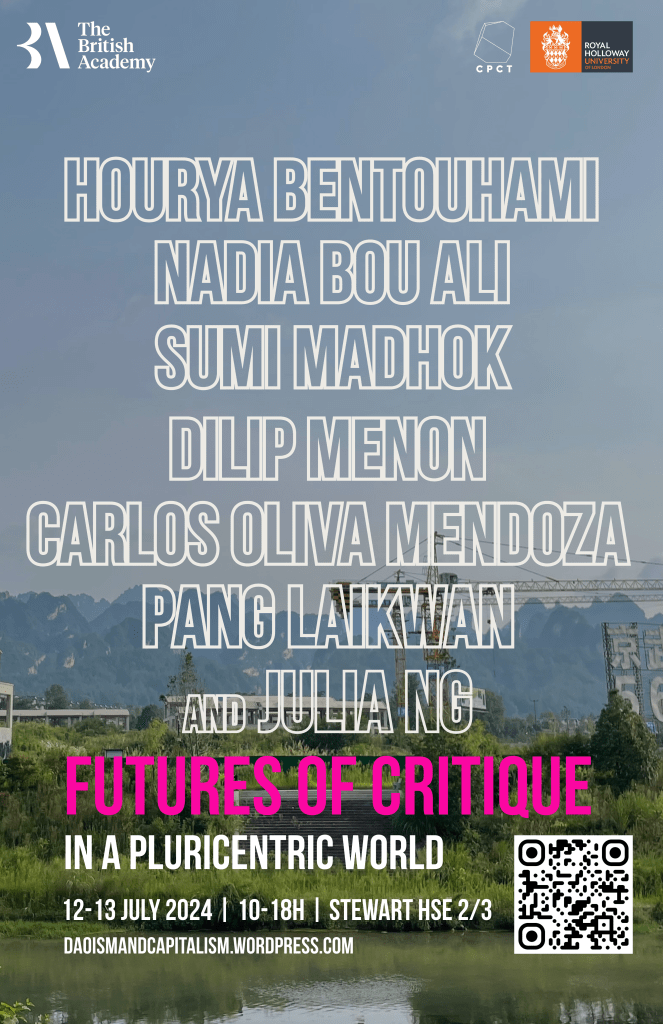
BRITISH ACADEMY CONFERENCE: Futures of Critique in a Pluricentric World (12 and 13 July, 2024, Senate House London)


Futures of Critique in a Pluricentric World 

A British Academy conference exploring horizons and methods of a critical theory for the 21st century.

Venue: Stewart House 2/3, Senate House London
Dates: 12 and 13 July, 2024 from 10:00 am to 6:00 pm BST

Taking as its premise the notion that critical languages move multi-directionally between a plurality of centres rather than disseminate from a single, metropolitan axis of power, this conference considers the emergences, conflicts, suppressions, adaptations and mutations of concepts that take place at a distance from the loci traditionally associated with critical theory—metropolitan Europe, North America. The speakers explore, inter alia, cases of conceptual cross-pollinations across worlds and histories beyond the “Global North”; and the influence, facilitated by variously colonial and imperial conditions of linguistic and philosophical translation, of concepts from the “Global South” on the development of critical theory. Broadly construing critical theory to include not only Frankfurt School Critical Theory but also feminist and gender theory, eco-criticism, psychoanalysis, and postcolonial and decolonial theory among others, the conference will have a dual aim: (i) to frame critical theory as a productively unstable entity that retains intelligible markers of its origins in sociopolitical and epistemological “crises”; and (ii) “map” the historical and contemporary diversity of critical keywords, their translations, and the tools they provide us for articulating the emancipatory potentials of vocabularies be they indigenous, hybrid, or global.

Free and open to the public, though registration is required. To register, please visit: https://www.eventbrite.co.uk/e/futures-of-critique-in-a-pluricentric-world-tickets-805233253337.

This event is the third of three associated with Dr. Julia Ng’s British Academy Mid-Career Fellowship project Daoism and Capitalism: Early Critical Theory and the Global South (MCFSS23\230039). Thanks also go to the Centre for Philosophy and Critical Thought ** and Royal Holloway’s Centre for Continental Philosophy for their generous support.

** N.B. Due to the UCU boycott of Goldsmiths and in solidarity with the staff who are currently at risk of redundancy due to the restructure planned by Goldsmiths’ management, this conference has been moved from campus to an alternative location and dissociated from Goldsmiths. We thank you for your understanding and support.

Tentative Programme
(For updates and more information, including abstracts, please visit https://daoismandcapitalism.wordpress.com/2024/06/10/public-event-3-futures-of-critique-in-a-pluricentric-world-july-12-and-13-2024/.)

Friday, 12 July 2024

10:00 Welcome and Introductory remarks — Julia Ng

10:15-11:25 Pang Laikwan (Chinese University Hong Kong) — Sovereign Logic, Decolonial Politics, and The Problematic Logic of Unity

11:30-12:40 Dilip M. Menon (Witwatersrand) — After Decoloniality   

12:40-2:00 Lunch break

2:00-3:10 Sumi Madhok (LSE) — Anti-Imperial Epistemic Justice

3:15-4:25 Carlos Oliva Mendoza (UNAM) — Critique, Baroque, and Capital  

4:30-5:40 Nadia Bou Ali (American University Beirut) — Critique and Scansion

Saturday, 13 July 2024

10:00-11:10 Julia Ng — Critical Space-Times

11:15-12:25 Hourya Bentouhami (Toulouse) — The Language of the Future

12:30-1:30 Concluding roundtable / Q&A

About the speakers

Hourya Bentouhami is a French-Moroccan Associate Professor of Philosophy at Université Toulouse Jean Jaurès, and a member of the Institut Universitaire de France. Her work on political philosophy and phenomenology focuses on the sensorial dynamics of racialization and gender assignment and on forms of economic dispossession as well as on the ways of disobeying them to create new forms of seeing and feeling in a livable world.

Nadia Bou Ali is Associate Professor and Director of the Critical Humanities for the Liberal Arts (CHLA) at the American University of Beirut. She is the author of Hall of Mirrors: Psychoanalysis and the Love of Arabic (Edinburgh University Press, 2020). She is co-editor (with Rohit Goel) of Lacan contra Foucault: Subjectivity, Sex, Politics (Bloomsbury 2018) and of Extimacies: Encounters Between Psychoanalysis and Philosophy (co-edited with Surti Singh), forthcoming from Northwestern University Press. She is also editing the first English translation of Mehdi Amel’s Theoretical Prolegomenon on the Impact of Socialist Thought in the National Liberation Movement: On Contradiction and The Colonial Mode of Production for Brill’s Historical Materialism Book Series. Nadia is a practicing analyst and member of The Lacan School, Bay Area, San Francisco.

Sumi Madhok is Professor of Political Theory and Gender Studies and Head of the Department of Gender Studies at LSE. Her work combines critical theory and ethnographic approaches with a focus on South Asia and is interested in social sciences focused on epistemic interventions from the Global South. Her latest book is Vernacular Rights Cultures: The Politics of Origins, Human Rights and Gendered Struggle for Justice (Cambridge, 2021), winner of the 2022 Susan Strange book award. It also received The International Studies Association’s Lee Ann Fujii Book Prize ‘Honorable Mention’.

Dilip M Menon is a Professor of History and International Relations and the Director of the Centre for Indian Studies in Africa, University of Witwatersrand. He is primarily a social historian of South Asia concerned with questions of caste and inequality. For the past decade he has been concerned with epistemologies from the global south and oceanic histories, and this has resulted in a series of edited volumes on capitalism, oceans, concepts, and cinema. A recent interview with Professor Menon can be found here: https://brill.com/view/journals/phen/8/4/article-p375_3.xml.

Carlos Oliva Mendoza is a writer and a professor at the National Autonomous University of Mexico’s (UNAM) Faculty of Philosophy of Letters, as well as a member of the National System of Researchers (SNI). Among other recognitions, he is the recipient of the International Narrative Award, Siglo XII; the National Award for Young Essay; and the National Award for Literary Essay. He is lead for the research projects “Critical Theory in Latin America” and “Baroque Modernity and Mexican Thought.” His latest published books are Cine mexicano y filosofía, Espacio y capital and Semiótica y capitalismo.

Pang Laikwan is Choh-Ming Li Professor of Cultural and Religious Studies and Chairperson of the Department of Cultural and Religious Studies at Chinese University Hong Kong. Her research spans a broad spectrum of issues related to culture in Modern and Contemporary China and Hong Kong. Her central philosophical project is the exploration of the dynamics between “many” and “one,” manifested in the intersections between culture and politics, copies and models, plurality and unity, as well as democracy and sovereignty. She is the author of a few books, and her scholarship has been recognized internationally. Her books received American Library Association (ALA) Choice 2020 Outstanding Academic Title and Chiang King-Kuo Foundation Publication Award. She herself also received the Discovery International Award offered by Australia Research Council, Research Excellence Award as well as Young Research Award by The Chinese University of Hong Kong.

Julia Ng is Reader in Critical Theory and founding Co-Director of the Centre for Philosophy and Critical Thought at Goldsmiths, University of London. She specialises in philosophical approaches to literature, modern German-Jewish thought, early 20th-century Germanophone literatures in their transnational contexts, and history of critical theory. Recent publications include her translation and critical edition of Walter Benjamin’s “Toward the Critique of Violence” (with P. Fenves; Stanford UP, 2021) and articles in Theory Culture & Society, Paragraph, CR: New Centennial Review, Modern Language Notes, diacritics, and Critical Times. Funded by a British Academy Mid-Career Fellowship, she is currently completing a book on Daoism and Capitalism, which has also received support from the Leverhulme Trust, the Center for Jewish History (NYC), and the British Society for the History of Philosophy.


Leave a comment

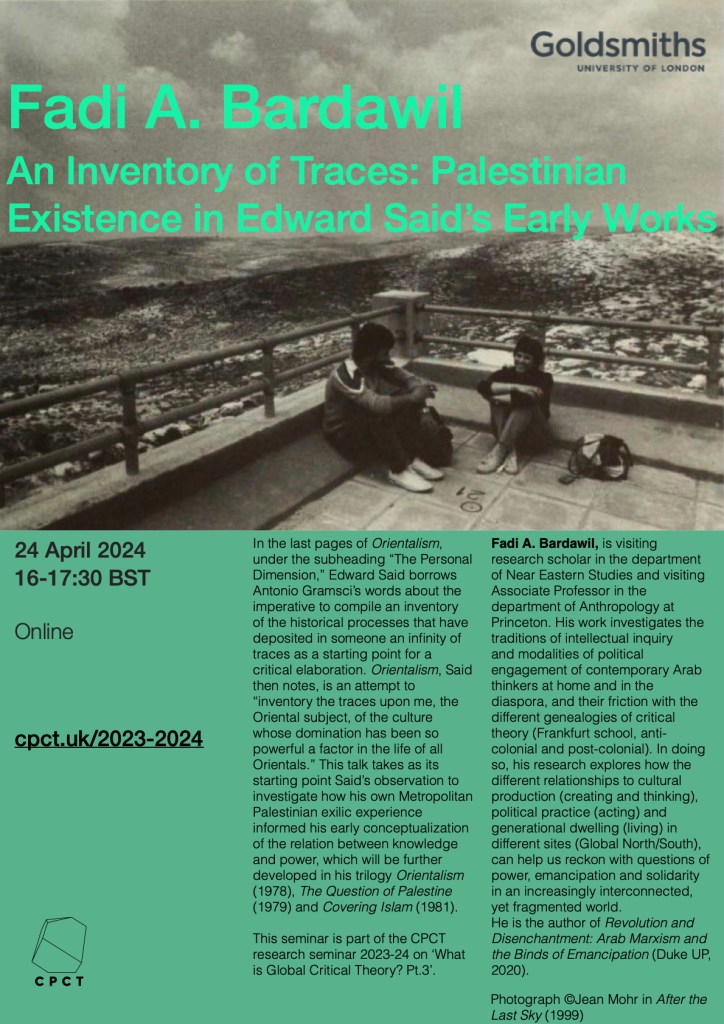
CPCT Research Seminar: Fadi A. Bardawil, ‘An Inventory of Traces: Palestinian Existence in Edward Said’s Early Works’ (24 April, 4pm BST, online)

An Inventory of Traces:
Palestinian Existence in Edward Said’s Early Works

Fadi A. Bardawil (Princeton University)

24 April 2024
16:00 – 17:30 BST
Online

REGISTER HERE for the zoom link

Contact: s.bromberg[@] gold.ac.uk

This seminar is part of the 23/24 CPCT research seminar series on ‘What is Global Critical Theory? Pt.3’ [link]. 

About the talk 

In the last pages of Orientalism, under the subheading “The Personal Dimension,” Edward Said borrows Antonio Gramsci’s words about the imperative to compile an inventory of the historical processes that have deposited in someone an infinity of traces as a starting point for a critical elaboration. Orientalism, Said then notes, is an attempt to “inventory the traces upon me, the Oriental subject, of the culture whose domination has been so powerful a factor in the life of all Orientals.” This talk takes as its starting point Said’s observation to investigate how his own Metropolitan Palestinian exilic experience informed his early conceptualization of the relation between knowledge and power, which will be further developed in his trilogy Orientalism (1978), The Question of Palestine (1979) and Covering Islam (1981). 

About the speaker 

Fadi A. Bardawil, is visiting research scholar in the department of Near Eastern Studies and visiting Associate Professor in the department of Anthropology at Princeton. 
His work investigates the traditions of intellectual inquiry and modalities of political engagement of contemporary Arab thinkers at home and in the diaspora, and their friction with the different genealogies of critical theory (Frankfurt school, anti-colonial and post-colonial). In doing so, his research explores how the different relationships to cultural production (creating and thinking), political practice (acting) and generational dwelling (living) in different sites (Global North/South), can help us reckon with questions of power, emancipation and solidarity in an increasingly interconnected, yet fragmented world. 
His recent Arabic and English writings have appeared in American Ethnologist,  boundary 2; Comparative Studies of South Asia, Africa and the Middle East; The Journal for Palestine Studies (Arabic edition); al-Jumhuriya; The Immanent Frame; Megaphone;  Political and Legal Anthropology Review Online; South Atlantic Quarterly; and World Records Journal
He is the author of Revolution and Disenchantment: Arab Marxism and the Binds of Emancipation (Duke UP, 2020). 


Leave a comment

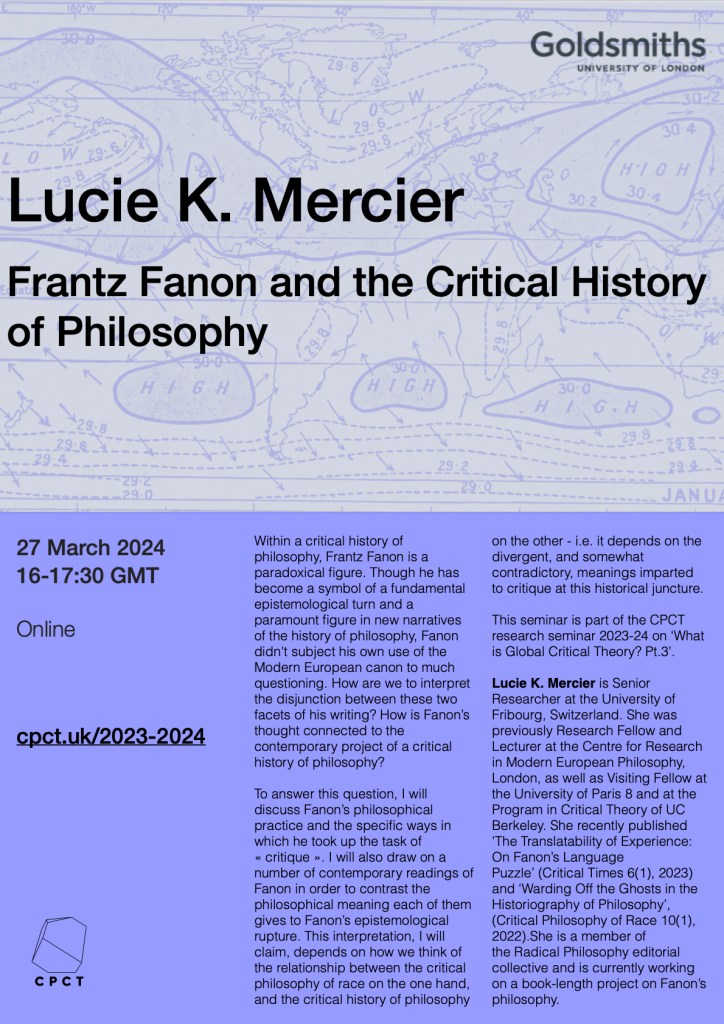
CPCT Research Seminar: Lucie K. Mercier, ‘Frantz Fanon and the Critical History of Philosophy’ (27 March, 4pm GMT, online)

Frantz Fanon and the Critical History of Philosophy

Lucie K. Mercier (University of Fribourg)

27 March 2024
16:00 – 17:30 GMT
Online

REGISTER HERE for the zoom link

Contact: s.bromberg [@] gold.ac.uk

This seminar is part of the 23/24 CPCT research seminar series on ‘What is Global Critical Theory? Pt.3’ [link]. 

About the talk 

Within a critical history of philosophy, Frantz Fanon is a paradoxical figure. Though he has become a symbol of a fundamental epistemological turn and a paramount figure in new narratives of the history of philosophy, Fanon didn’t subject his own use of the Modern European canon to much questioning. How are we to interpret the disjunction between these two facets of his writing? How is Fanon’s thought connected to the contemporary project of a critical history of philosophy? 

To answer this question, I will discuss Fanon’s philosophical practice and the specific ways in which he took up the task of « critique ». I will also draw on a number of contemporary readings of Fanon in order to contrast the philosophical meaning each of them gives to Fanon’s epistemological rupture. This interpretation, I will claim, depends on how we think of the relationship between the critical philosophy of race on the one hand, and the critical history of philosophy on the other – i.e. it depends on the divergent, and somewhat contradictory, meanings imparted to critique at this historical juncture. 

About the speaker 

Lucie K. Mercier is Senior Researcher at the University of Fribourg, Switzerland. She was previously Research Fellow and Lecturer at the Centre for Research in Modern European Philosophy, London, as well as Visiting Fellow at the University of Paris 8 and at the Program in Critical Theory of UC Berkeley. She recently published ‘The Translatability of Experience: On Fanon’s Language Puzzle’ (Critical Times 6(1), 2023) and ‘Warding Off the Ghosts in the Historiography of Philosophy’, (Critical Philosophy of Race 10(1), 2022).She is a member of the Radical Philosophy editorial collective and is currently working on a book-length project on Fanon’s philosophy.


Leave a comment

RECORDING – Nick Nesbitt – Marx’s Critique of Capitalist Slavery (21 Feb 24)

A recording of Nick Nesbitt on ‘Marx’s Critique of Capitalist Slavery’ as part of the 2023/24 CPCT research seminar on ‘What is Global Critical Theory? (Pt.3)’.


Leave a comment

RECORDING – Matthieu Renault – Rewriting the “Decline of the West” in the Black Atlantic (17 Jan 2024)

A recording of Matthieu Renault on ‘Rewriting the “Decline of the West” in the Black Atlantic’ as part of the 2023/24 CPCT research seminar on ‘What is Global Critical Theory? (Pt.3)’.


Leave a comment

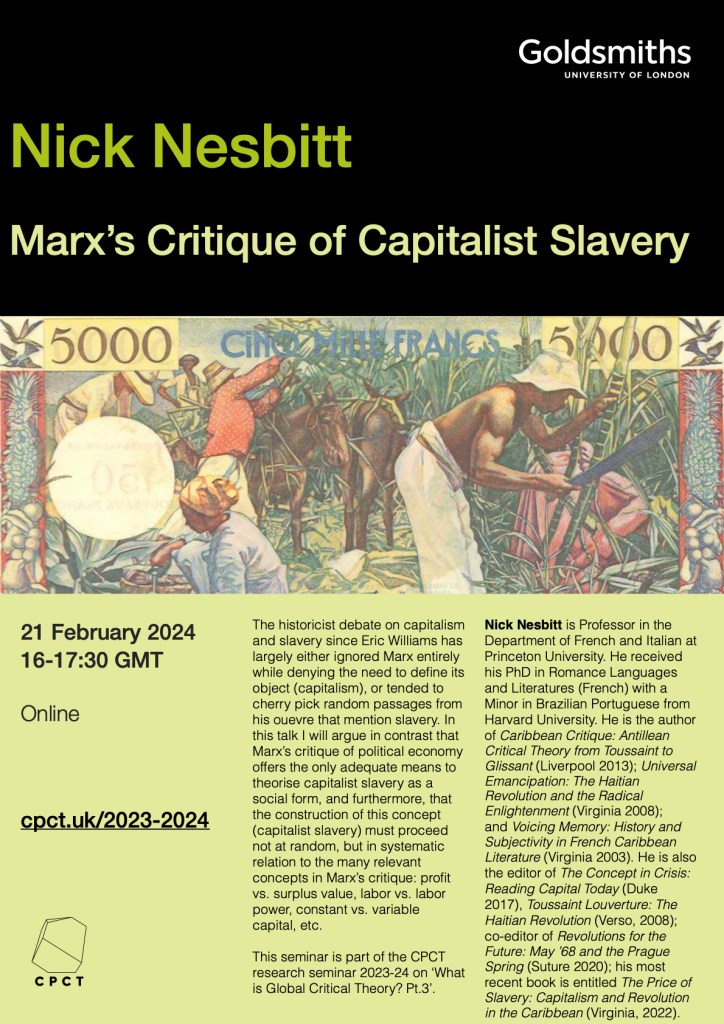
CPCT Research Seminar: Nick Nesbitt, ‘Marx’s Critique of Capitalist Slavery’ (21 Feb, 4pm GMT, online)

Marx’s Critique of Capitalist Slavery

Nick Nesbitt (Princeton University)

21 February 2024
16:00 – 17:30 GMT
Online

REGISTER HERE for the zoom link

Contact: s.bromberg[@] gold.ac.uk

This seminar is part of the 23/24 CPCT research seminar series on ‘What is Global Critical Theory? Pt.3’ [link]. 

About the talk 

The historicist debate on capitalism and slavery since Eric Williams has largely either ignored Marx entirely while denying the need to define its object (capitalism), or tended to cherry pick random passages from his ouevre that mention slavery. In this talk I will argue in contrast that Marx’s critique of political economy offers the only adequate means to theorise capitalist slavery as a social form, and furthermore, that the construction of this concept (capitalist slavery) must proceed not at random, but in systematic relation to the many relevant concepts in Marx’s critique: profit vs. surplus value, labor vs. labor power, constant vs. variable capital, etc.

About the speaker 

Nick Nesbitt is Professor in the Department of French and Italian at Princeton University. He received his PhD in Romance Languages and Literatures (French) with a Minor in Brazilian Portuguese from Harvard University. He has previously taught at the University of Aberdeen (Scotland) and at Miami University (Ohio), and in 2003-4 he was a Mellon Fellow at the Cornell University Society for the Humanities. He is the author of Caribbean Critique: Antillean Critical Theory from Toussaint to Glissant (Liverpool 2013); Universal Emancipation: The Haitian Revolution and the Radical Enlightenment (Virginia 2008); and Voicing Memory: History and Subjectivity in French Caribbean Literature (Virginia 2003). He is also the editor of The Concept in Crisis: Reading Capital Today (Duke 2017), Toussaint Louverture: The Haitian Revolution (Verso, 2008); co-editor of Revolutions for the Future: May ’68 and the Prague Spring (Suture 2020); and co-editor (with Brian Hulse) of Sounding the Virtual: Gilles Deleuze and the Philosophy of Music (Ashgate 2010). His most recent book is entitled The Price of Slavery: Capitalism and Revolution in the Caribbean (Virginia, 2022).


Leave a comment

RECORDING of Asia Theories Network – “Field Report” (14 Dec 2023)

A recording of Asia Theory Network – ‘Field Report’ presented by Li-Chun Hsiao, Oscar V. Campomanes, Alex Taek-Gwang Lee, Hung-chiung Li as part of the 2023/24 CPCT research seminar on ‘What is Global Critical Theory? (Pt.3)’.


Leave a comment

RECORDING of Yuji Nishiyama: The Trials of Untranslatable: Derrida in Japan & The Association for Deconstruction (23 November 2023)

A recording of Yuji Nishiyama presenting on ‘The Trials of Untranslatable: Derrida in Japan & The Association for Deconstruction’ as part of the 2023/24 CPCT research seminar on ‘What is Global Critical Theory? (Pt.3)’. 


Leave a comment

RECORDING of Safieddine & Giordani – ‘Reflections on Translating Arab Marxism’ (18 January 2023)

A recording of Hicham Safieddine and Angela Giordani presenting on ‘Reflections on Translating Arab Marxism’ as part of the 2022/23 CPCT research seminar on ‘Translating Global Critical Theory’. See their related book publication Hicham Safieddine (ed.), Angela Giordani (trans.), Arab Marxism and National Liberation: Selected Writings of Mahdi Amel (Brill, 2020).