We’re pleased to announce the commencement of our Research Seminar this year, which is devoted to the topic ‘Music and Philosophy.’ We’re holding this in a hybrid format so you can join us either in RHB 139 or online via Zoom. Please visit https://cpct.uk/2025-26/ for more details, including a detailed seminar plan, links to the readings, and the Zoom registration link. Free and open to the public as per usual.
Tag Archives: Research Seminar
Samir Haddad (Fordham): ‘Derrida on Restructuring the University’ (30 April 2025)

‘Derrida on Restructuring the University’
Samir Haddad (Philosophy, Fordham)
a special session of
‘On Truth and Lies in the Extramoral University’
CPCT Research Seminar 2024-25
Time: Wednesday, 30 April 2025, 4:00-6:00 pm UK time.
Venue: RHB 138 and online
Zoom registration: https://gold-ac-uk.zoom.us/meeting/register/m-qsXjg-SrG5HmiIdhzcNA
Readings
René Haby, “Pour une modernisation du système éducatif” (esp. pp.1-10) [PDF]; Jacques Derrida, “Divided Bodies: Responses to La Nouvelle Critique” [PDF]; Jacques Derrida, “The Age of Hegel” [PDF]; Jacques Derrida, Jacques Bouveresse, Catherine Malabou, et al., “Report of the Committee on Philosophy and Epistemology (1990)” [PDF]
About the session
In the 1970s and 1980s, Derrida was heavily involved in debates on the place of philosophy in education in France. In this seminar we will read a selection of texts related to two of Derrida’s interventions in this period, with an eye to how they might speak to challenges we now face, several decades later and in different national contexts. The first intervention was precipitated by proposals made in 1974 by the French Minister of Education, René Haby, who sought to “modernize” the curriculum in the lycée. Among Haby’s proposals were calls for more emphasis on the sciences and social sciences over the humanities, greater interdisciplinarity, and the need to better train future workers in the face of rapidly changing technology and systems of communication. In response, Derrida and others sought to rethink the role that philosophy should play in a student’s education, and made various counter-proposals for reform of their own. The second intervention dates to 1989, when Derrida was asked by Pierre Bourdieu and François Gros, themselves charged by the Minister of Education at that time, to co-chair with Jacques Bouveresse a Committee on Philosophy and Epistemology as a part of a larger project aiming to reform French education as a whole. The resulting report develops further the ideas first raised in the 1970s, and constitutes Derrida’s most detailed vision for transforming the teaching of philosophy in France.
About the session leader
Samir Haddad is Associate Professor of Philosophy at Fordham University. He specializes in 20th century and contemporary continental philosophy, particularly French philosophy and deconstruction, and in the philosophy of education. He is the author of Derrida and the Inheritance of Democracy (Indiana, 2013) and is currently working on two research projects, one focused on Derrida’s work on education, and the other on the roles that translation and multilingualism might play in philosophical pedagogy.
* * *
About the seminar
CPCT’s annual research seminar meets on a regular basis and is open to centre members, graduate affiliates, and other interested staff and students at Goldsmiths and beyond. It aims to serve as a forum for philosophical work and critical conversation at Goldsmiths.
Taking its inspiration from the title of the famous essay by Friedrich Nietzsche, our research seminar this year poses the following question: what is the contemporary university for? By definition “extramoral” in the sense that it is premised on the pursuit of knowledge without the interference of power and authority—the classical loci of which were Church and State—the modern university nevertheless exists in a world driven by profit, riddled with war, and beset with an ever-unfolding polycrisis of environmental, racial, economic, technological, and geopolitical dimensions. What, then, is the role of the university vis-à-vis its extramorality or, indeed, its moral purpose? We wish in particular to interrogate the university’s role in truth-telling and truth-making, inter alia in relation to the era of post-truth, alt-facts, and now AI technologies that seem to have deeply unsettled classical definitions of knowing, certainty, and consciousness, and to questions of whose truth, when and where truth is that emergent pluricentric views of the world have opened up. “Extramoral” is, of course, also a play on the word “extramural,” and we wish to recall the 2010 student-led debates on the university’s purpose when tuition fees were first introduced.
Convened by Julia Ng (j.ng[at]gold.ac.uk), Svenja Bromberg (s.bromberg[at]gold.ac.uk), and Sultan Doughan (s.doughan[at]gold.ac.uk).
This year’s sessions will be hybrid; to participate online, please register at the links below each session on the detailed session plan, where you will also find links to the readings. Free and open to the public.
CPCT Research Seminar 2024-25: ‘On Truth and Lies in the Extramoral University’

We’re pleased to announce the commencement of our Research Seminar this year, which is devoted to the topic ‘On Truth and Lies in the Extramoral University.’ Moreover, we’re holding this in a hybrid format this year so you can join us either in RHB 138 or online via Zoom. Please visit https://cpct.uk/2024-2025/ for more details, including a detailed seminar plan, links to the readings, and the Zoom registration link. Free and open to the public as per usual.
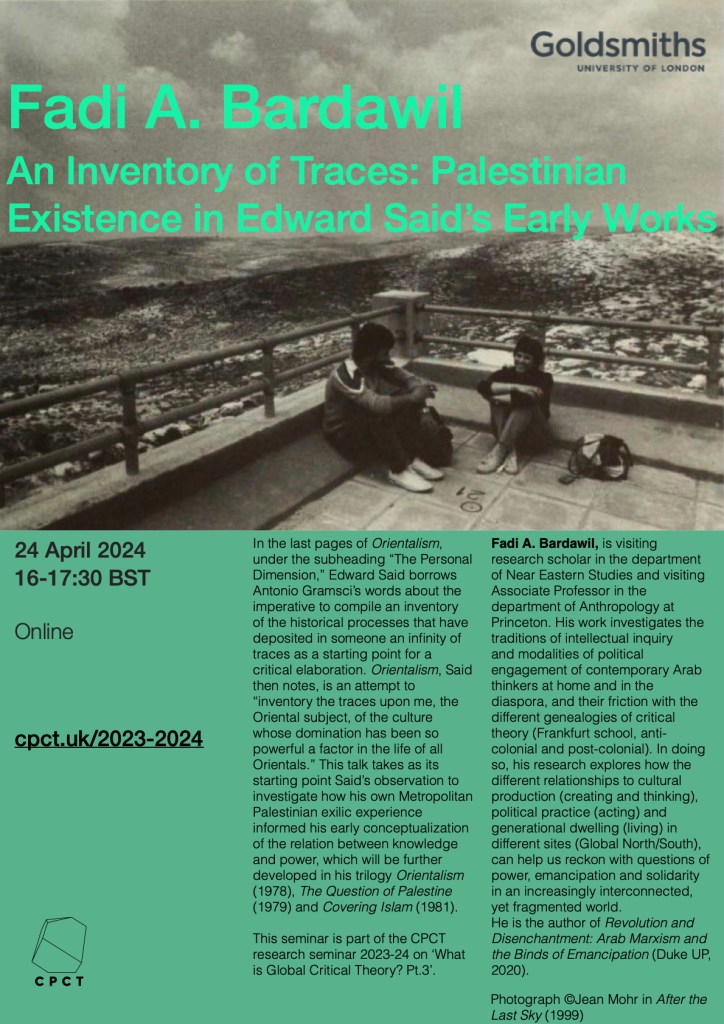
CPCT Research Seminar: Fadi A. Bardawil, ‘An Inventory of Traces: Palestinian Existence in Edward Said’s Early Works’ (24 April, 4pm BST, online)

An Inventory of Traces:
Palestinian Existence in Edward Said’s Early Works
Fadi A. Bardawil (Princeton University)
24 April 2024
16:00 – 17:30 BST
Online
REGISTER HERE for the zoom link
Contact: s.bromberg[@] gold.ac.uk
This seminar is part of the 23/24 CPCT research seminar series on ‘What is Global Critical Theory? Pt.3’ [link].
About the talk
In the last pages of Orientalism, under the subheading “The Personal Dimension,” Edward Said borrows Antonio Gramsci’s words about the imperative to compile an inventory of the historical processes that have deposited in someone an infinity of traces as a starting point for a critical elaboration. Orientalism, Said then notes, is an attempt to “inventory the traces upon me, the Oriental subject, of the culture whose domination has been so powerful a factor in the life of all Orientals.” This talk takes as its starting point Said’s observation to investigate how his own Metropolitan Palestinian exilic experience informed his early conceptualization of the relation between knowledge and power, which will be further developed in his trilogy Orientalism (1978), The Question of Palestine (1979) and Covering Islam (1981).
About the speaker
Fadi A. Bardawil, is visiting research scholar in the department of Near Eastern Studies and visiting Associate Professor in the department of Anthropology at Princeton.
His work investigates the traditions of intellectual inquiry and modalities of political engagement of contemporary Arab thinkers at home and in the diaspora, and their friction with the different genealogies of critical theory (Frankfurt school, anti-colonial and post-colonial). In doing so, his research explores how the different relationships to cultural production (creating and thinking), political practice (acting) and generational dwelling (living) in different sites (Global North/South), can help us reckon with questions of power, emancipation and solidarity in an increasingly interconnected, yet fragmented world.
His recent Arabic and English writings have appeared in American Ethnologist, boundary 2; Comparative Studies of South Asia, Africa and the Middle East; The Journal for Palestine Studies (Arabic edition); al-Jumhuriya; The Immanent Frame; Megaphone; Political and Legal Anthropology Review Online; South Atlantic Quarterly; and World Records Journal.
He is the author of Revolution and Disenchantment: Arab Marxism and the Binds of Emancipation (Duke UP, 2020).
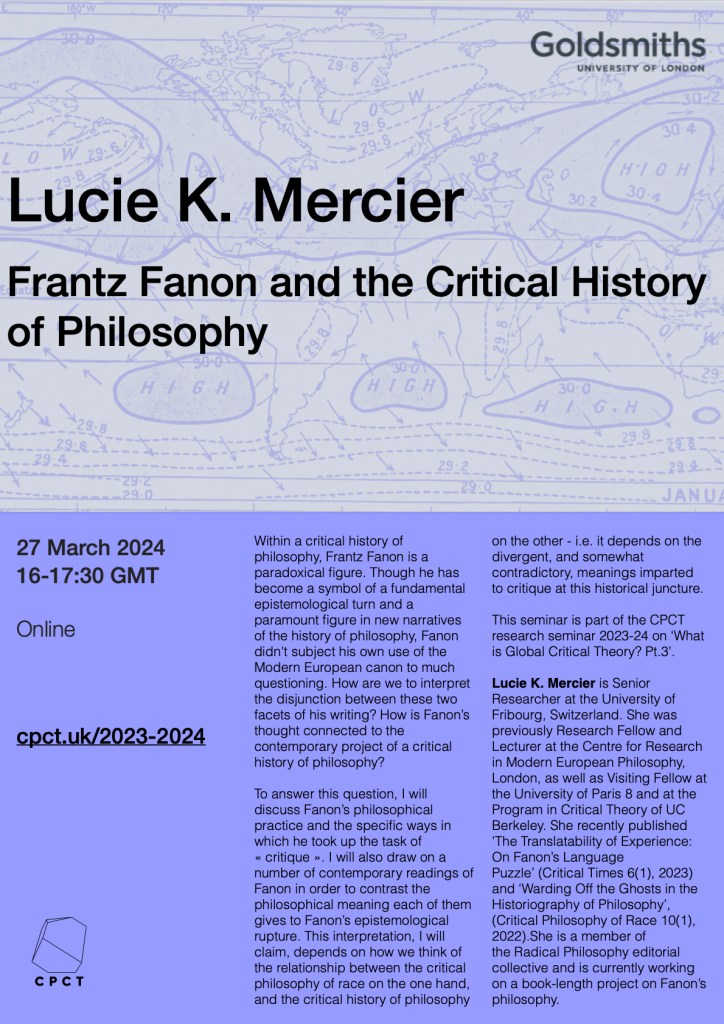
CPCT Research Seminar: Lucie K. Mercier, ‘Frantz Fanon and the Critical History of Philosophy’ (27 March, 4pm GMT, online)

Frantz Fanon and the Critical History of Philosophy
Lucie K. Mercier (University of Fribourg)
27 March 2024
16:00 – 17:30 GMT
Online
REGISTER HERE for the zoom link
Contact: s.bromberg [@] gold.ac.uk
This seminar is part of the 23/24 CPCT research seminar series on ‘What is Global Critical Theory? Pt.3’ [link].
About the talk
Within a critical history of philosophy, Frantz Fanon is a paradoxical figure. Though he has become a symbol of a fundamental epistemological turn and a paramount figure in new narratives of the history of philosophy, Fanon didn’t subject his own use of the Modern European canon to much questioning. How are we to interpret the disjunction between these two facets of his writing? How is Fanon’s thought connected to the contemporary project of a critical history of philosophy?
To answer this question, I will discuss Fanon’s philosophical practice and the specific ways in which he took up the task of « critique ». I will also draw on a number of contemporary readings of Fanon in order to contrast the philosophical meaning each of them gives to Fanon’s epistemological rupture. This interpretation, I will claim, depends on how we think of the relationship between the critical philosophy of race on the one hand, and the critical history of philosophy on the other – i.e. it depends on the divergent, and somewhat contradictory, meanings imparted to critique at this historical juncture.
About the speaker
Lucie K. Mercier is Senior Researcher at the University of Fribourg, Switzerland. She was previously Research Fellow and Lecturer at the Centre for Research in Modern European Philosophy, London, as well as Visiting Fellow at the University of Paris 8 and at the Program in Critical Theory of UC Berkeley. She recently published ‘The Translatability of Experience: On Fanon’s Language Puzzle’ (Critical Times 6(1), 2023) and ‘Warding Off the Ghosts in the Historiography of Philosophy’, (Critical Philosophy of Race 10(1), 2022).She is a member of the Radical Philosophy editorial collective and is currently working on a book-length project on Fanon’s philosophy.
RECORDING – Nick Nesbitt – Marx’s Critique of Capitalist Slavery (21 Feb 24)
A recording of Nick Nesbitt on ‘Marx’s Critique of Capitalist Slavery’ as part of the 2023/24 CPCT research seminar on ‘What is Global Critical Theory? (Pt.3)’.
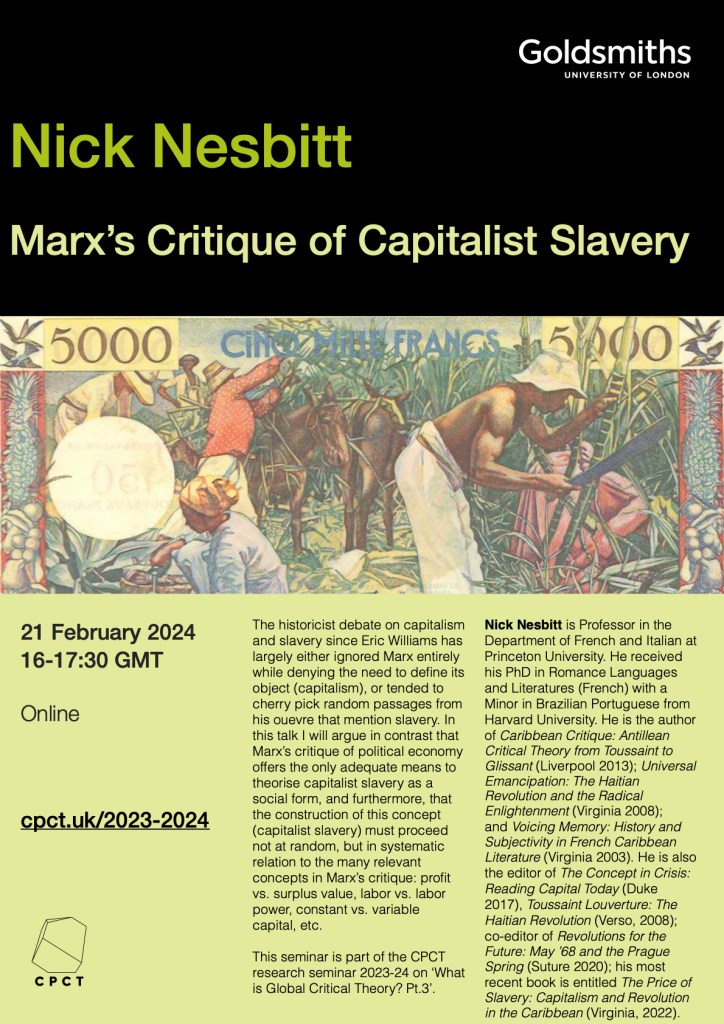
CPCT Research Seminar: Nick Nesbitt, ‘Marx’s Critique of Capitalist Slavery’ (21 Feb, 4pm GMT, online)

Marx’s Critique of Capitalist Slavery
Nick Nesbitt (Princeton University)
21 February 2024
16:00 – 17:30 GMT
Online
REGISTER HERE for the zoom link
Contact: s.bromberg[@] gold.ac.uk
This seminar is part of the 23/24 CPCT research seminar series on ‘What is Global Critical Theory? Pt.3’ [link].
About the talk
The historicist debate on capitalism and slavery since Eric Williams has largely either ignored Marx entirely while denying the need to define its object (capitalism), or tended to cherry pick random passages from his ouevre that mention slavery. In this talk I will argue in contrast that Marx’s critique of political economy offers the only adequate means to theorise capitalist slavery as a social form, and furthermore, that the construction of this concept (capitalist slavery) must proceed not at random, but in systematic relation to the many relevant concepts in Marx’s critique: profit vs. surplus value, labor vs. labor power, constant vs. variable capital, etc.
About the speaker
Nick Nesbitt is Professor in the Department of French and Italian at Princeton University. He received his PhD in Romance Languages and Literatures (French) with a Minor in Brazilian Portuguese from Harvard University. He has previously taught at the University of Aberdeen (Scotland) and at Miami University (Ohio), and in 2003-4 he was a Mellon Fellow at the Cornell University Society for the Humanities. He is the author of Caribbean Critique: Antillean Critical Theory from Toussaint to Glissant (Liverpool 2013); Universal Emancipation: The Haitian Revolution and the Radical Enlightenment (Virginia 2008); and Voicing Memory: History and Subjectivity in French Caribbean Literature (Virginia 2003). He is also the editor of The Concept in Crisis: Reading Capital Today (Duke 2017), Toussaint Louverture: The Haitian Revolution (Verso, 2008); co-editor of Revolutions for the Future: May ’68 and the Prague Spring (Suture 2020); and co-editor (with Brian Hulse) of Sounding the Virtual: Gilles Deleuze and the Philosophy of Music (Ashgate 2010). His most recent book is entitled The Price of Slavery: Capitalism and Revolution in the Caribbean (Virginia, 2022).
RECORDING of Asia Theories Network – “Field Report” (14 Dec 2023)
A recording of Asia Theory Network – ‘Field Report’ presented by Li-Chun Hsiao, Oscar V. Campomanes, Alex Taek-Gwang Lee, Hung-chiung Li as part of the 2023/24 CPCT research seminar on ‘What is Global Critical Theory? (Pt.3)’.
RECORDING of Yuji Nishiyama: The Trials of Untranslatable: Derrida in Japan & The Association for Deconstruction (23 November 2023)
RECORDING of Safieddine & Giordani – ‘Reflections on Translating Arab Marxism’ (18 January 2023)
A recording of Hicham Safieddine and Angela Giordani presenting on ‘Reflections on Translating Arab Marxism’ as part of the 2022/23 CPCT research seminar on ‘Translating Global Critical Theory’. See their related book publication Hicham Safieddine (ed.), Angela Giordani (trans.), Arab Marxism and National Liberation: Selected Writings of Mahdi Amel (Brill, 2020).