Category Archives: Events
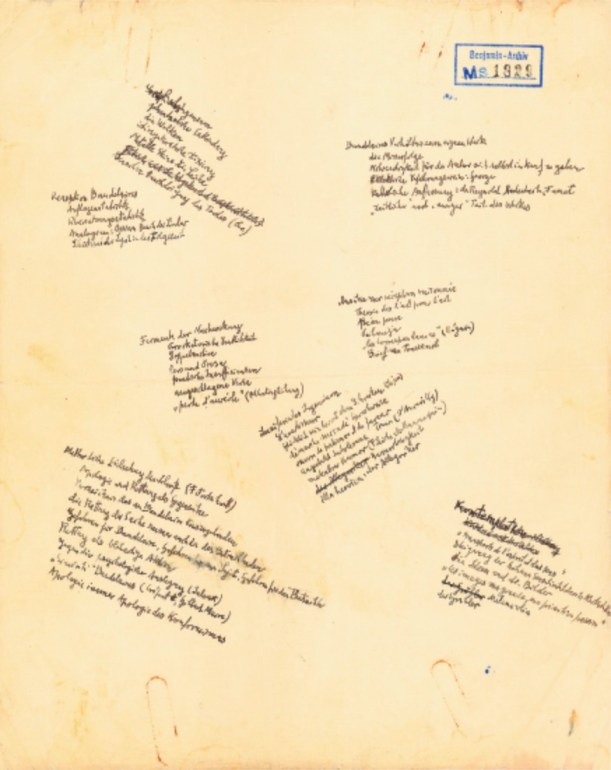
CFP: Benjamin’s Baudelaire — Constellations of Modernity. An AHRC CHASE Workshop for Early Career Researchers

Call for Papers
Benjamin’s Baudelaire — Constellations of Modernity
A Workshop for Early Career Researchers
Event date: Saturday, 11th May 2019
Location: Goldsmiths, University of London
Deadline for abstracts: Monday, 4th February 2019
Contact: benjaminsbaudelaire@gmail.com
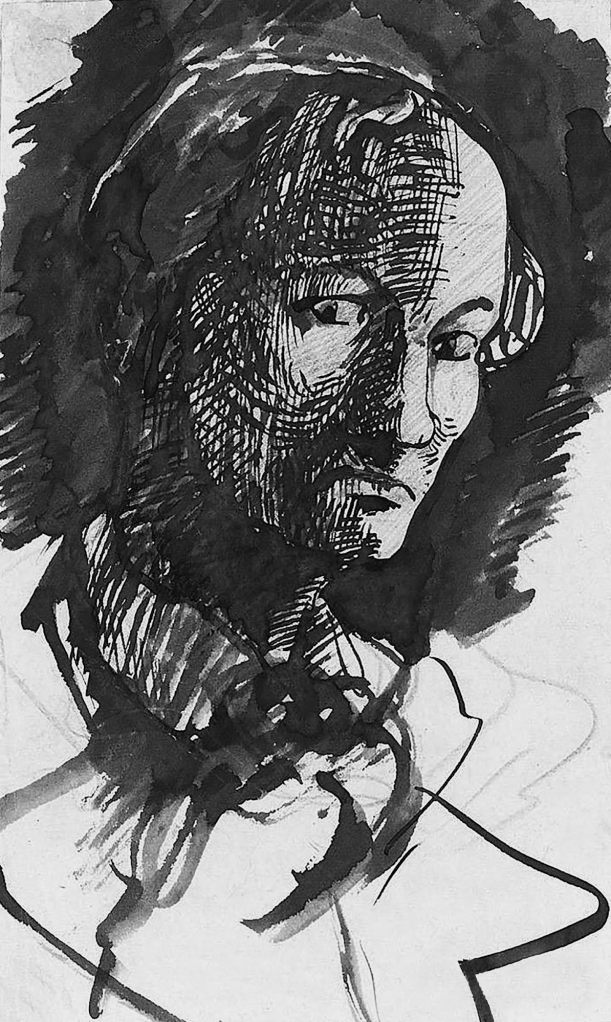
In affiliation with the Centre for Philosophy and Critical Thought’s 2018–19 research seminar series on Baudelaire and Philosophy as well as the corresponding conference to be held in June 2019, a one-day workshop will offer early career researchers the chance to re-examine the conceptual and methodological implications of Walter Benjamin’s relationship to ‘The Writer of Modern Life’. The workshop will consist of several debates in relation to set reading as well as short presentations from all of the participants.
Geology of Race – Arun Saldanha (Dec 7)

Geology of Race: Anthropos, Capital, and Universality under Pressure of Extinction
Ben Pimlott Building Lecture Theatre
5-7pm
Encouraged by a couple of references to Marxism in The Human Planet, a short mass-market book published this year by two physical geographers, Simon Lewis and Mark Maslin, this talk will start by explaining why a critical conversation between geology and the humanities is likely to be defining of the twenty-first century episteme. In claiming that the cumulative and accelerating destruction by capitalism of species, climate stability, and social formations will be legible forever in Earth’s crust, and in finding objective reasons to doubt the viability of the human species in the coming centuries, the Anthropocene might be the most consequential concept ever invented. Of course, it is not “man” so much as industrial capitalism precipitated by primitive accumulation that has brought about a new detectable phase in the history of the earth. Anthropos is not a totality over and against “nature”, but itself an ecology fissured in essence by vectors we call sex, class, race, religion, and nation. Focusing on the Anthropocene’s racial dimensions I will rehearse the key historical trajectories which converged into the structural racism and slow violence (which could also be called differential extinguishability) of modern globalization: slavery, monopoly, genocide, underdevelopment, carbon emissions, toxicity, refugees. Extinction is both an ever-thickening possibility on the horizon for the human species and what has already threatened some social formations in order for today’s wealth to materialize. Inspired by Deleuze and Guattari, a geology of race understands there are substrata to biopolitical discrimination running deeper than those of capital and prejudice. Stratigraphers millennia into the future will be able to read racism in the rocks, provided they are radical.
The talk ends by turning to the simple but momentously pressing question: what politics is capable of deflecting racial capitalism’s path towards extinction. While Badiou is understandably skeptical about environmentalism, I will argue there has never been a better justification for revolutionary universality than the Anthropocene. Geocommunism is the name for the hypothesis of a mode of production without private property and border, in which the few do not wreak havoc on the many to enrich themselves, but collectivities share the earth as an immense and perishable commons.
Arun Saldanha is Associate Professor of Geography, Environment, and Society at the University of Minnesota. He is author of Space After Deleuze (Bloomsbury, 2017) and Psychedelic White: Goa Trance and the Viscosity of Race (Minnesota, 2007), and he is coeditor of Deleuze and Race (Edinburgh, 2013), Sexual Difference Between Psychoanalysis and Vitalism (Routledge, 2013), Geographies of Race and Food: Fields Markets Bodies (Ashgate, 2013), and the Deleuze Studies special issue “Deleuze and Guattari in the Anthropocene” (2016).
Recording of Alenka Zupančič — Love thy neighbour as you love thyself!?(Nov 8, 2018)

Alenka Zupančič
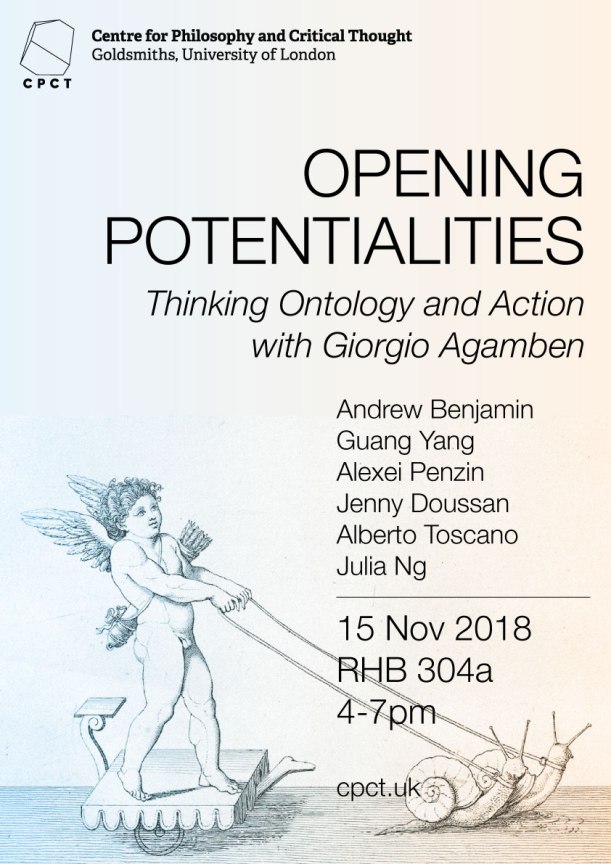
Opening Potentialities: Thinking Ontology and Action with Giorgio Agamben (15 Nov 2018)

Opening Potentialities: Thinking Ontology and Action with Giorgio Agamben Continue reading
Love thy neighbour as you love thyself!? – Alenka Zupančič (Nov 8)

5.30-7.30pm
8 November 2018
Media Research Building, Screen 1
Goldsmiths, University of London
New Cross SE14 6NW
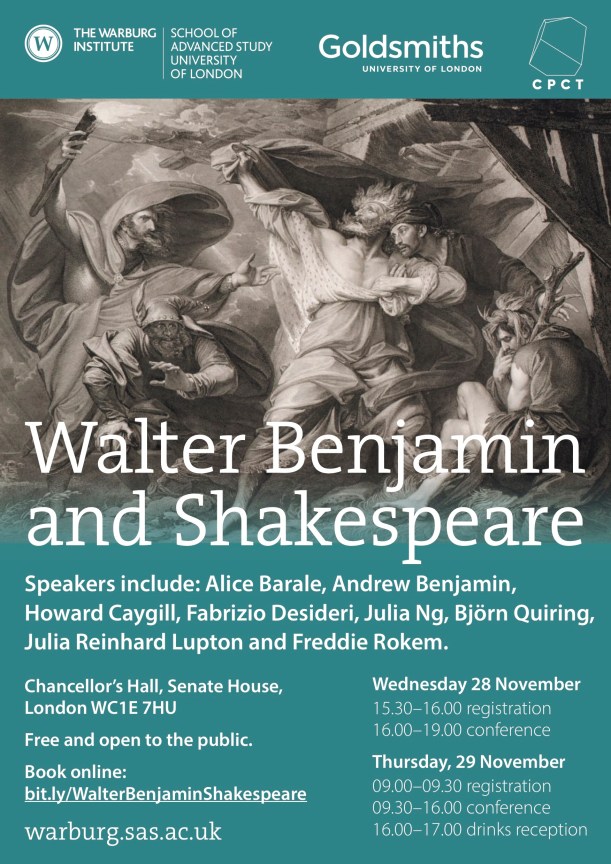
Walter Benjamin and Shakespeare: A Conference (WBLRN / Warburg Institute; 28-29 Nov 2018)
Walter Benjamin and Shakespeare
A Conference co-hosted by the Walter Benjamin London Research Network, Kingston University, and The Warburg Institute
Date: 28 November 2018, 4:00pm – 29 November 2018, 5:00pm
Venue: Chancellor’s Hall, Senate House, London WC1E 7HU
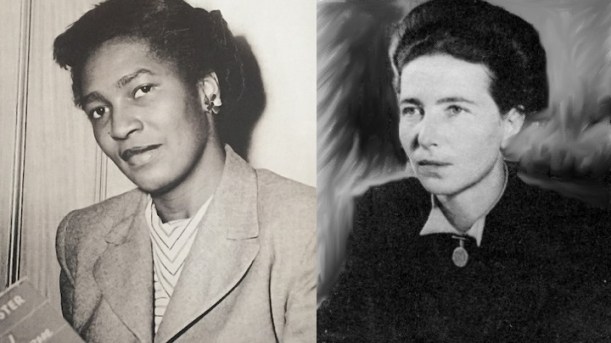
1949: A Debate Between Claudia Jones and Simone de Beauvoir – a lecture by Kathryn Sophia Belle (Oct 4)

5-7pm
4 October 2018
Room RHB 256
Goldsmiths, University of London
New Cross SE14 6NW
This paper puts Claudia Jones (“An End to the Neglect of the Problems of Negro Women!”) in conversation with Simone de Beauvoir (The Second Sex). It pays particular attention to Jones’ intersectional analysis (of Black women’s experiences as simultaneously raced, classed, and gendered), juxtaposing it to de Beauvoir’s analogical approach (analysing gender oppression as analogous with racial oppression).

Kathryn Sophia Belle (formerly known as Kathryn T. Gines), is an Associate Professor of Philosophy at Pennsylvania State University. She is the author of Hannah Arendt and the Negro Question (Indiana UP, 2014) and the co-editor (with Donna-Dale L. Marcano and Maria del Guadalupe Davidson) of Convergences: Black Feminism and Continental Philosophy (SUNY, 2010) and a founder of the journal Critical Philosophy of Race. She is the founding director of the Collegium of Black Women Philosophers.
This event is co-sponsored by the Centre for Feminist Research
All welcome.
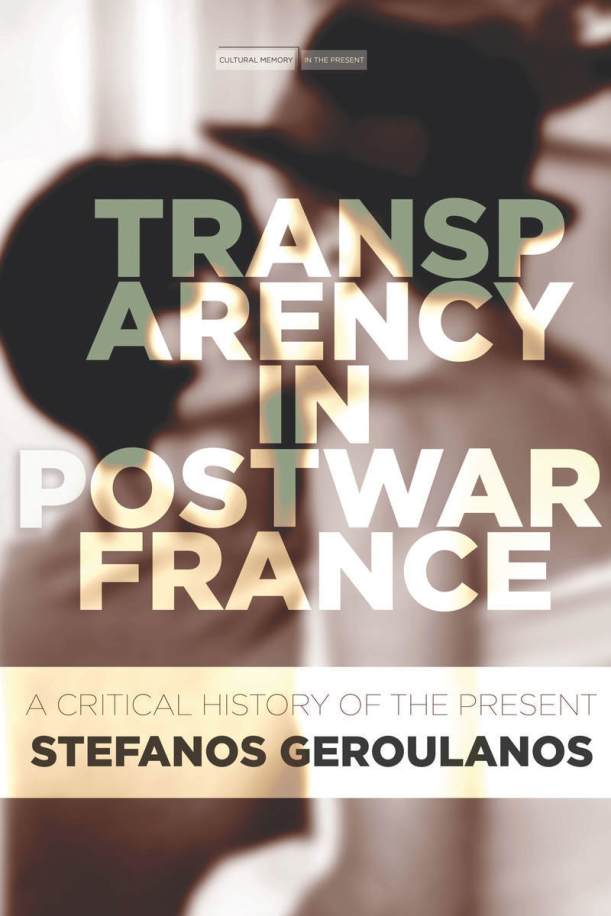
Book Symposium: Stefanos Geroulanos (NYU) on Transparency in Postwar France

Stefanos Geroulanos (NYU) discusses his recent book with
Alberto Toscano and Svenja Bromberg
3-5pm
12 June 2018
Richard Hoggart Building 137a
Goldsmiths Annual Philosophy Lecture – Alienation & Freedom: Frantz Fanon’s Lost and Last Works

Jean Khalfa and Robert J.C. Young give the first Goldsmiths Annual Philosophy Lecture, on the hitherto unpublished and unavailable works of Frantz Fanon.
4-7pm
1 June 2018
LG02, Professor Stuart Hall Building
Since the publication of The Wretched of the Earth in 1961, Fanon’s work has been deeply significant for generations of intellectuals, philosophers and activists seeking to radically interrogate our understandings of violence, race, political subjectivity, mental illness and the challenges of decolonization. In CPCT’s first annual lecture, we are joined by the editors of the landmark collection Alienation and Freedom. This volume collects together unpublished and unavailable works comprising around half of Fanon’s entire output – which were previously inaccessible or thought to be lost. This book introduces audiences to a new Fanon, a more personal Fanon and one whose literary and psychiatric works, in particular, take centre stage. Khalfa and Young will explore how these writings provide new depth and complexity to our understanding of Fanon’s entire oeuvre, revealing more of his powerful thinking about identity, race and activism which remain remarkably prescient. The talk will shed new light on the work of a major 20th-century philosopher, and on newly available texts which oblige us to take a fresh look at the intellectual history of anti-colonial and post-colonial thought, as well as to address with Fanon some of the most pressing theoretical issues of our time.
The lecture will be followed by a response by Jane Hiddleston and will also feature a performance-reading of excerpts from the two plays by Fanon included in Alienation & Freedom: The Drowning Eye and Parallel Hands. Continue reading