The Centre for Philosophy and Critical Thought, Goldsmiths University of London

Research Centre run jointly between the Departments of Sociology and English and Comparative Literature at Goldsmiths University, London


Leave a comment

Welcome to CPCT’s Visiting Professor for Autumn 2025, Prof. Arun Saldanha (U Minnesota, Twin Cities)

We’re pleased to welcome Professor Arun Saldanha as a Visiting Professor at the Centre for Philosophy and Critical Thought in the Autumn term of 2025. Arun Saldanha is Professor in the Department of Geography, Environment, and Society at the University of Minnesota. He is the author or editor of books on race, music, and continental philosophy. At CPCT, he will be working on a new book tentatively titled Phenotypically: A Materialist Theory of Race, which seeks a critical “return to” Darwin after Fanon in light of a resurgence of far-right fantasies around human biology. Professor Saldanha will deliver a talk at CPCT on the basic questions driving his book on Friday 21 November 2025 from 17:00-19:00 in RHB 137a. To receive a notification about this event, please consider subscribing to our mailing list here.

Professor Saldanha will also be leading a session of CPCT’s Research Seminar on “Music and Philosophy” around a piece he published on the October 7 rave massacre. The session will take place on Wednesday, 26 November 2025 from 16:00-18:00 in RHB 139 and online. For details including registration link for hybrid attendance, please visit https://cpct.uk/2025-26/.


Leave a comment

CPCT Research Seminar 2025-26: ‘Music and Philosophy’

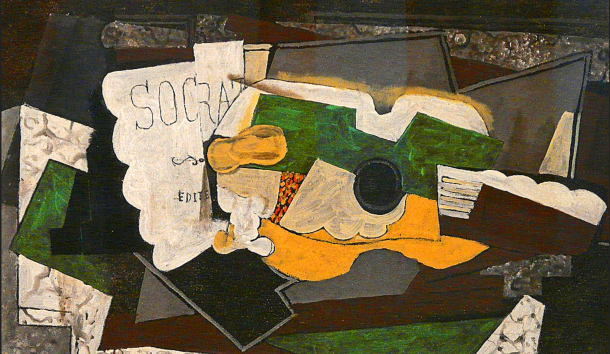
Image: Georges Braque, “Guitare et Verre” (1921)

We’re pleased to announce the commencement of our Research Seminar this year, which is devoted to the topic ‘Music and Philosophy.’ We’re holding this in a hybrid format so you can join us either in RHB 139 or online via Zoom. Please visit https://cpct.uk/2025-26/ for more details, including a detailed seminar plan, links to the readings, and the Zoom registration link. Free and open to the public as per usual.


Leave a comment

Your Feedback

Dear Friends of CPCT,

We are appealing to you as friends of the Centre for Philosophy and Critical Thought (CPCT) at Goldsmiths, University of London for your feedback about our activities in recent years. The impetus of this exercise is twofold: a) we would like to understand your experience of CPCT by creating a structured space for you to give us feedback; and b) we would like to incorporate your feedback into an upcoming review of research centres at the university. 

We’d be very grateful if you could take the time to fill out the survey below. It should only take around 10 minutes of your time.

Go to the survey: https://forms.gle/wPGcBkAtYHX5XvUD6

We would be especially grateful for responses that arrive by Thursday, 29 May 2025.

Many thanks for your participation! 

Very best wishes,
CPCT 


Leave a comment

New partnership with Shakespeare in Philosophy (ShiP), Symposium on “Shakespeare and the Slovenian School of Philosophy and Psychoanalysis” (14 June 2025)


Dear Friends of CPCT,

We’re pleased to announce a new partnership with Shakespeare in Philosophy (ShiP), a non-profit symposium series exploring the relation between Shakespeare and the philosophical work that has taken inspiration from his oeuvre. Its goal is to create a space for dialogue and discussion involving Shakespeare scholarship, wider philosophical and socio-political issues, and the general public. Events are held in collaboration with Garrick’s Temple to Shakespeare at the Temple built by the pre-eminent actor David Garrick beside the Thames in 1755.

ShiP’s next event is on 14 June 2025 on ‘Shakespeare and the Slovenian School of Philosophy and Psychoanalysis’—for booking, please register here.

Continue reading


Leave a comment

NEW PUBLICATION: “Singularity’s -Abilities,” a Special Dossier on Samuel Weber, Modern Language Notes: Comparative Literature Issue 139.5 (December 2024)


Dear Friends of CPCT,

We’re pleased to announce the publication of “Singularity’s -Abilities,” a Special Dossier of the Modern Language Notes: Comparative Literature Issue 139.5 (December 2024), which has just been made openly accessible on Project Muse. The dossier collects reworked versions of most of the talks that were delivered at a conference at CPCT (online) and co-organized with Northwestern University in December 2020 in celebration of Samuel Weber’s 80th birthday and in honor of his distinguished career and far-reaching influence on several generations of critical theorists now spread around the globe. The dossier also includes a new piece by Sam entitled “Transference: A Cliché?”.

Continue reading


Leave a comment

CPCT Research Seminar 2024-25: ‘On Truth and Lies in the Extramoral University’

We’re pleased to announce the commencement of our Research Seminar this year, which is devoted to the topic ‘On Truth and Lies in the Extramoral University.’ Moreover, we’re holding this in a hybrid format this year so you can join us either in RHB 138 or online via Zoom. Please visit https://cpct.uk/2024-2025/ for more details, including a detailed seminar plan, links to the readings, and the Zoom registration link. Free and open to the public as per usual.


Leave a comment

BRITISH ACADEMY SYMPOSIUM: Chinese Modernity in German Jewish Thought (May 3, 2024; Senate House London)


Chinese Modernity in German Jewish Thought

A British Academy symposium on the circulation of images of China in German Jewish letters of the early 20th century.

Venue: Stewart House 2/3, Senate House London
Date: May 3, 2024 from 3:30-6:40 pm

Too often, critical discussions around antisemitism and anticolonialism seem completely at odds with one another. This workshop asks whether a consideration of the images of ‘China’ that circulated amongst German Jewish thinkers might help complicate or resolve this impasse by suggesting a different orientation to both the Christian-colonial project and the racialisation of work. How were these images of China used to imagine different ways of organising social, political, and economic life in a context of intensifying antisemitism, capital-critical sentiment, and ambivalence towards the European legacies of imperialism and colonialism in the ‘Orient’?

Free and open to the public, though registration is required. 

To register, please visit: https://www.eventbrite.co.uk/e/chinese-modernity-in-german-jewish-thought-tickets-805024077687 

For more information, please visit https://daoismandcapitalism.wordpress.com/

This event is the second of three associated with Dr. Julia Ng’s British Academy Mid-Career Fellowship project Daoism and Capitalism: Early Critical Theory and the Global South (MCFSS23\230039). Thanks also go to Goldsmiths’ Centre for Philosophy and Critical Thought and Royal Holloway’s Centre for Continental Philosophy for their generous support.

Programme

3:30-3:45 pm
Welcome and Introduction: Daoism, Capitalism, and German Jewish Thought
Dr. Julia Ng (Goldsmiths)

Ideas circulated from a modernizing China in the 1910s and 1920s amongst major German Jewish thinkers as they grappled with their own modernity and contemporaneity. How useful or limited is “Orientalism” as an interpretive framework for grasping the career of these ideas, and might competing “Orientalisms”—that of Buber, for instance, referring to quite a different “Orient” altogether, or Marx, which points towards China as a historical entity—complicate the picture in illuminating ways?

3:45-4:25 pm
Rosenzweig, Hegel, and ‘Oriental Messianism’
Dr. Daniel Weiss (Cambridge)

Hegel famously portrayed Jewish messianism as characterized by an ‘Oriental’ orientation that fails to produce effective agency in history.  By contrast, Franz Rosenzweig reaffirmed key elements of Jewish messianism criticized by Hegel, including elements that could outwardly appear linked to passivity or non-action.  However, Rosenzweig treats the Jewish orientation not as weak or ineffective, but as a committed stance that will lead the world to messianic redemption and to the overthrow of ‘illusory’ power-claims.  We will see that, although Rosenzweig himself criticizes various aspects of Daoism, his account of Judaism shares elements in common with various nineteenth and early-twentieth German portrayals of Daoism.  As such, we can understand him as calling into question dominant Christian portrayals of both Judaism and Daoism, and seeking to reclaim the supposedly ‘Oriental’ characteristics criticized by others.  Rosenzweig’s development of a modern, challenging account of Judaism can thus be understood parallelling the ways in which European writers contended with ways in which China’s modernizing developments likewise presented a challenge to dominant Western preconceptions.

4:30-5:10 pm
Ex Oriente Lux: Martin Buber’s Dao-Hasidic Mysticism of the Worldly
Professor Agata Bielik-Robson (Nottingham)

Martin Buber’s interest in Chinese Daoism begins very early in his intellectual career and coincides – not at all accidentally – with his interest in Hasidism: both are treated by him as the cases of “spiritually rich” Orientalism which he opposes to the disenchanted West. Between 1906-1909, he writes The Tales of Rabbi Nachman, The Legend of the Baal Shem, and the Hasidism inspired Ecstatic Confessions, but he also, under the influence of Wang Qingdao, the visiting lecturer at the Berlin Seminar for Oriental Languages, publishes Talks and Parables of Zhuangzi (1910) and  Chinese Ghost and Love Stories (1911) which offer a partial translation of Liaozhai Zhiyu, an early eighteenth century compilation of folktales done by Pu Songling. From this time on, Daoism – interpreted in close comparative relation to Hasidism – will never leave Buber, although he will modify his attitude towards its main concept, the Dao, over time. While in Buber’s early phase, Dao is most of all a notion of a “mystical unity” connecting the sage with the essential oneness of the world, in the later dialogic phase (beginning with his 1923 I and Thou), Dao emerges rather as the Path: the dynamic way into and through the world appreciated in its concreteness and multiplicity. Thus, in his Ascona lecture on Daoism, delivered in 1924, Buber repudiates his earlier “escapist” mysticism of the One, which now transforms into a “intraworldly” mysticism of the Two, strongly focused on the ultimate realness of the particulars, never again to be considered as an ontological “illusion.” Just as before Dao represented for him a transcendental oneness underlying all, closely corresponding with the Hasidic understanding of God as the ehad, the One pervading all creation – now it represents for him a Path into the World, where creation is to be conceived as “individuation of all things,” this time corresponding with the other meaning of ehad: not simply one, but strictly singular and unique. In my paper, I will present this trajectory in close parallel with Buber’s changing views on Hassidism, but will also juxtapose Buber’s use of the Chinese motifs with Martin Heidegger’s turn towards Daoism as instrumental for his post-war Kehre which redefined the relation between Being and beings in favour of the latter. In both thinkers, the Dao conceived as a Path into (and of) the World plays an important role in their turn towards the worldly.  

5:15-5:55 pm
Kafka’s Dao and the Reverse of Possession
Dr. Julia Ng (Goldsmiths) 

Reading, inter alia, Kafka’s Zürauer Aphorisms and the fragment “Workforce without Possession” alongside works of Daoism and on contemporaneous China that were consulted by Kafka, this paper explores how Kafka’s treatment of figures of ancestrality, nonhuman animation, and reversion opens up questions of ‘race,’ community, and political-economic organisation. 

6:00-6:30 pm
Roundtable

6:30-6:40 pm
Q&A 

About the speakers

Agata Bielik-Robson is Professor of Jewish Studies in the Department of Theology and Religious Studies at the University of Nottingham. She has published widely on all areas of Jewish philosophy with special emphasis paid on modern Jewish thought, from Spinoza to Derrida. She is the author of Another Finitude: Messianic Vitalism and Philosophy (Bloomsbury 2019), Jewish Cryptotheologies of Late Modernity: Philosophical Marranos (Routledge 2014), and co-editor of Judaism in Contemporary Thought: Traces and Influences (Routledge 2014) and Tsimtsum and Modernity (2021).

Daniel H. Weiss is is Polonsky-Coexist Senior Lecturer in Jewish Studies, Faculty of Divinity, University of Cambridge. He is author of Paradox and the Prophets: Hermann Cohen and the Indirect Communication of Religion (2012) and Modern Jewish Philosophy and the Politics of Divine Violence (2023), among other publications, and co-editor of multiple books, including Scripture and Violence (2020) and Tsimtsum and Modernity (2021). Actively involved in the Cambridge Interfaith Programme, he is a recent recipient of a Humboldt Research Fellowship for Experienced Researchers.

Julia Ng is Reader in Critical Theory and founding Co-Director of the Centre for Philosophy and Critical Thought at Goldsmiths, University of London. She specialises in philosophical approaches to literature, modern German-Jewish thought, early 20th-century Germanophone literatures in their transnational contexts, and history of critical theory. Recent publications include her translation and critical edition of Walter Benjamin’s “Toward the Critique of Violence” (with P. Fenves; Stanford UP, 2021) and articles in Theory Culture & Society, Paragraph, CR: New Centennial Review, Modern Language Notes, diacritics, and Critical Times. Funded by a British Academy Mid-Career Fellowship, she is currently completing a book on Daoism and Capitalism, which has also received support from the Leverhulme Trust, the Center for Jewish History (NYC), and the British Society for the History of Philosophy.


Leave a comment

CPCT Research Seminar: Matthieu Renault, ‘Rewriting the “Decline of the West” in the Black Atlantic’ (17 Jan, 4pm, online)

Rewriting the “Decline of the West” in the Black Atlantic

Matthieu Renault, Université Toulouse – Jean Jaurès (France)

17 January 2024
16:00 – 17:30 GMT
Online

REGISTER HERE to get the zoom link

Contact: s.bromberg[@] gold.ac.uk

This seminar is part of the 23/24 CPCT research seminar series on ‘What is Global Critical Theory? Pt.3’ [link]. 

About the talk 

What happens, from both theoretical and political viewpoints, when intra-Western notions and laments on the “decline of the West” – pessimistic, conservative, and sometimes openly fascist – are taken up, translated and transformed from a non-Western perspective – with emancipatory or even revolutionary aims? My talk will begin to explore this question by examining Caribbean and African-American rewritings of this theme as it found its inaugural formula in Oswald Spengler’s (in)famous The Decline of the West (1918-1922). After briefly tracing back the massive transatlantic circulations of Spengler’s philosophy in the interwar period, I will focus on the writings of key figures in twentieth-century black radical thought: W.E.B. Du Bois, C.L.R. James, Suzanne and Aimé Césaire, George Schuyler, and Malcolm X.

About the speaker 

Matthieu Renault is Professor in “Critical history of philosophy” at the Université Toulouse – Jean Jaurès (France), and a member of the Research Team on Philosophical Rationalities and Knowledge (ERRaPhiS). His research focuses on the relationships between philosophy and non-European societies, the (post)imperial history of knowledge and its minority rewritings (class-gender-race). He is the author of: Frantz Fanon. De l’anticolonialisme à la critique postcoloniale (Éditions Amsterdam, 2011) ; L’Amérique de John Locke. L’expansion coloniale de la philosophie européenne (Éditions Amsterdam, 2014) ; C.L.R. James. La vie révolutionnaire d’un « Platon noir » (La Découverte, 2016) ; L’empire de la révolution. Lénine et les musulmans de Russie (Syllepse, 2017) ; W.E.B. Du Bois. Double conscience et condition raciale, with Magali Bessone (Éditions Amsterdam, 2021,) ; and, forthcoming, Maîtres et esclaves. Archives du Laboratoire d’analyse des Mythologiques de la modernité (Les Presses du réel, 2024) Kollontaï. Défaire la famille, refaire l’amour (La Fabrique, 2024), with Olga Bronnikova.


Leave a comment

CPCT Research Seminar: Asia Theories Network – “Field Report” (14 Dec, 12 noon, online seminar)

Asia Theories Network – “Field Report” 

Li-Chun Hsiao, Oscar V. Campomanes, Alex Taek-Gwang Lee, Hung-chiung Li 

14 December 2023
12-1.30pm
Online
 

As part of our series, ‘What is Global Critical Theory?’, Goldsmiths Centre for Philosophy and Critical Thought (CPCT) hosts a roundtable with colleagues from the Asia Theories Network (ATN) surveying their work and critical theory in Asia. 

REGISTER HERE to get the zoom link! 

Contact: jacob.mcguinn[@] gold.ac.uk 

About the talk 

The series of short presentations we put together here can be considered, to a necessarily limited extent (yet one that, we hope, still warrants critical attention), a “state of the field” report on the studies of “critical theory” based in Asia, in conjunction with the studies of the epistemological, cultural, and socio-political changes and possibilities of Asia undertaken by scholars of Asia Theories Network (ATN) or those we connect with or know of through ATN. Acutely cognizant of the malleability of the umbrella term “critical theory” as well as the variety of existing schools of thought (Deleuzian, postcolonialist, etc.) and disciplines we may be associated with (or the lack of neatly fit categories), we proceed with no more than a loosely conceived (critical) “theory” as our common denominator, on the basis of which we seek to push the envelope of the productions of theoretical knowledge about and around Asia by means of connecting with, and learning from, multiple sites or nodal points of theoretical interventions. The aforementioned practices and vision(s) of theoretical inquiry can be illustrated by Critical Asia Archives: Events and Theories, which is a bi-annual online publication platform created in 2020 by ATN and co-edited by Li-Chun Hsiao and Hung-chiung Li, with members of the editorial board or guest editors outside ATN taking turns to curate special topics focused on one specific site of theoretical engagement (e.g. Taiwan, Japan, etc.). In the first presentation, Hsiao and/or Li will elaborate, in light of the Hong Kong topics, on how new horizons of critical thought not only can be precipitated by monumental events, as is usually the case, but also by the end of any prospect of such events.

As the coordinator of ATN’s participation in this Global Critical Theory Seminar at Goldsmiths, Hsiao will introduce and reflect on the contexts in which the local groundwork of ATN was laid, and through the lends of which two iterations of our recent work can be understood: The first is the historical “moment of critical theory” in these parts of Asia that coincided with the waves of democratization movements sweeping across South Korea, the Philippines, and Taiwan in the 1980s. The second context didn’t emerge until after a time lapse in which critical theory evolved as a branch of institutionalized knowledge; to many of us, it is this keen awareness of and the discontent with critical theory’s status as “just another specialty” that brought us together and formed Asia Theories Network in the first place. The second presentation, by Alex Taek-Gwang Lee, will discuss the ideas around the June 2023 “Global Authoritarianism” conference he organized, in collaboration with ATN and other organizations, which explored, among other things, the specter of authoritarianism that can serve as both enabler and disabler of critical-theoretical inquiries and interventions. In the third presentation, Oscar Compomanes, who is the chief organizer of the ATN workshop on “the University,” held in Manilla on December 4-7 this year, will report and reflect on the visceral double threats of shrinking thought horizons inside the university as well as the eroded freedoms outside it, particularly in the Philippines. Finally, in the context of the intellectual endeavors by ATN outlined above, Li will introduce and discuss an edited volume of critical essays, titled Entangled Waterscapes in Asia, which, featuring contributions from a number of ATN members, is co-edited by Li and Kwai-Cheung Lo. 

About the speakers

Li-Chun Hsiao (Ph.D. in Comparative Literature, SUNY Buffalo) is Professor at Waseda University in Tokyo, specializing in postcolonial studies, literary and cultural theories, Taiwan literature and culture, and Anglophone Caribbean literatures. He was the Editor-in-Chief of the journal Chung Wai Literary Quarterly from 2015 to 2017, and current serves as co-editor-in-chief of Critical Asia Archives. Having been a visiting scholar at Hitotsubashi University (2017-18) and UCLA (2011-12), Hsiao is the author of the monographs The Soldier-Writer, the Expatriate, and Cold War Modernism in Taiwan: Freedom in the Trenches. (Lexington Books, 2022) and The Indivisible Globe, the Indissoluble Nation: Universality, Postcoloniality, and Nationalism in the Age of Globalization (ibidem, 2021). He has book chapters collected in the edited volumes Keywords of Taiwan Theory (Unitas 2019), Comparatizing Taiwan (Routledge 2015) and Representing Humanity in an Age of Terror (Purdue UP 2010), and his papers have been published by Critical Arts (2020), Chungwai Literary Quarterly (2014), Concentric: Literary and Cultural Studies (2010), CLCWeb: Comparative Literature and Culture (2009), and M/MLA Journal (2008), among other journals. 

Oscar V. Campomanes (PhD in American Civilization from Brown University) is Associate Professor of Literary and Cultural Studies, the Department of English, and holds the Rev. James F. Donelan SJ Professorial Chair in the Humanities, the Loyola Schools, Ateneo de Manila University. He was ASEAN University Network (AUN) Distinguished Visiting Professor in American Studies at Vietnam National University-Hanoi in 2001-02, and Visiting Scholar in the Division of Cultural Studies, Department of Religious and Cultural Studies, The Chinese University of Hong Kong, in 2020, Term 2. Recent publications include the essay on Filipino visual arts for SANGHAYA: Philippine Culture and the Arts Yearbook 2020 (Cultural Center of the Philippines, 2021), and an extended essay on the Filipino American Marxist writer Carlos Bulosan in Mari Jo Buhle et al., Eds., Encyclopedia of the American Left (Verso, 2022). The book he co-edited with the Filipinist economic historian Yoshiko Nagano and anthropologist Nobutaka Suzuki, Colonialism and Modernity: Re-Mapping Philippine Histories, has just been published by Ateneo de Naga University Press (2022).

Alex Taek-Gwang Lee is a professor of cultural studies and a founding director of the Center for Technology in Humanities at Kyung Hee University, Korea. He is a visiting professor at the University of Brighton and was invited as a visiting professor at the Centre for Culture Media and Governance, Jamia Millia Islamia University, India. He served as an academic adviser for Gwangju Biennale in 2017 and as a program manager for the Venice Biennale of Architecture in 2021. He is a board member of The International Consortium of Critical Theory Programs (ICCTP) and Asia Theories Network (ATN). He edited the third volume of The Idea of Communism (2016) and Deleuze, Guattari and the Schizoanalysis of Postmedia (2023). He published articles in journals such as Telos, Deleuze and Guattari Studies and Philosophy Today, and chapters in The Bloomsbury Handbook of World Theory (2021), Thinking with Animation (2021), Back to the ’30s?: Recurring Crises of Capitalism, Liberalism and Democracy (2020) and Balibar/Wallerstein’s “Race, Nation, Class”: Rereading a Dialogue for Our Times (2018).

Hung-chiung Li is Associate Professor in the Department of Foreign Languages and Literatures at National Taiwan University, Taiwan. He is also Co-Coordinator of the Asia Theories Network, and founding Co-Editor-in-Chief of Critical Asia Archives. He has been the vice president of the Comparative Literature Association of the Republic of China (Taiwan), and the editor-in-chief of Chung Wai Literary Quarterly. His research interest includes critical theory, comparative literature, and Taiwanese and East Asian cultures and thoughts. 


Leave a comment

Goldsmiths Annual Philosophy Lectures 2023: Bruno Bosteels (Columbia), 6 and 8 June 2023; online

The Centre for Philosophy and Critical Thought cordially invites you to the

Goldsmiths Annual Philosophy Lectures 2023

Bruno Bosteels (Columbia)

Part 1

Tuesday, 6 June 2023

3:00-5:30 pm BST, online

Join Zoom Meeting
https://gold-ac-uk.zoom.us/j/94320937081

The State and Insurrection

Respondent: Camila Vergara (Politics, Cambridge) 

Over the past decades, politics has taken a clear insurrectionary turn. Long before the storming of the Capitol on January 6, 2021, the Left too had begun identifying its momentum with various popular uprisings and insurrectionary movements. An updated version of Lenin’s classic text therefore could be titled The State and Insurrection, insofar as the focus on the takeover of state power has become a thing of the past for the radical Left. In Europe, for example, this trend had been growing ever since the events of 1968, while in Latin America the declining power and electoral defeats of the Pink Tide governments contributed to a similar exhaustion of state-oriented politics. The result in both cases, however, is an extreme impoverishment in the theory of the state—long considered a major lacuna in classical Marxism and nowadays for the most part replaced with a vague libertarian consensus against the cold monster of the state.

Facebook event page for Pt. 1

Part 2

Thursday, 8 June 2023

3:00-5:30 pm BST, online

Register for Zoom Meeting
https://gold-ac-uk.zoom.us/webinar/register/WN_xndeIqPERyKR_YrlvviXSQ

Marx in Mexico, Mexico in Marx

Respondent: Andrés Saenz de Sicilia (Central Saint Martins) 

Among the so-called peripheries of the capitalist body, Marx always had a special interest in Mexico. While his and especially Engels’s support for the US invasion of Mexico long overshadowed this part of his investigations, the late Marx would devote some of his most fascinating Ethnological Notebooks to the interpretation of precapitalist economic formations and kinship structures among the Aztecs. In fact, long before he would copy and annotate the chapter on “The Aztec Confederacy” from Lewis H. Morgan’s 1877 Ancient Society, already in the 1850s William H. Prescott’s The Conquest of Mexico had given him access to the notion of the calpulli, which forms the basis for a long underground history of communal revolts, all the way to Emiliano Zapata during the Mexican Revolution. Marx thus provides us with the materials for an alternative history and theory of the commune, independently of the 1871 Paris Commune.

Facebook event page for Pt. 2

ABOUT THE SPEAKERS:

Bruno Bosteels is professor in the Department of Latin American and Iberian Cultures and the Institute for Comparative Literature and Society at Columbia University, USA. His research covers a wide range of topics in literature, culture and politics in modern Latin America as well as contemporary philosophy and political theory. He is currently preparing two new books, the first a sustained polemical engagement with contemporary post-Heideggerian thought, titled Philosophies of Defeat: The Jargon of Finitude (Verso), and the other, its utopian counterpart, The Mexican Commune (Duke). A collection of essays is forthcoming under the title The State and Insurrection: New Interventions in Latin American Marxist Theory (Pittsburgh). 

Camila Vergara is a Marie Skłodowska-Curie Fellow at the University of Cambridge and the author of Systemic Corruption. Constitutional Ideas for an Anti-Oligarchic Republic (Princeton University Press 2020).  

Andrés Saenz de Sicilia is a British-Mexican philosopher and artist who teaches at Central Saint Martins. He has published widely on social and political philosophy in addition to leading socially engaged research projects and collaborations. 

Contactcentreforphilosophyandcriticalthought@gold.ac.uk