Message on behalf of phi-net, an early career network for philosophy and critical theory funded by CHASE-AHRC and co-hosted by CPCT and the Birkbeck Institute for the Moving Image (BIMI):
Dear all,
We’re delighted to bring you details of our first phi-net events as part of the network’s 2026/27 annual programme ‘Against Frictionlessness’: a reading group session and a screening of Ghost Dance (1983) with director Ken McMullen.
We’ll start with the question of the spectre as a figure of thought for philosophy and art and consider the friction and fiction of linear time described by Jacques Derrida as ‘artifactuality’.
Reading list together with details about the screening below. Please join us if you can and feel free to share widely. All the best, Anna, Grace and Jack https://phinet.cargo.site/ –– Ghost Dance group-read 19th October 2026, 6:30pm Birkbeck Malet Street,Room253
Jacques Derrida, ‘Artifactualities’ in Jacques Derrida and Bernard Stiegler, Echographies of Television: Filmed Interviews, translated by Jennifer Bajorek (London: Polity Press, 2002), pp. 1–27
Jacques Derrida and Bernard Stiegler, ‘Spectrographies’ in Echographies of Television: Filmed Interviews, pp. 113–34
Further reading/viewing:
Jacques Derrida, excerpt from Spectres of Marx: The State of the Debt, the Work of Mourning and the New International, translated by Peggy Kamuf (New York and London: Routledge Classics, 2006), pp. 185–221. Republished here
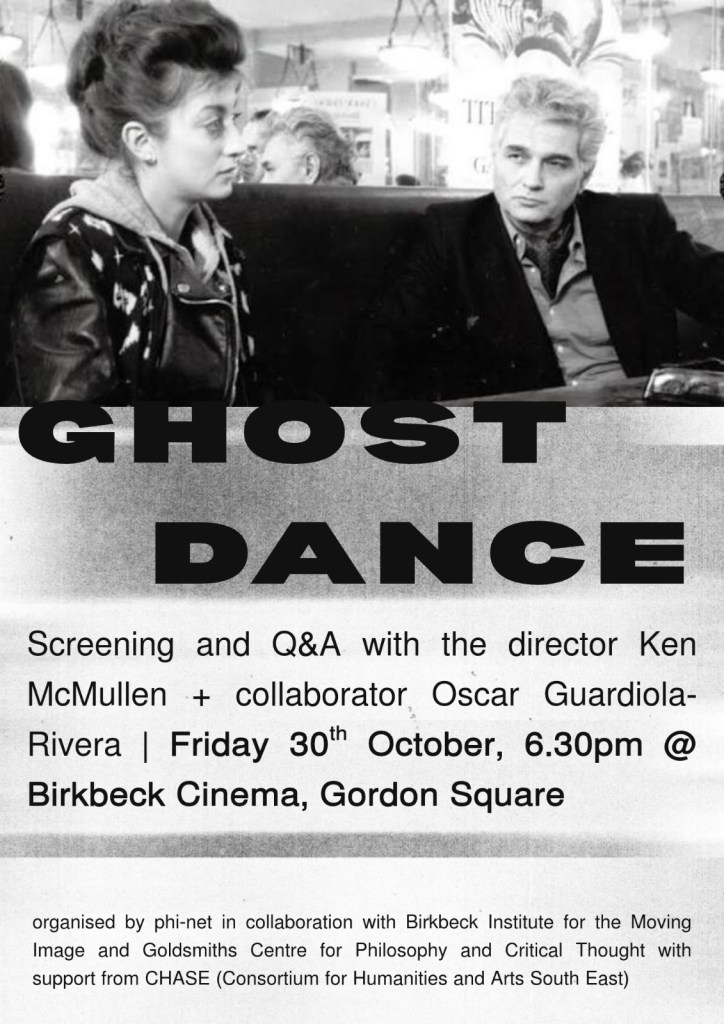
Ghost Dance (1983) Screening and Q&A with the director Ken McMullen and collaborator Oscar Guardiola-Rivera Birkbeck Cinema – 30th October 2026, 6.30pm In association with Birkbeck Institute for the Moving Image (BIMI)
Ghosts are ubiquitous, their influence inevitable. Far from catalysing a move beyond the age of ghosts, technological advancements are bringing them out; the supernatural finds its home in myth and radio waves equally. While tech enables ghosts’ renewed visibility, our histories affirm their ever-presence. In response to social, political and psychic fragmentation, we seek to incorporate them, to internalise them and allow their unconscious to speak through our bodies. Fundamentally intertwined with the past and memory, they do not appear, they only return.
Ken McMullen’s Ghost Dance (1983) explores the ghost as the passing between boundaries, blurring the lines of history and memory, consciousness and corporeality, the primordial and the advanced. It follows two women adrift in Paris and London, dual sides of a persona that collapse into one through their interactions with one another, as they seek to find the ghosts present in the remnants of history, Marx and the Paris Commune; anthropologies of early human psychology; the shift away from tangibility through media and cinema; and the “ghost in the machine” that speaks through the answerphone. The narrative flows from Pascale’s discussions with Jacques Derrida on what it means to be haunted, a precursory view on ideas he developed in Specters of Marx (1993) a decade later, to a non-linear experimentation with image and sound, evoking the confrontation with dualism, materialism and form, enabled by the ghost’s passing into the present from a past that never was.
This screening will conclude with a Q&A with the director Ken McMullen and collaborator Oscar Guardiola-Rivera on the enduring influence of the ghost in contemporary memory, recent technological changes and the ghost’s lingering presence within those, and the notion of the ghost as the disruptor of narrative and linearity.
Ken McMullen is a film director, artist, and Professor of Film at Kingston University London. He has produced and directed more than 50 motion picture works, including major international feature films such as Zina (1985), 1871 (1987) and Hamlet Within (2022). Oscar Guardiola-Rivera is a writer, philosopher, cultural critic, and Professor of Human Rights and Political Philosophy at Birkbeck Law School. He is the author of the critically acclaimed What If Latin America Ruled the World? (Bloomsbury, 2010) and Story of a Death Foretold (Bloomsbury, 2013).
We are pleased to announce the establishment of phi-net, an early career network for philosophy and critical theory funded by CHASE-AHRC and co-hosted by CPCT and the Birkbeck Institute for the Moving Image (BIMI).
As disciplines whose sources and references point to contributions to wider intellectual histories, philosophy and critical theory continue to influence and reflect interdisciplinarity in fields across the arts and the humanities. The CHASE Early Career Network for Philosophy and Critical Theory (phi-net) provides a forum for engaging with and preserving the spirit of this collective exchange with a view to adapting and incorporating perspectives from its guests and participants and to supporting ongoing interdisciplinary research in doctoral and early-career researcher communities.
Provocation for 2026-27: AgainstFrictionlessness
phi-net’s programme for AY 2026-27 considers friction and frictionlessness through three lenses: ecology, capital, and poetics. Taking up objects, super-objects, flesh, spectres, parasites, diamonds, shipping containers, seams, data, rhetoric, ground, and the other, we ask: how can we grasp friction as an affective, aesthetic, or ontological category? And how has its classification evolved up to our historical-critical present? How does philosophy and critical theory account for desires for and aversions to friction? How does friction(lessness) figure in our political ideals and alternatives, in our hopes and fears? Collaborators on our programme so far include Prof. Ken McMullen (Kingston), Prof. Oscar Guardiola-Rivera (Birkbeck) and Prof. Esther Leslie (Birkbeck), with more to be announced soon.
phi-net’s programme provides an opportunity for training and development for all CHASE (Consortium for the Humanities and the Arts South-east England) researchers seeking to adopt topics and methods in philosophy and critical theory into their research, including researcher-led workshops, film screenings, and an annual postgraduate conference. Our programme is organised in collaboration with the Centre for Philosophy and Critical Thought (CPCT) at Goldsmiths, University of London and the Birkbeck Institute for the Moving Image (BIMI). We are supported by the CHASE doctoral training partnership.
phi-net is co-coordinated by Anna Titov (University of East Anglia, Philosophy), Grace Marshall (Birkbeck, History) and Jack Morson (Goldsmiths, Literary and Critical Theory).
To join our mailing list, or to express interest in contributing to the Network’s activities, please contact: chasephinet@gmail.com
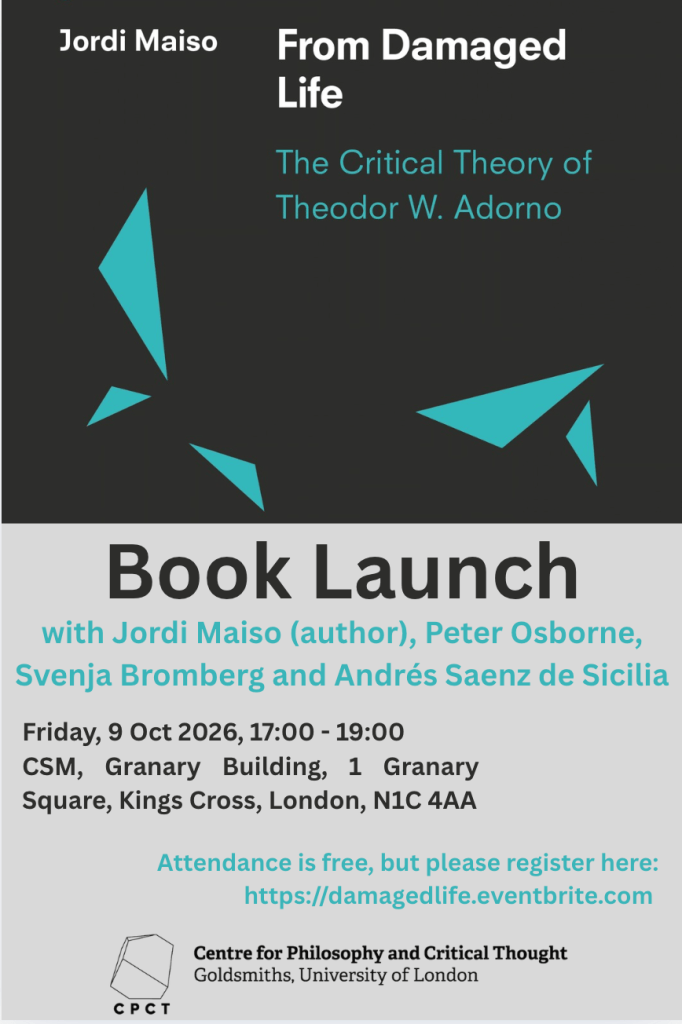
Please join us for the launch of Jordi Maiso’s book ‘From Damaged Life: The Critical Theory of Theodor W. Adorno’ with Peter Osborne (CRMEP), Svenja Bromberg (Goldsmiths) and Andrés Saenz de Sicilia (Northeastern). It is organised by the Centre for Philosophy and Critical Theory (CPCT) at Goldsmiths, University of London.
Friday, 9 Oct 2026, 17:00 – 19:00
Central Saint Martins, Granary Building
1 Granary Square, Kings Cross, London, N1C 4AA
Room: D115
*NB – this event will take place at Central Saint Martins Granary Square building due to ongoing industrial action at Goldsmiths. Room information will be added shortly. Registration is essential*
‘From Damaged Life: The Critical Theory of Theodor W. Adorno’ is a timely intervention in contemporary debates on critical theory, the critique of capitalism, authoritarianism, and social regression. Moving beyond interpretations that confine Adorno primarily to aesthetics or negative dialectics, the book reconstructs his thought as a historically grounded critical theory of advanced capitalism, rooted in the catastrophic experiences of fascism, Auschwitz, and the consolidation of new forms of domination.
At the centre of Maiso’s interpretation lies Adorno’s concept of “damaged life,” understood as a framework for analysing the social production of suffering, the anthropological transformation of subjectivity, and the persistence of unfreedom under conditions of total socialization. Rearticulating Adorno in close relation to Marx’s critique of political economy, the book foregrounds his relevance for analysing fetishism, culture industry, ideological transformation, authoritarian potential, and the blocked horizons of emancipation in contemporary capitalist societies.
About the author:
Jordi Maiso is Associate Professor at the Complutense University of Madrid. His work focuses on Frankfurt School Critical Theory and its contemporary relevance, particularly the thought of Theodor W. Adorno. Bringing together Critical Theory and the critique of political economy, his research examines the social constitution of subjectivity and the transformations of social experience under advanced capitalism. He has published extensively on Critical Theory, aesthetics, social philosophy, the mutations of the culture industry, and authoritarianism. Maiso is Editor-in-Chief of Constelaciones. Revista de Teoría Crítica, Chair of the Spanish Society for Critical Theory Studies (SETC), and a member of the Editorial Board of the Journal of Adorno Studies.
The recordings for the British Academy symposium “Chinese Modernity in German Jewish Thought” (May 3, 2024) are now available on our YouTube channel here:
A British Academy symposium on the circulation of images of China in German Jewish letters of the early 20th century.
Venue: Stewart House 2/3, Senate House London Date: May 3, 2024 from 3:30-6:40 pm
Too often, critical discussions around antisemitism and anticolonialism seem completely at odds with one another. This workshop asks whether a consideration of the images of ‘China’ that circulated amongst German Jewish thinkers might help complicate or resolve this impasse by suggesting a different orientation to both the Christian-colonial project and the racialisation of work. How were these images of China used to imagine different ways of organising social, political, and economic life in a context of intensifying antisemitism, capital-critical sentiment, and ambivalence towards the European legacies of imperialism and colonialism in the ‘Orient’?
Free and open to the public, though registration is required.
3:30-3:45 pm Welcome and Introduction: Daoism, Capitalism, and German Jewish Thought Dr. Julia Ng (Goldsmiths)
Ideas circulated from a modernizing China in the 1910s and 1920s amongst major German Jewish thinkers as they grappled with their own modernity and contemporaneity. How useful or limited is “Orientalism” as an interpretive framework for grasping the career of these ideas, and might competing “Orientalisms”—that of Buber, for instance, referring to quite a different “Orient” altogether, or Marx, which points towards China as a historical entity—complicate the picture in illuminating ways?
3:45-4:25 pm Rosenzweig, Hegel, and ‘Oriental Messianism’ Dr. Daniel Weiss (Cambridge)
Hegel famously portrayed Jewish messianism as characterized by an ‘Oriental’ orientation that fails to produce effective agency in history. By contrast, Franz Rosenzweig reaffirmed key elements of Jewish messianism criticized by Hegel, including elements that could outwardly appear linked to passivity or non-action. However, Rosenzweig treats the Jewish orientation not as weak or ineffective, but as a committed stance that will lead the world to messianic redemption and to the overthrow of ‘illusory’ power-claims. We will see that, although Rosenzweig himself criticizes various aspects of Daoism, his account of Judaism shares elements in common with various nineteenth and early-twentieth German portrayals of Daoism. As such, we can understand him as calling into question dominant Christian portrayals of both Judaism and Daoism, and seeking to reclaim the supposedly ‘Oriental’ characteristics criticized by others. Rosenzweig’s development of a modern, challenging account of Judaism can thus be understood parallelling the ways in which European writers contended with ways in which China’s modernizing developments likewise presented a challenge to dominant Western preconceptions.
4:30-5:10 pm Ex Oriente Lux: Martin Buber’s Dao-Hasidic Mysticism of the Worldly Professor Agata Bielik-Robson (Nottingham)
Martin Buber’s interest in Chinese Daoism begins very early in his intellectual career and coincides – not at all accidentally – with his interest in Hasidism: both are treated by him as the cases of “spiritually rich” Orientalism which he opposes to the disenchanted West. Between 1906-1909, he writes The Tales of Rabbi Nachman, The Legend of the Baal Shem, and the Hasidism inspired Ecstatic Confessions, but he also, under the influence of Wang Qingdao, the visiting lecturer at the Berlin Seminar for Oriental Languages, publishes Talks and Parables of Zhuangzi (1910) and Chinese Ghost and Love Stories (1911) which offer a partial translation of Liaozhai Zhiyu, an early eighteenth century compilation of folktales done by Pu Songling. From this time on, Daoism – interpreted in close comparative relation to Hasidism – will never leave Buber, although he will modify his attitude towards its main concept, the Dao, over time. While in Buber’s early phase, Dao is most of all a notion of a “mystical unity” connecting the sage with the essential oneness of the world, in the later dialogic phase (beginning with his 1923 I and Thou), Dao emerges rather as the Path: the dynamic way into and through the world appreciated in its concreteness and multiplicity. Thus, in his Ascona lecture on Daoism, delivered in 1924, Buber repudiates his earlier “escapist” mysticism of the One, which now transforms into a “intraworldly” mysticism of the Two, strongly focused on the ultimate realness of the particulars, never again to be considered as an ontological “illusion.” Just as before Dao represented for him a transcendental oneness underlying all, closely corresponding with the Hasidic understanding of God as the ehad, the One pervading all creation – now it represents for him a Path into the World, where creation is to be conceived as “individuation of all things,” this time corresponding with the other meaning of ehad: not simply one, but strictly singular and unique. In my paper, I will present this trajectory in close parallel with Buber’s changing views on Hassidism, but will also juxtapose Buber’s use of the Chinese motifs with Martin Heidegger’s turn towards Daoism as instrumental for his post-war Kehre which redefined the relation between Being and beings in favour of the latter. In both thinkers, the Dao conceived as a Path into (and of) the World plays an important role in their turn towards the worldly.
5:15-5:55 pm Kafka’s Dao and the Reverse of Possession Dr. Julia Ng (Goldsmiths)
Reading, inter alia, Kafka’s Zürauer Aphorisms and the fragment “Workforce without Possession” alongside works of Daoism and on contemporaneous China that were consulted by Kafka, this paper explores how Kafka’s treatment of figures of ancestrality, nonhuman animation, and reversion opens up questions of ‘race,’ community, and political-economic organisation.
6:00-6:30 pm Roundtable
6:30-6:40 pm Q&A
About the speakers
Agata Bielik-Robson is Professor of Jewish Studies in the Department of Theology and Religious Studies at the University of Nottingham. She has published widely on all areas of Jewish philosophy with special emphasis paid on modern Jewish thought, from Spinoza to Derrida. She is the author of Another Finitude: Messianic Vitalism and Philosophy (Bloomsbury 2019), Jewish Cryptotheologies of Late Modernity: Philosophical Marranos (Routledge 2014), and co-editor of Judaism in Contemporary Thought: Traces and Influences (Routledge 2014) and Tsimtsum and Modernity (2021).
Daniel H. Weiss is is Polonsky-Coexist Senior Lecturer in Jewish Studies, Faculty of Divinity, University of Cambridge. He is author of Paradox and the Prophets: Hermann Cohen and the Indirect Communication of Religion (2012) and Modern Jewish Philosophy and the Politics of Divine Violence (2023), among other publications, and co-editor of multiple books, including Scripture and Violence (2020) and Tsimtsum and Modernity (2021). Actively involved in the Cambridge Interfaith Programme, he is a recent recipient of a Humboldt Research Fellowship for Experienced Researchers.
Julia Ng is Reader in Critical Theory and founding Co-Director of the Centre for Philosophy and Critical Thought at Goldsmiths, University of London. She specialises in philosophical approaches to literature, modern German-Jewish thought, early 20th-century Germanophone literatures in their transnational contexts, and history of critical theory. Recent publications include her translation and critical edition of Walter Benjamin’s “Toward the Critique of Violence” (with P. Fenves; Stanford UP, 2021) and articles in Theory Culture & Society, Paragraph, CR: New Centennial Review, Modern Language Notes, diacritics, and Critical Times. Funded by a British Academy Mid-Career Fellowship, she is currently completing a book on Daoism and Capitalism, which has also received support from the Leverhulme Trust, the Center for Jewish History (NYC), and the British Society for the History of Philosophy.
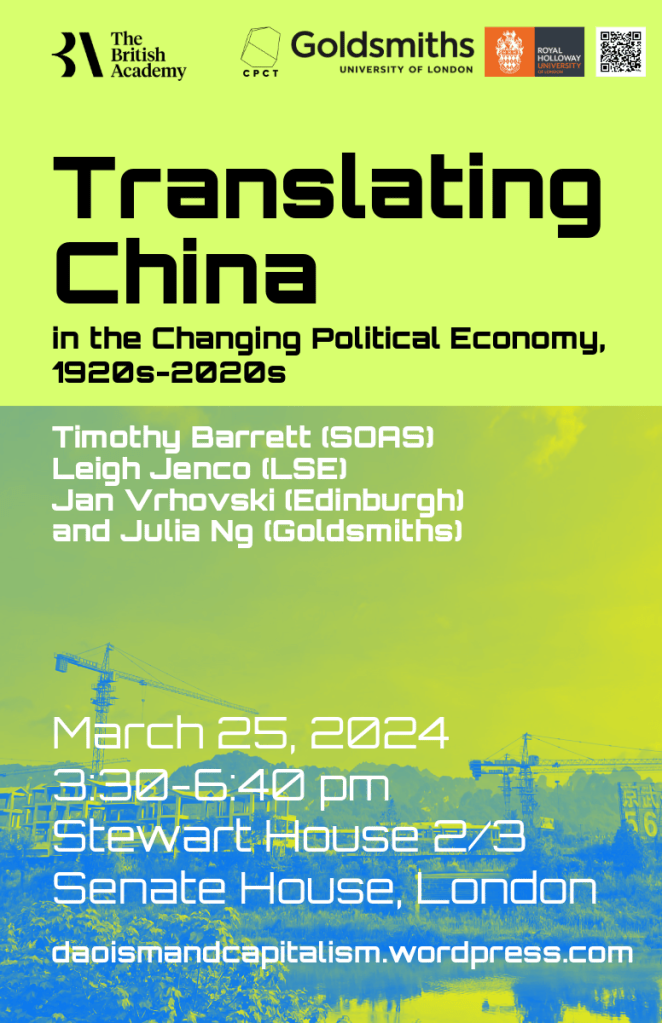
Translating China in the Changing Political Economy, 1920s-2020s
A British Academy symposium on 100 years of China’s place in Europe’s linguistic, political, and philosophical formation.
Venue: Stewart House 2/3, Senate House London Date: March 25, 2024 from 3:30-6:40 pm
We often hear about China in the news in connection to changes in the global political economy—concerning, for instance, the new infrastructural world order (Belt and Road Initiative), supply chains and their dependencies, and rebalances in the relation of law and traditional culture (tianxia or ‘Chinese’ universalism; ‘civilisational’ harmony). Yet much less consideration has been given to the direct impact that cultural translations broadly conceived and moving in multiple directions have on the fashioning of ‘China’ as a new global political and economic actor. Drawing examples from the British-German-Chinese 1920s for the 2020s, this public symposium and roundtable will explore the links between: (i) the teaching of modern non-European languages and the setting up of institutions to facilitate this teaching (e.g., SOAS) in support of British and German trade interests abroad; (ii) the specific role that philosophical and literary translations play in constructing the image of China as a political and economic counterpart during times of shifting geopolitical relations; (iii) the contribution of public intellectuals such as Bertrand Russell and Richard Wilhelm; and (iv) reinventions of Confucian and Daoist traditions by public intellectuals seeking to legitimise or criticise policy in China. How might a consideration of these moments in the translative process help us more deeply understand and critically analyze the pictures of political economy given to us in times of seemingly unprecedented change?
Free and open to the public, though registration is required. Registered attendees will receive (via the registration confirmation email) a booklet containing a collection of ‘artefacts’ selected by the speakers for consideration ahead of the event as well as an opportunity to submit a question for possible inclusion in the roundtable discussion.
3:30-3:45 pm Welcome and Introduction: Translation as Political-Economic Communication? Dr. Julia Ng (Goldsmiths)
How might translation, broadly conceived, serve as a mode of political-economic communication? In these opening remarks, I will outline a constellation of texts, institutions and ideas associated in particular with the German Sinologist and translator Richard Wilhelm, a constellation that intersects with British and Chinese counterparts to suggest an altogether distinct and crucial way of picturing multilinear political economic transformations.
3:45-4:25 pm Laozi: The Story So Far Professor Timothy Barrett (SOAS)
Daoist thought in Europe in the interwar period looked back on a history of translation stretching back at least a century. In 1934 Arthur Waley prefaced his own attempt at situating Laozi in his historical context by contrast with all earlier translators with an assertion that his predecessors had been ‘scriptural’, treating the Chinese text of the Daode jing as an authoritative statement of Daoism to be interpreted as it was, not viewed as a product of a certain time and place. While this may be so, the assumptions behind these earlier translations had their own times and places that are in themselves worth recapitulating. Perhaps the diversity of approaches that a quick background survey reveals may help in situating 1920s and later European responses.
4:30-5:10 pm China’s Russell Paradox: On the Historical Significance of ‘Misunderstanding’ between Russell and China Dr. Jan Vrhovski (Edinburgh)
Between 1920 and 1921, the British philosopher and logician Bertrand Russell embarked on a significant journey to China, leaving a significant mark on the country’s intellectual landscape. Russell’s visit and lectures in China catalysed various developments within Chinese academia, intellectual circles, and socio-political discourse. However, even after more than a century, the precise impact of Russell’s philosophy on China remains somewhat enigmatic. Historiographical gaps and ideological paradigms obscure a comprehensive understanding of this encounter, exacerbated by fundamental disparities between Chinese interpretations of Russell’s ideas and his perception of China. In my presentation, I aim to shed light on the historical lineage and intellectual significance of the enduring “misunderstanding” of Russell’s philosophy in early Republican China. This misunderstanding critically shaped the boundaries of Chinese intellectual discourse on science, materialism, and modernity. Conversely, I will explore Russell’s portrayal of China in the years following his return to Europe, during the period of his life which Ray Monk (2000) somewhat provocatively titled “the ghost of madness.” Of particular interest is Russell’s anthology The Problem of China, which offers insight into his perceptions of the country and its intellectual past, present, and future. Special attention will be given to the two decades following Russell’s visit to China, providing a nuanced exploration of the complexities inherent in this paradoxical relationship.
5:15-5:55 pm Global China, or Chinese Global Orders? 1920s-2020s Professor Leigh Jenco (LSE)
In this paper, I will examine the idea of canons, how they are formed, and what political work they do. I will focus on the so-called “Great Books” curricula that were developing starting in the 1920s as a way to discuss what “Great Books” should be and the difficulties of incorporating the Chinese classics into this curriculum, with a comparative look at the canon-formation around the Five Classics (especially the Shangshu and Mandate of Heaven). I will then connect this with Xi Jinping’s “Global Civilization Initiative” to explore its relationship to how we think about cultural appropriation, now and in the past.
6:00-6:30 pm Roundtable
6:30-6:40 pm Q&A
About the speakers
Timothy Barrett is professor emeritus of East Asian History at SOAS, University of London, where he taught from 1986 to 2013, primarily covering Chinese religious history, on which he has published several books, besides some further publications on the reception of the Chinese tradition in Europe. A graduate of Cambridge with a doctorate in Religious Studies from Yale, he had earlier taught in Chinese Studies at Cambridge for over a decade.
Jan Vrhovski is a research fellow at the department of Science, Technology, and Innovation Studies, School of Social and Political Science at the University of Edinburgh. His research interests include intellectual history of modern China, history of analytic philosophy, mathematical logic, history and philosophy of science in China, and international history of mathematics. His current book projects include the Science and Metaphysics Debate (Brill, 2024) and Palgrave Handbook of the History of Analytic Philosophy in China (2025-).
Leigh Jenco (PhD, Chicago) is Professor of Political Theory at the London School of Economics, specializing in Chinese and comparative political theory. She has served as editor of the American Political Science Review (2016-2020) and currently stands as member of the APSA Council. She has received numerous major grants, most recently the Chinese Global Orders global convening programme funded by the British Academy. Her publications include Making the Political: Founding and Action in the Political Theory of Zhang Shizhao (Cambridge UP, 2010) and Changing Referents: Learning Across Space and Time in China and the West (Oxford UP, 2015) as well as articles in American Political Science Review, Political Theory, Modern China, and T’oung Pao.
Julia Ng is Reader in Critical Theory and founding Co-Director of the Centre for Philosophy and Critical Thought at Goldsmiths, University of London. She specialises in philosophical approaches to literature, modern German-Jewish thought, early 20th-century Germanophone literatures in their transnational contexts, and history of critical theory. Recent publications include her translation and critical edition of Walter Benjamin’s “Toward the Critique of Violence” (with P. Fenves; Stanford UP, 2021) and articles in Theory Culture & Society, Paragraph, CR: New Centennial Review, Modern Language Notes, diacritics, and Critical Times. Funded by a British Academy Mid-Career Fellowship, she is currently completing a book on Daoism and Capitalism, which has also received support from the Leverhulme Trust, the Center for Jewish History (NYC), and the British Society for the History of Philosophy.