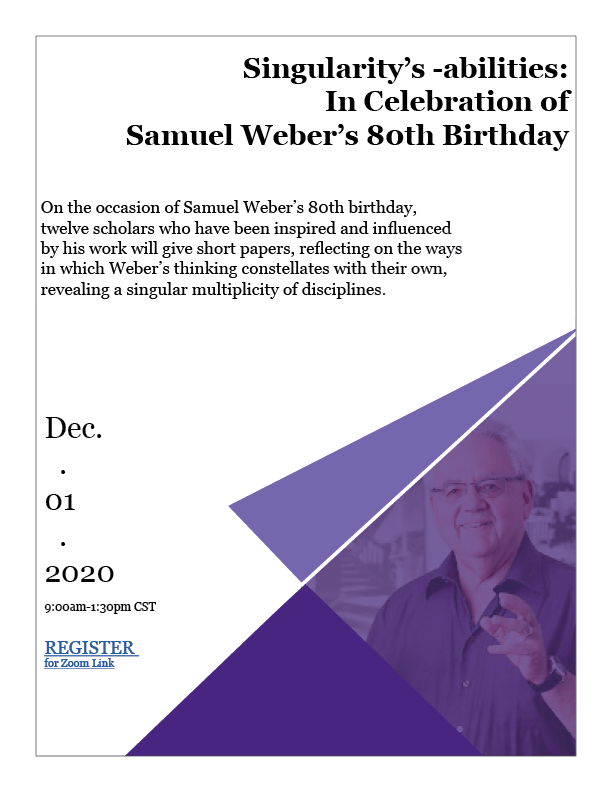
Please join us for Singularity’s -abilities: In Celebration of Samuel Weber’s 80th Birthday this Tuesday December 1st at 9am CST. Speakers, agenda, and registration info below.
Presentations will be in English and German. All times are local to Chicago, USA.
Speakers:
9:00am – 10:00am — Singularity’s Inscriptions
Isabelle Alfandary – Learning to Read with Sam Weber Julia Ng – Whistling Lillabullero Hans-Jörg Rheinberger – Schreiben und Experimentieren Bernard Geoghegan – Theatricality and AI (Moderator: James Martel)
10:15am – 11:15am — Singularity’s Philosophy
Peter Fenves – Singularity, Again Astrid Deuber-Mankowsky – The Ever New Angel Diego Rosello – The Task of Thanking: Thanking as Thinking with Samuel Weber Laura Chiesa – tba (Moderators: James Martel, Julia Ng)
11:45am-12:45pm — Singularity’s Politics
Marian Hobson – How can classification be violent? Weber and Derrida Javier Burdman – Sam Weber’s Response to Lyotard’s Just Gaming and the Elusive Link between Deconstruction and Politics James Martel – Singularity and the Commandment: another form of law Héctor Castaño – Singularity in Translation and the Economy of Cultural Difference (Moderator: Julia Ng)
1:00pm – 1:30pm Response by Samuel Weber
Organized by Jörg Kreienbrock, James Martel, Julia Ng, and generously co-sponsored by Northwestern University, San Francisco State University, and the Centre for Philosophy and Critical Thought at Goldsmiths, University of London
NB: DUE TO UNFORESEEN CIRCUMSTANCES, THIS TALK HAS BEEN CANCELLED
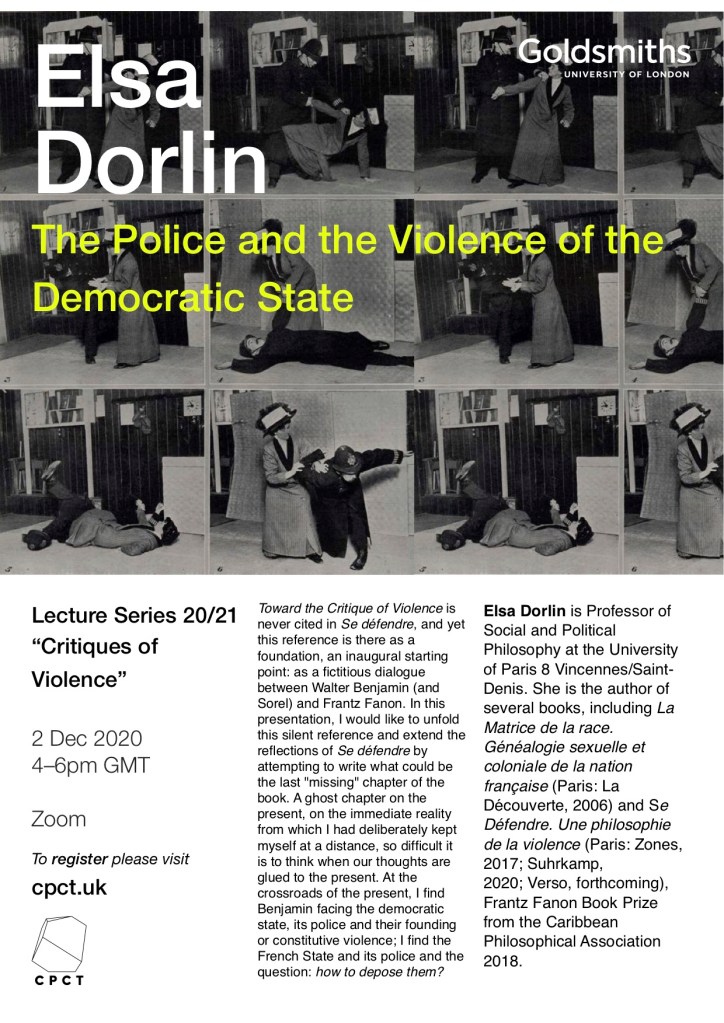
The Centre for Philosophy and Critical Thought at Goldsmiths, University of London cordially invites you to its Lecture Series 20/21 on “Critiques of Violence”:
The Police and the Violence of the Democratic State
In my book Se défendre. Une philosophie de la violence (Defending Oneself: A Philosophy of Violence), a major reference is missing: Walter Benjamin’s text, Toward the Critique of Violence (1921). Not that the text was not relevant, nor that Benjamin’s work and the thought were not familiar to me. It was by following the theses On the Concept of History that I initiated my genealogical approach to the notion of constellated time; but it was by tacitly shadowing Benjamin, grasping in the breaches of history for what belongs to an ontology of divine violence – of which revolutionary violence is like the replica and imprint – that I made explicit my intention to turn to muscle rather than law in order to think self-defense, because “there is something rotten in the law”.
Toward the Critique of Violence is never cited in Se défendre, and yet this reference is there as a foundation, an inaugural starting point: all of its tragic protagonists – the state, natural law, positive law, the working class, the concept of property, the critique of the contract, life and death, the revolution, but also the mystical part of the carnal gesture that saves – are reanimated in the book I wanted to write. As a hidden reference, it is the fictitious dialogue between Walter Benjamin (but also Sorel) and Frantz Fanon that is deployed there. The critique of state violence, of the state itself – of right, of law, of the legal contract – and of their attendant mythologies is at the heart of my reflection.
In this presentation, I would like to unfold this silent reference and extend the reflections of Se défendre by attempting to write what could be the last “missing” chapter of the book. A ghost chapter on the present, on the immediate reality from which I had deliberately kept myself at a distance, so difficult it is to think when our thoughts are glued to the present. At the crossroads of the present, I find Benjamin facing the democratic state, its police and their founding or constitutive violence; I find the French State and its police and the question: how to depose them?
About the speaker:
Elsa Dorlin is Professor of Social and Political Philosophy at the University of Paris 8 Vincennes/Saint-Denis. She is the author of several books, including La Matrice de la race. Généalogie sexuelle et coloniale de la nation française (Paris: La Découverte, 2006) and Se Défendre. Une philosophie de la violence (Paris: Zones, 2017; Suhrkamp, 2020; Verso, forthcoming), Frantz Fanon Book Prize from the Caribbean Philosophical Association 2018.
Paul Klee (From the Song of Songs) Version II ((Aus dem hohen Lied) (II. Fassung))
CPCT Research Seminar 2020-21: Critiques of Violence
We’re pleased to announce the programme for this year’s Research Seminar, which is convened by Andrea Mura and Julia Ng. A detailed session plan including further readings and links to PDFs is available at https://cpct.uk/2020-21/.
Description: 2021 is the 100th anniversary of the publication of two texts that were seminal for the development of the modern critique of the state: Walter Benjamin’s “Toward the Critique of Violence” and Sigmund Freud’s Mass Psychology and the Analysis of the Ego. The years around 1921 were not only the immediate aftermath of a number of revolutionary events in the environs of “Europe” (Russia, Germany), however; they were also coincident with the abolition of the world’s last widely recognized caliphate, the reshaping of the Arab Middle East, and the creation of the first Islamic mass movement of the twentieth-century: the Muslim Brotherhood. Taking this triple anniversary as its point of departure, this seminar will investigate what it means to “critique violence” and what being a “state” stands for during the long decade around and in the immediate aftermath of the First World War, both for contemporaries of the time and for us today who are the heirs to some of the most influential writings in political and legal thought resulting from this period. Alternating between close systematic readings of the texts in question and a genealogical approach to their historical and intertextual contexts, the seminar will seek to return the conceptual and practical stakes of a critique of violence to their full complexity, reconsidering them as articulations of implicit and explicit debates on anti-imperialism, nationalisms old and new, the value of constitutionalism, and the ambiguous role of religion in the modern world.
** N.B.: IN LIGHT OF THE COVID-19 SITUATION THE CONFERENCE WILL BE POSTPONED TO AY2020-21, LIKELY EARLY DECEMBER 2020. DETAILS WILL BE ANNOUNCED WHEN FINAL DATES HAVE BEEN CONFIRMED. PLEASE CONTINUE TO SEND US YOUR ABSTRACTS; THE DEADLINE FOR SUBMISSIONS HAS NOW BEEN EXTENDED TO 1 SEPTEMBER 2020.**
3-4 June 2020
Centre for Philosophy and Critical Thought
Goldsmiths, University of London
Deadline for submissions: 1 April 2020**New deadline: 1 September 2020
CONFIRMED SPEAKERS
Tina Chanter (University of Newcastle)
Rebecca Comay (University of Toronto)
Jeremy Matthew Glick (Hunter College)
Bonnie Honig (Brown University)
Miriam Leonard (University College London)
Manfred Posani Löwenstein (Istituto Italiano per gli Studi Storici)
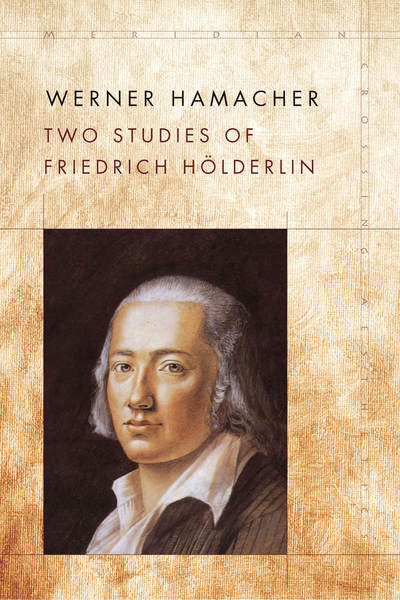
CPCT is pleased to share with you the news of a publication that may be of interest to you: Werner Hamacher’s Two Studies of Friedrich Hölderlin, edited by Peter Fenves and Julia Ng, and translated by Julia Ng and Anthony Curtis Adler, has just appeared with Stanford UP. Werner Hamacher was an external affiliate of CPCT. In October 2015, he delivered a lecture on “Now, History” at Goldsmiths in inauguration of the Walter Benjamin London Research Network.
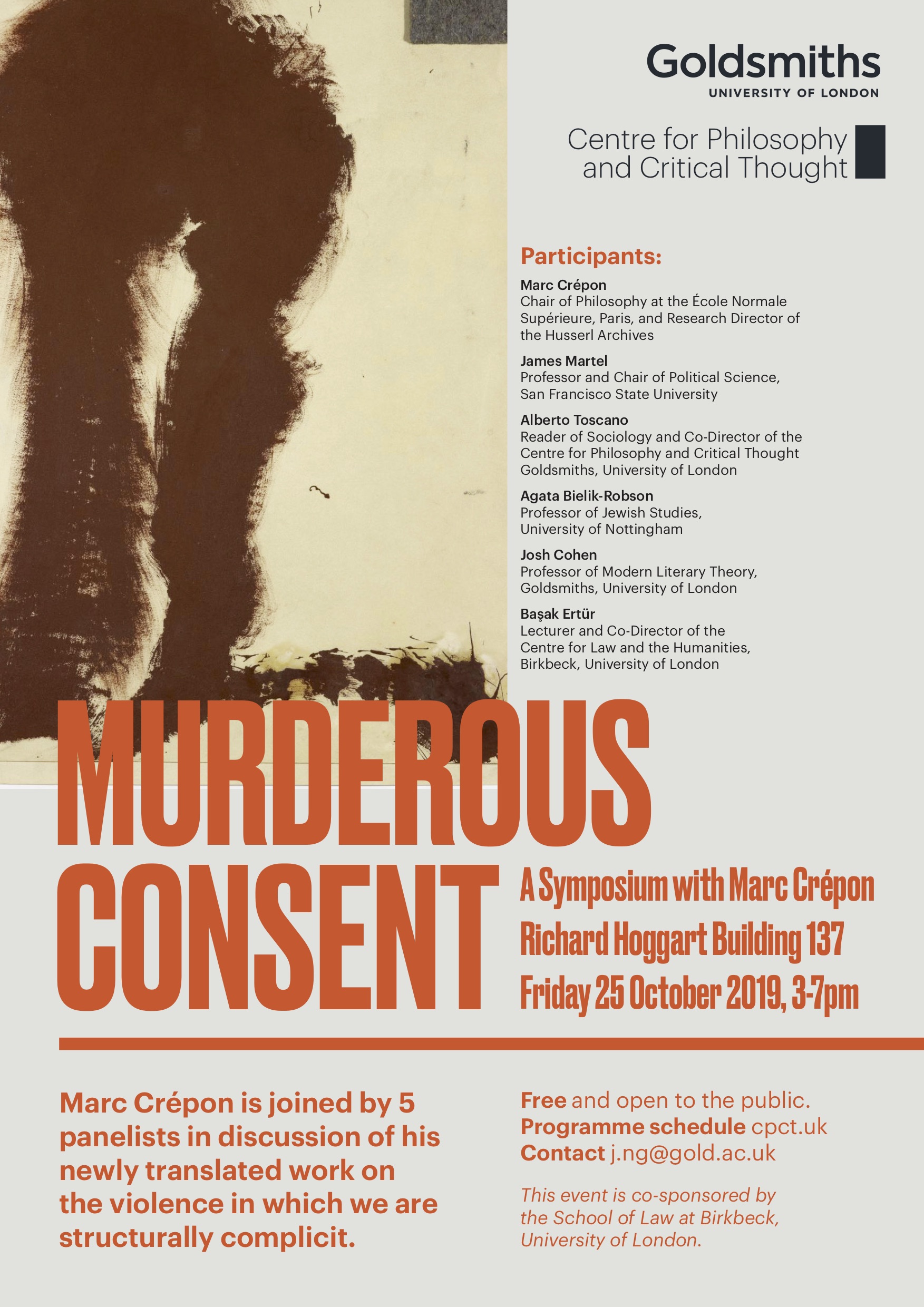
Marc Crépon (École Normale Supérieure, Paris) is joined by 5 panelists in discussion of his newly translated work on the violence in which we are structurally complicit.
[please note the venue change from a previous announcement]
PRIMITIVISM NOW is a one-day workshop featuring speakers from a range of disciplines, from literary theory to philosophy, politics to art history. They will consider whether it is possible to think anew about primitivism, a field whose theoretical underpinnings have largely lain dormant since the poststructural and postcolonial critiques of primitivism in the 1980s and 90s.Continue reading →
On May 10-11th 2019, PhD Candidates Sofia Cumming (University of East Anglia, 2017 Cohort) and Federica Murè (Goldsmiths, 2018 Cohort) put together a programme of events centred on the work of Walter Benjamin (1892–1940). Continue reading →