

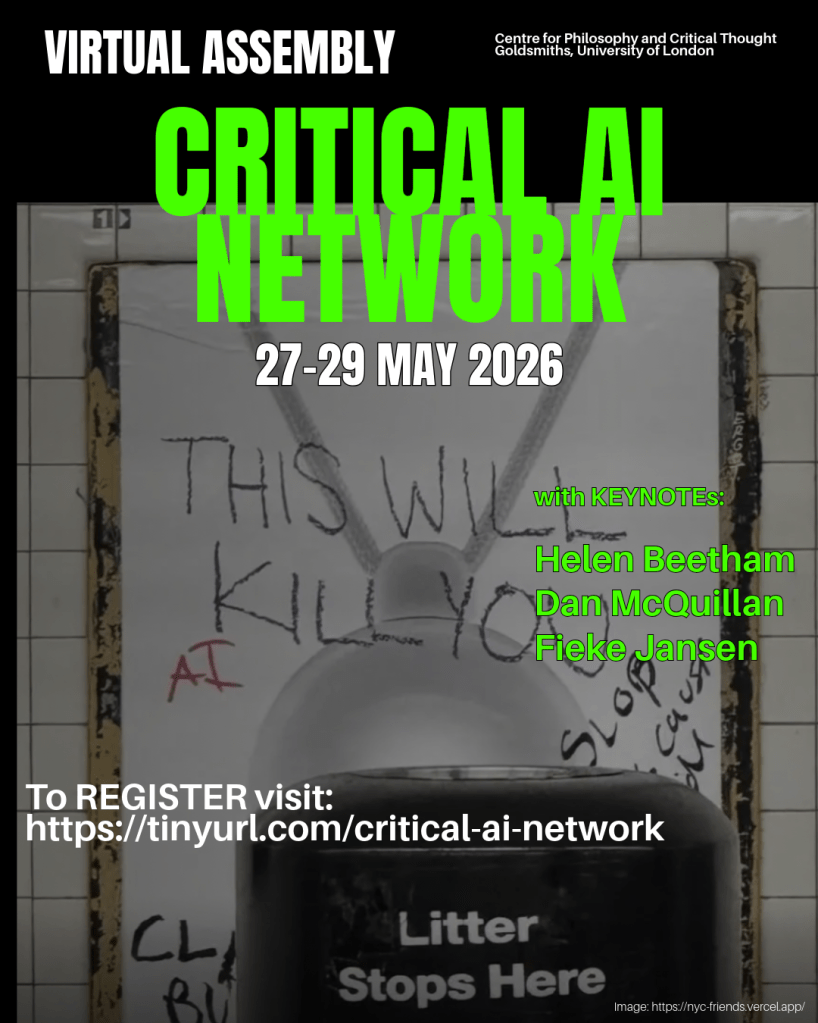
We are pleased to announce the programme for CAIN-CPCT’s inaugural Virtual Assembly on the question of “How do we break something that is already broken?” The virtual assembly will take place online on 27, 28 and 29 May 2026 from 3:30-8:00pm (UK).
If you would like to attend and have not yet registered, please consider doing so by filling this form. Zoom registration links and pre-circulated papers will be sent to registered attendees.
For a continually updated programme with more information on the speakers and their presentations, please visit this link.
A. AI in Education, AI as Education — Wednesday, 27 May 2026
How has AI been insinuated into education, and in what ways has AI been taken for education itself, overtaking, eliminating, or usurping the civic and/or intellectual purposes of formal and informal learning? What are some of your case studies of local policy and examples of lived experience we might learn from? How might we formulate the most effective counterarguments – and organizing – against the integration of AI into our curricula and delivery that address local policy and financial conditions?
3:30-3:50 pm
Welcome and Introduction
Julia Ng and Dan McQuillan (CPCT / Goldsmiths)
3:50-4:00 pm
Some Words on the State of Affairs
Jenny Doussan (CPCT / Goldsmiths)
4:00-4:50 pm
Panel 1
Rachel McCarthy (Goldsmiths)
Martha Kenney and Martha Lincoln (San Francisco State University)
Sarah Fitterer, Dominik Gangl and Jannes Ulbrich (Technical University Berlin and the Berlin University of the Arts (UdK)
5:00-5:50 pm
Panel 2
Sanjay Sharma (Warwick)
Zuleika Suliman (University of South Africa)
Jeremy Auerbach (University College Dublin)
6:00-6:50 pm
Panel 3
Gavin Duffy (Goldsmiths)
Anna Traianou (Goldsmiths)
Veli Hillman (Goldsmiths)
7:00-7:20 pm
Keynote A
Helen Beetham
7:20-8:00 pm
Q&A and Discussion
B. AI in and as Law, Governance, and Politics — Thursday, 28 May 2026
As AI creeps into normalised deployment in legal practice, policy articulation, and decision making in the guise of efficiency and accuracy, questions have yet to be posed about the impact on labour conditions and labour law, the status of evidence, the right to refuse, and the rights of those affected by AI-facilitated decisions, to name just a few. Moreover, the extent to which AI is being used to manipulate democratic elections via data harvesting, psychographic profiling, and micro-targeting, amongst other strategies, has raised seemingly unanswerable questions about the future of democracy. Indeed, is politics even possible in the age of AI? How might we set about articulating and answering some of these questions? How might we question the role of governance, whether of the state or of the institution, in mediating and facilitating the introduction of AI into all facets of our lives?
4:00-4:50 pm
Panel 1
Jake Goldenfein and Fan Yang (Melbourne Law School)
Dimitra Kotouza (Labour Research Department)
Neal Thomas (Wilfrid Laurier University)
5:00-5:50 pm
Panel 2
Brett Zehner (Exeter)
Freya Van den Boom (Antwerp)
Eric Brown (Corvinus University of Budapest)
6:00-6:50 pm
Panel 3
Jeannette Eicks (The Colleges of Law)
Conor Heaney and Connal Parsley (Kent Law School)
Ana Fernandez-Aballi (Groningen)
7:00-7:20 pm
Keynote B
Dan McQuillan (Goldsmiths)
7:20-8:00 pm
Q&A and Discussion
C. The Ecology of AI, AI and the Environment — Friday, 29 May 2026
Guided by the premise that under the hood, AI is simply the same technology whether it is being introduced into education or other domains of life, we ask how we might articulate and analyze the relations forged by AI between vastly different areas that hitherto appeared to be unconnected. What insights might be gained from situating AI within an ecology? How does AI compete with others in this ecology for natural resources, and what can be done to mitigate, contain, or reverse this impact? If, as we propose, AI should be evaluated not as a tool with a use value but rather as the latest symptom of misused infrastructures, how might we articulate the counterproductivity that AI adoption represents within its ecology for any green policy?
4:00-4:50 pm
Panel 1
Jiayi Young (University of California, Davis)
Mariana Marangoni (University of the Arts London)
Mattia Paginelli (Goldsmiths)
5:00-5:50 pm
Panel 2
Chiara Haefliger (Goldsmiths)
Nicholas Lawrence (Warwick)
Jordan Kinder (New York University)
6:00-6:50 pm
Panel 3
Becky Kazansky (AIDEMOCRACY, Goldsmiths)
Sini Matikainen (London School of Economics)
Hamish van der Ven (University of British Columbia)
7:00-7:20 pm
Keynote C
Fieke Jansen (Amsterdam)
7:20-8:00 pm
Q&A and Discussion
8:00-8:30 pm
General Assembly Meeting — next steps?

