The Centre for Philosophy and Critical Thought, Goldsmiths University of London

Research Centre run jointly between the Departments of Sociology and English and Comparative Literature at Goldsmiths University, London


Leave a comment

New partnership with Shakespeare in Philosophy (ShiP), Symposium on “Shakespeare and the Slovenian School of Philosophy and Psychoanalysis” (14 June 2025)


Dear Friends of CPCT,

We’re pleased to announce a new partnership with Shakespeare in Philosophy (ShiP), a non-profit symposium series exploring the relation between Shakespeare and the philosophical work that has taken inspiration from his oeuvre. Its goal is to create a space for dialogue and discussion involving Shakespeare scholarship, wider philosophical and socio-political issues, and the general public. Events are held in collaboration with Garrick’s Temple to Shakespeare at the Temple built by the pre-eminent actor David Garrick beside the Thames in 1755.

ShiP’s next event is on 14 June 2025 on ‘Shakespeare and the Slovenian School of Philosophy and Psychoanalysis’—for booking, please register here.

Continue reading


Leave a comment

Samir Haddad (Fordham): ‘Derrida on Restructuring the University’ (30 April 2025)

‘Derrida on Restructuring the University’
Samir Haddad (Philosophy, Fordham)

a special session of 
‘On Truth and Lies in the Extramoral University’

CPCT Research Seminar 2024-25

Time: Wednesday, 30 April 2025, 4:00-6:00 pm UK time.
Venue: RHB 138 and online

Zoom registration: https://gold-ac-uk.zoom.us/meeting/register/m-qsXjg-SrG5HmiIdhzcNA 

Readings

René Haby, “Pour une modernisation du système éducatif” (esp. pp.1-10) [PDF]; Jacques Derrida, “Divided Bodies: Responses to La Nouvelle Critique” [PDF]; Jacques Derrida, “The Age of Hegel” [PDF]; Jacques Derrida, Jacques Bouveresse, Catherine Malabou, et al., “Report of the Committee on Philosophy and Epistemology (1990)” [PDF]

About the session

In the 1970s and 1980s, Derrida was heavily involved in debates on the place of philosophy in education in France. In this seminar we will read a selection of texts related to two of Derrida’s interventions in this period, with an eye to how they might speak to challenges we now face, several decades later and in different national contexts. The first intervention was precipitated by proposals made in 1974 by the French Minister of Education, René Haby, who sought to “modernize” the curriculum in the lycée. Among Haby’s proposals were calls for more emphasis on the sciences and social sciences over the humanities, greater interdisciplinarity, and the need to better train future workers in the face of rapidly changing technology and systems of communication. In response, Derrida and others sought to rethink the role that philosophy should play in a student’s education, and made various counter-proposals for reform of their own. The second intervention dates to 1989, when Derrida was asked by Pierre Bourdieu and François Gros, themselves charged by the Minister of Education at that time, to co-chair with Jacques Bouveresse a Committee on Philosophy and Epistemology as a part of a larger project aiming to reform French education as a whole. The resulting report develops further the ideas first raised in the 1970s, and constitutes Derrida’s most detailed vision for transforming the teaching of philosophy in France.

About the session leader

Samir Haddad is Associate Professor of Philosophy at Fordham University. He specializes in 20th century and contemporary continental philosophy, particularly French philosophy and deconstruction, and in the philosophy of education. He is the author of Derrida and the Inheritance of Democracy (Indiana, 2013) and is currently working on two research projects, one focused on Derrida’s work on education, and the other on the roles that translation and multilingualism might play in philosophical pedagogy.  


* * * 
About the seminar

CPCT’s annual research seminar meets on a regular basis and is open to centre members, graduate affiliates, and other interested staff and students at Goldsmiths and beyond. It aims to serve as a forum for philosophical work and critical conversation at Goldsmiths.

Taking its inspiration from the title of the famous essay by Friedrich Nietzsche, our research seminar this year poses the following question: what is the contemporary university for? By definition “extramoral” in the sense that it is premised on the pursuit of knowledge without the interference of power and authority—the classical loci of which were Church and State—the modern university nevertheless exists in a world driven by profit, riddled with war, and beset with an ever-unfolding polycrisis of environmental, racial, economic, technological, and geopolitical dimensions. What, then, is the role of the university vis-à-vis its extramorality or, indeed, its moral purpose? We wish in particular to interrogate the university’s role in truth-telling and truth-making, inter alia in relation to the era of post-truth, alt-facts, and now AI technologies that seem to have deeply unsettled classical definitions of knowing, certainty, and consciousness, and to questions of whose truth, when and where truth is that emergent pluricentric views of the world have opened up. “Extramoral” is, of course, also a play on the word “extramural,” and we wish to recall the 2010 student-led debates on the university’s purpose when tuition fees were first introduced. 

Convened by Julia Ng (j.ng[at]gold.ac.uk), Svenja Bromberg (s.bromberg[at]gold.ac.uk), and Sultan Doughan (s.doughan[at]gold.ac.uk).


This year’s sessions will be hybrid; to participate online, please register at the links below each session on the detailed session plan, where you will also find links to the readings. Free and open to the public.


Leave a comment

Recordings of British Academy Symposium “Chinese Modernity in German Jewish Thought” (May 3, 2024)

The recordings for the British Academy symposium “Chinese Modernity in German Jewish Thought” (May 3, 2024) are now available on our YouTube channel here:

Continue reading


Leave a comment

BRITISH ACADEMY SYMPOSIUM: Chinese Modernity in German Jewish Thought (May 3, 2024; Senate House London)


Chinese Modernity in German Jewish Thought

A British Academy symposium on the circulation of images of China in German Jewish letters of the early 20th century.

Venue: Stewart House 2/3, Senate House London
Date: May 3, 2024 from 3:30-6:40 pm

Too often, critical discussions around antisemitism and anticolonialism seem completely at odds with one another. This workshop asks whether a consideration of the images of ‘China’ that circulated amongst German Jewish thinkers might help complicate or resolve this impasse by suggesting a different orientation to both the Christian-colonial project and the racialisation of work. How were these images of China used to imagine different ways of organising social, political, and economic life in a context of intensifying antisemitism, capital-critical sentiment, and ambivalence towards the European legacies of imperialism and colonialism in the ‘Orient’?

Free and open to the public, though registration is required. 

To register, please visit: https://www.eventbrite.co.uk/e/chinese-modernity-in-german-jewish-thought-tickets-805024077687 

For more information, please visit https://daoismandcapitalism.wordpress.com/

This event is the second of three associated with Dr. Julia Ng’s British Academy Mid-Career Fellowship project Daoism and Capitalism: Early Critical Theory and the Global South (MCFSS23\230039). Thanks also go to Goldsmiths’ Centre for Philosophy and Critical Thought and Royal Holloway’s Centre for Continental Philosophy for their generous support.

Programme

3:30-3:45 pm
Welcome and Introduction: Daoism, Capitalism, and German Jewish Thought
Dr. Julia Ng (Goldsmiths)

Ideas circulated from a modernizing China in the 1910s and 1920s amongst major German Jewish thinkers as they grappled with their own modernity and contemporaneity. How useful or limited is “Orientalism” as an interpretive framework for grasping the career of these ideas, and might competing “Orientalisms”—that of Buber, for instance, referring to quite a different “Orient” altogether, or Marx, which points towards China as a historical entity—complicate the picture in illuminating ways?

3:45-4:25 pm
Rosenzweig, Hegel, and ‘Oriental Messianism’
Dr. Daniel Weiss (Cambridge)

Hegel famously portrayed Jewish messianism as characterized by an ‘Oriental’ orientation that fails to produce effective agency in history.  By contrast, Franz Rosenzweig reaffirmed key elements of Jewish messianism criticized by Hegel, including elements that could outwardly appear linked to passivity or non-action.  However, Rosenzweig treats the Jewish orientation not as weak or ineffective, but as a committed stance that will lead the world to messianic redemption and to the overthrow of ‘illusory’ power-claims.  We will see that, although Rosenzweig himself criticizes various aspects of Daoism, his account of Judaism shares elements in common with various nineteenth and early-twentieth German portrayals of Daoism.  As such, we can understand him as calling into question dominant Christian portrayals of both Judaism and Daoism, and seeking to reclaim the supposedly ‘Oriental’ characteristics criticized by others.  Rosenzweig’s development of a modern, challenging account of Judaism can thus be understood parallelling the ways in which European writers contended with ways in which China’s modernizing developments likewise presented a challenge to dominant Western preconceptions.

4:30-5:10 pm
Ex Oriente Lux: Martin Buber’s Dao-Hasidic Mysticism of the Worldly
Professor Agata Bielik-Robson (Nottingham)

Martin Buber’s interest in Chinese Daoism begins very early in his intellectual career and coincides – not at all accidentally – with his interest in Hasidism: both are treated by him as the cases of “spiritually rich” Orientalism which he opposes to the disenchanted West. Between 1906-1909, he writes The Tales of Rabbi Nachman, The Legend of the Baal Shem, and the Hasidism inspired Ecstatic Confessions, but he also, under the influence of Wang Qingdao, the visiting lecturer at the Berlin Seminar for Oriental Languages, publishes Talks and Parables of Zhuangzi (1910) and  Chinese Ghost and Love Stories (1911) which offer a partial translation of Liaozhai Zhiyu, an early eighteenth century compilation of folktales done by Pu Songling. From this time on, Daoism – interpreted in close comparative relation to Hasidism – will never leave Buber, although he will modify his attitude towards its main concept, the Dao, over time. While in Buber’s early phase, Dao is most of all a notion of a “mystical unity” connecting the sage with the essential oneness of the world, in the later dialogic phase (beginning with his 1923 I and Thou), Dao emerges rather as the Path: the dynamic way into and through the world appreciated in its concreteness and multiplicity. Thus, in his Ascona lecture on Daoism, delivered in 1924, Buber repudiates his earlier “escapist” mysticism of the One, which now transforms into a “intraworldly” mysticism of the Two, strongly focused on the ultimate realness of the particulars, never again to be considered as an ontological “illusion.” Just as before Dao represented for him a transcendental oneness underlying all, closely corresponding with the Hasidic understanding of God as the ehad, the One pervading all creation – now it represents for him a Path into the World, where creation is to be conceived as “individuation of all things,” this time corresponding with the other meaning of ehad: not simply one, but strictly singular and unique. In my paper, I will present this trajectory in close parallel with Buber’s changing views on Hassidism, but will also juxtapose Buber’s use of the Chinese motifs with Martin Heidegger’s turn towards Daoism as instrumental for his post-war Kehre which redefined the relation between Being and beings in favour of the latter. In both thinkers, the Dao conceived as a Path into (and of) the World plays an important role in their turn towards the worldly.  

5:15-5:55 pm
Kafka’s Dao and the Reverse of Possession
Dr. Julia Ng (Goldsmiths) 

Reading, inter alia, Kafka’s Zürauer Aphorisms and the fragment “Workforce without Possession” alongside works of Daoism and on contemporaneous China that were consulted by Kafka, this paper explores how Kafka’s treatment of figures of ancestrality, nonhuman animation, and reversion opens up questions of ‘race,’ community, and political-economic organisation. 

6:00-6:30 pm
Roundtable

6:30-6:40 pm
Q&A 

About the speakers

Agata Bielik-Robson is Professor of Jewish Studies in the Department of Theology and Religious Studies at the University of Nottingham. She has published widely on all areas of Jewish philosophy with special emphasis paid on modern Jewish thought, from Spinoza to Derrida. She is the author of Another Finitude: Messianic Vitalism and Philosophy (Bloomsbury 2019), Jewish Cryptotheologies of Late Modernity: Philosophical Marranos (Routledge 2014), and co-editor of Judaism in Contemporary Thought: Traces and Influences (Routledge 2014) and Tsimtsum and Modernity (2021).

Daniel H. Weiss is is Polonsky-Coexist Senior Lecturer in Jewish Studies, Faculty of Divinity, University of Cambridge. He is author of Paradox and the Prophets: Hermann Cohen and the Indirect Communication of Religion (2012) and Modern Jewish Philosophy and the Politics of Divine Violence (2023), among other publications, and co-editor of multiple books, including Scripture and Violence (2020) and Tsimtsum and Modernity (2021). Actively involved in the Cambridge Interfaith Programme, he is a recent recipient of a Humboldt Research Fellowship for Experienced Researchers.

Julia Ng is Reader in Critical Theory and founding Co-Director of the Centre for Philosophy and Critical Thought at Goldsmiths, University of London. She specialises in philosophical approaches to literature, modern German-Jewish thought, early 20th-century Germanophone literatures in their transnational contexts, and history of critical theory. Recent publications include her translation and critical edition of Walter Benjamin’s “Toward the Critique of Violence” (with P. Fenves; Stanford UP, 2021) and articles in Theory Culture & Society, Paragraph, CR: New Centennial Review, Modern Language Notes, diacritics, and Critical Times. Funded by a British Academy Mid-Career Fellowship, she is currently completing a book on Daoism and Capitalism, which has also received support from the Leverhulme Trust, the Center for Jewish History (NYC), and the British Society for the History of Philosophy.


Leave a comment

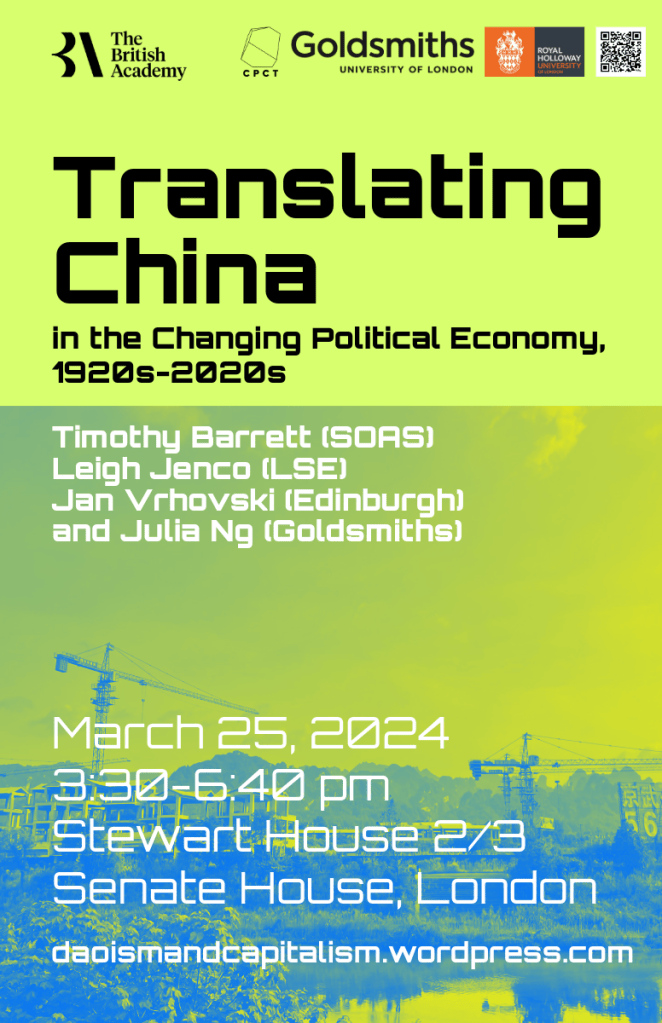
SYMPOSIUM: Translating China in the Changing Political Economy, 1920s-2020s (March 25, 2024, Senate House London)

Translating China in the Changing Political Economy, 1920s-2020s

A British Academy symposium on 100 years of China’s place in Europe’s linguistic, political, and philosophical formation.

Venue: Stewart House 2/3, Senate House London
Date: March 25, 2024 from 3:30-6:40 pm

We often hear about China in the news in connection to changes in the global political economy—concerning, for instance, the new infrastructural world order (Belt and Road Initiative), supply chains and their dependencies, and rebalances in the relation of law and traditional culture (tianxia or ‘Chinese’ universalism; ‘civilisational’ harmony). Yet much less consideration has been given to the direct impact that cultural translations broadly conceived and moving in multiple directions have on the fashioning of ‘China’ as a new global political and economic actor. Drawing examples from the British-German-Chinese 1920s for the 2020s, this public symposium and roundtable will explore the links between: (i) the teaching of modern non-European languages and the setting up of institutions to facilitate this teaching (e.g., SOAS) in support of British and German trade interests abroad; (ii) the specific role that philosophical and literary translations play in constructing the image of China as a political and economic counterpart during times of shifting geopolitical relations; (iii) the contribution of public intellectuals such as Bertrand Russell and Richard Wilhelm; and (iv) reinventions of Confucian and Daoist traditions by public intellectuals seeking to legitimise or criticise policy in China. How might a consideration of these moments in the translative process help us more deeply understand and critically analyze the pictures of political economy given to us in times of seemingly unprecedented change?

Free and open to the public, though registration is required. Registered attendees will receive (via the registration confirmation email) a booklet containing a collection of ‘artefacts’ selected by the speakers for consideration ahead of the event as well as an opportunity to submit a question for possible inclusion in the roundtable discussion.

To register, please visit: https://www.eventbrite.co.uk/e/translating-china-in-the-changing-political-economy-1920s-2020s-tickets-804851200607.

This event is the first of three associated with Dr. Julia Ng’s British Academy Mid-Career Fellowship project Daoism and Capitalism: Early Critical Theory and the Global South (MCFSS23\230039). Thanks also go to Goldsmiths’ Centre for Philosophy and Critical Thought and Royal Holloway’s Centre for Continental Philosophy for their generous support.

Programme

3:30-3:45 pm
Welcome and Introduction: Translation as Political-Economic Communication? 
Dr. Julia Ng (Goldsmiths)

How might translation, broadly conceived, serve as a mode of political-economic communication? In these opening remarks, I will outline a constellation of texts, institutions and ideas associated in particular with the German Sinologist and translator Richard Wilhelm, a constellation that intersects with British and Chinese counterparts to suggest an altogether distinct and crucial way of picturing multilinear political economic transformations.

3:45-4:25 pm
Laozi: The Story So Far
Professor Timothy Barrett (SOAS)

Daoist thought in Europe in the interwar period looked back on a history of translation stretching back at least a century.  In 1934 Arthur Waley prefaced his own attempt at situating Laozi in his historical context by contrast with all earlier translators with an assertion that his predecessors had been ‘scriptural’, treating the Chinese text of the Daode jing as an authoritative statement of Daoism to be interpreted as it was, not viewed as a product of a certain time and place.  While this may be so, the assumptions behind these earlier translations had their own times and places that are in themselves worth recapitulating.  Perhaps the diversity of approaches that a quick background survey reveals may help in situating 1920s and later European responses.

4:30-5:10 pm
China’s Russell Paradox: On the Historical Significance of ‘Misunderstanding’ between Russell and China
Dr. Jan Vrhovski (Edinburgh)

Between 1920 and 1921, the British philosopher and logician Bertrand Russell embarked on a significant journey to China, leaving a significant mark on the country’s intellectual landscape. Russell’s visit and lectures in China catalysed various developments within Chinese academia, intellectual circles, and socio-political discourse. However, even after more than a century, the precise impact of Russell’s philosophy on China remains somewhat enigmatic. Historiographical gaps and ideological paradigms obscure a comprehensive understanding of this encounter, exacerbated by fundamental disparities between Chinese interpretations of Russell’s ideas and his perception of China. In my presentation, I aim to shed light on the historical lineage and intellectual significance of the enduring “misunderstanding” of Russell’s philosophy in early Republican China. This misunderstanding critically shaped the boundaries of Chinese intellectual discourse on science, materialism, and modernity. Conversely, I will explore Russell’s portrayal of China in the years following his return to Europe, during the period of his life which Ray Monk (2000) somewhat provocatively titled “the ghost of madness.” Of particular interest is Russell’s anthology The Problem of China, which offers insight into his perceptions of the country and its intellectual past, present, and future. Special attention will be given to the two decades following Russell’s visit to China, providing a nuanced exploration of the complexities inherent in this paradoxical relationship.

5:15-5:55 pm 
Global China, or Chinese Global Orders? 1920s-2020s
Professor Leigh Jenco (LSE)

In this paper, I will examine the idea of canons, how they are formed, and what political work they do. I will focus on the so-called “Great Books” curricula that were developing starting in the 1920s as a way to discuss what “Great Books” should be and the difficulties of incorporating the Chinese classics into this curriculum, with a comparative look at the canon-formation around the Five Classics (especially the Shangshu and Mandate of Heaven). I will then connect this with Xi Jinping’s “Global Civilization Initiative” to explore its relationship to how we think about cultural appropriation, now and in the past.

6:00-6:30 pm 
Roundtable

6:30-6:40 pm
Q&A

About the speakers

Timothy Barrett is professor emeritus of East Asian History at SOAS, University of London, where he taught from 1986 to 2013, primarily covering Chinese religious history, on which he has published several books, besides some further publications on the reception of the Chinese tradition in Europe. A graduate of Cambridge with a doctorate in Religious Studies from Yale, he had earlier taught in Chinese Studies at Cambridge for over a decade.

Jan Vrhovski is a research fellow at the department of Science, Technology, and Innovation Studies, School of Social and Political Science at the University of Edinburgh. His research interests include intellectual history of modern China, history of analytic philosophy, mathematical logic, history and philosophy of science in China, and international history of mathematics. His current book projects include the Science and Metaphysics Debate (Brill, 2024) and Palgrave Handbook of the History of Analytic Philosophy in China (2025-).

Leigh Jenco (PhD, Chicago) is Professor of Political Theory at the London School of Economics, specializing in Chinese and comparative political theory. She has served as editor of the American Political Science Review (2016-2020) and currently stands as member of the APSA Council. She has received numerous major grants, most recently the Chinese Global Orders global convening programme funded by the British Academy. Her publications include Making the Political: Founding and Action in the Political Theory of Zhang Shizhao (Cambridge UP, 2010) and Changing Referents: Learning Across Space and Time in China and the West (Oxford UP, 2015) as well as articles in American Political Science Review, Political Theory, Modern China, and T’oung Pao.

Julia Ng is Reader in Critical Theory and founding Co-Director of the Centre for Philosophy and Critical Thought at Goldsmiths, University of London. She specialises in philosophical approaches to literature, modern German-Jewish thought, early 20th-century Germanophone literatures in their transnational contexts, and history of critical theory. Recent publications include her translation and critical edition of Walter Benjamin’s “Toward the Critique of Violence” (with P. Fenves; Stanford UP, 2021) and articles in Theory Culture & Society, Paragraph, CR: New Centennial Review, Modern Language Notes, diacritics, and Critical Times. Funded by a British Academy Mid-Career Fellowship, she is currently completing a book on Daoism and Capitalism, which has also received support from the Leverhulme Trust, the Center for Jewish History (NYC), and the British Society for the History of Philosophy.