The Centre for Philosophy and Critical Thought, Goldsmiths University of London

Research Centre run jointly between the Departments of Sociology and English and Comparative Literature at Goldsmiths University, London


Leave a comment

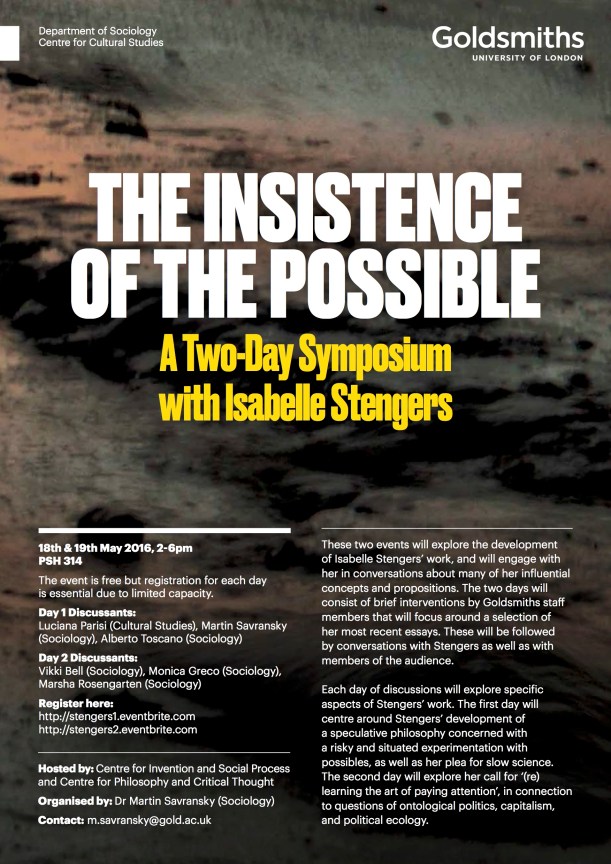
The Insistence of the Possible: Symposium with Isabelle Stengers (Day 2)

Stengers-Sociology_Event_Poster_Final_A3_updated.jpgA two-day Symposium with Isabelle Stengers and Goldsmiths academics

19 May 2016
2:00pm – 6:00pm
PSH 314, Professor Stuart Hall Building

These two symposia will explore the development of Isabelle Stengers’ most recent work, and will engage with her and the audience in conversations about many of her influential concepts and propositions. The two days will consist of brief interventions by Goldsmiths staff members that will focus around a selection of her most recent essays. These will be followed by conversations with Stengers as well as with members of the audience.
The second day will explore her call for ‘(re)learning the art of paying attention’, in connection to questions of ontological politics, capitalism, and political ecology.

Discussants: Vikki Bell (Sociology), Monica Greco (Sociology) and Marsha Rosengarten (Sociology)

Register Here


Leave a comment

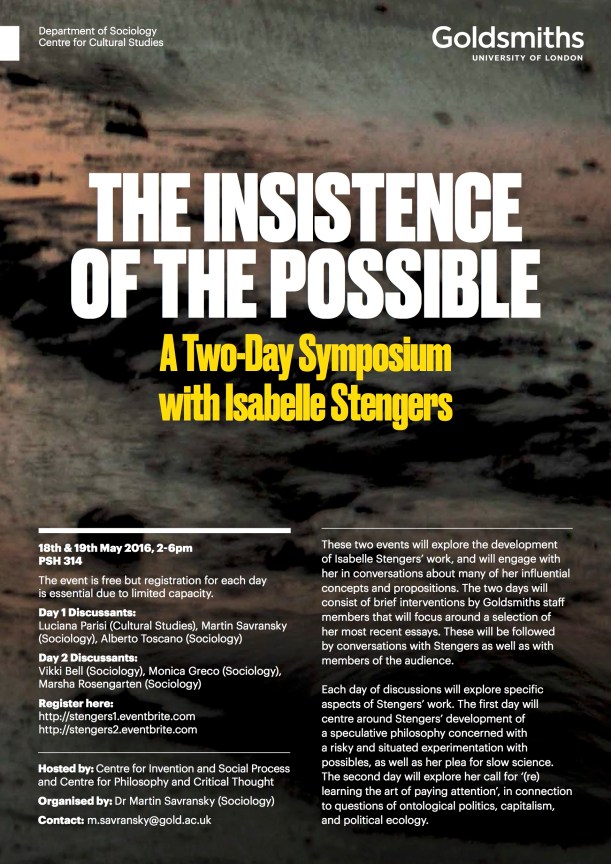
The Insistence of the Possible: Symposium with Isabelle Stengers (Day 1)

Stengers-Sociology_Event_Poster_Final_A3_updated.jpg

A two-day Symposium with Isabelle Stengers and Goldsmiths academics

18 May 2016
2:00pm – 6:00pm
PSH 314, Professor Stuart Hall Building

These two events will explore the development of Isabelle Stengers’ work, and will engage with her in conversations about many of her influential concepts and propositions. The two days will consist of brief interventions by Goldsmiths staff members that will focus around a selection of her most recent essays. These will be followed by conversations with Stengers as well as with members of the audience.

Each day of discussions will explore specific aspects of Stengers’ work. The first day will centre around Stengers’ development of a speculative philosophy concerned with a risky and situated experimentation with possibles, as well as her plea for slow science.

Discussants: Luciana Parisi (Cultural Studies), Martin Savransky (Sociology), and Alberto Toscano (Sociology)

Register Here


Leave a comment

On Justice: Variations On a Theme Borrowed From Benjamin in 1916 (II)

Justice 2 poster w logo.jpg

Variation Two: Massimiliano Tomba (Padova) reconsiders Benjamin’s idea of justice as a transformative form of anticipation that carries its own criterion of its rightness.

28 Apr 2016
1:00pm – 6:00pm
LG01, Professor Stuart Hall Building

In the second of this two-part event, Massimiliano Tomba will reconsider Benjamin’s idea of divine violence—made famous in the essay “Towards the Critique of Violence”—as a form of anticipation that might be politically transformative because it carries its own criterion of its rightness.

Massimiliano Tomba is Professor of Political Philosophy at the University of Padova. His research focuses mainly on modern German philosophy, critical theory and globalization. He is co-organizer of an initiative titled ‘Next Generation Global Studies (NGGS)’ which aims at reconsidering predominant schemes of interpretation of global societies in order to overcome prevailing Eurocentric perspectives of political space and time. His work has involved theorists such as Kant, Hegel and post-Hegelian thought, Marx, Walter Benjamin, and Theodor Adorno. Among his  publications are Krise und Kritik bei Bruno Bauer. Kategorien des Politischen im nachhegelschen Denken, Frankfurt am Main, Peter Lang, 2005; La vera politica. Kant e Benjamin: la possibilità della giustizia, Macerata, Quodlibet, 2006; Marx’s Temporalities, Leiden, Brill, 2013.


In October 1916, Gershom Scholem copied into his diary a passage “from a notebook Walter Benjamin lent [him]” under the heading, “Notes Toward a Work on the Category of Justice.” Never included in either the two-volume or the seven-volume collected works and only reappearing upon publication of Scholem’s diaries, these “Notes” nonetheless represent a crucial juncture in the development of Benjamin’s thinking on the political. From one direction, the “Notes” are the culmination of intense discussions between Benjamin and Scholem on the concept of historical time, which issued into a number of important reflections on tragedy, time-reckoning, and language. In the other direction, the “Notes” inaugurated a series of objections and responses between the two friends that include Scholem’s own set of theses on the category of justice from 1919 and 1925, Scholem’s writings on Jonah, and texts surrounding Benjamin’s discussion of law and violence that come to a head with a number of fragments on lying circa 1923.

Using the “Notes Toward a Work on the Category of Justice” as its point of departure, this two-part event takes up the invitation to read together a “convolute” of shorter or lesser-known texts that contribute to a larger theme that Benjamin did not perhaps execute fully, but therefore provides a new context for understanding better known writings such as the Language essay or “Towards the Critique of Violence.” Each day will pivot around a variation on the theme, with presentations and seminar-style discussion based on pre-circulated texts.

For more information on the schedule and for a copy of the texts please visit https://benjaminonjustice.wordpress.com/


Leave a comment

On Justice: Variations On a Theme Borrowed From Benjamin in 1916 (I)

Justice 1 poster w logo.jpg

Variation One: Peter Fenves (Northwestern) discusses Benjamin’s concept of justice in relation to whether there can ever be a thing rightfully possessed.

20 Apr 2016
1:00pm – 6:00pm
Lecture Theatre, Ben Pimlott Building

In the first of this two-part event, Peter Fenves discusses the provenance of Benjamin’s notes on justice in Kant’s Doctrine of Right, and asks, with Benjamin, whether there can ever be a thing rightfully possessed.

Peter Fenves, Joan and Sarepta Harrison Professor of Literature, is professor of German, Comparative Literary Studies, and Jewish Studies as well as adjunct professor of Philosophy, Political Science, and English. He is the author of A Peculiar Fate: Metaphysics and World-History in Kant (Cornell University Press, 1991), “Chatter”: Language and History in Kierkegaard (Stanford University Press, 1993), Arresting Language: From Leibniz to Benjamin (Stanford University Press, 2001), and Late Kant: Towards Another Law of the Earth (Routledge, 2003), which was translated into German in 2010; and most recently The Messianic Reduction: Walter Benjamin and the Shape of Time (Stanford University Press, 2010).


In October 1916, Gershom Scholem copied into his diary a passage “from a notebook Walter Benjamin lent [him]” under the heading, “Notes Toward a Work on the Category of Justice.” Never included in either the two-volume or the seven-volume collected works and only reappearing upon publication of Scholem’s diaries, these “Notes” nonetheless represent a crucial juncture in the development of Benjamin’s thinking on the political. From one direction, the “Notes” are the culmination of intense discussions between Benjamin and Scholem on the concept of historical time, which issued into a number of important reflections on tragedy, time-reckoning, and language. In the other direction, the “Notes” inaugurated a series of objections and responses between the two friends that include Scholem’s own set of theses on the category of justice from 1919 and 1925, Scholem’s writings on Jonah, and texts surrounding Benjamin’s discussion of law and violence that come to a head with a number of fragments on lying circa 1923.

Using the “Notes Toward a Work on the Category of Justice” as its point of departure, this two-part event takes up the invitation to read together a “convolute” of shorter or lesser-known texts that contribute to a larger theme that Benjamin did not perhaps execute fully, but therefore provides a new context for understanding better known writings such as the Language essay or “Towards the Critique of Violence.” Each day will pivot around a variation on the theme, with presentations and seminar-style discussion based on pre-circulated texts.

For more information on the schedule and for a copy of the texts please visithttps://benjaminonjustice.wordpress.com/

Click here for further information.


Leave a comment

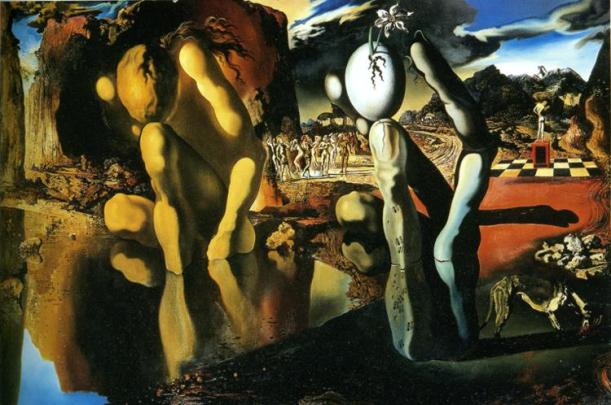
Politics Between Narcissism and Negativity

2016-3 Tomsic - salvador-dali-the-metamorphosis-of-narcissus.jpeg

What is the link between desire and exploitation, and what does it mean for political thought?

14 Mar 2016
6:00pm – 7:30pm
137a, Richard Hoggart Building

One of the earliest discoveries of psychoanalysis concerned the intimate relation of the social structures and the unconscious mechanisms. Jacques Lacan later reframed this connection by speaking of homology between political and libidinal economy. In this way, he indicated that psychoanalysis significantly widened the space, in which critical thought and emancipatory politics should intervene in order to intensify the possibilities of a social change. The talk will begin by discussing two concepts, which demonstrate a wide-reaching link between Marx and Freud’s critical projects, before passing on to more general examination of the link between libidinal bonds and mechanisms of exploitation.

Samo Tomšic is the author of The Capitalist Unconscious: Marx and Lacan, and is currently research assistant in the interdisciplinary cluster “Image Knowledge Gestaltung” at the Humboldt University in Berlin.

All welcome. No need to book.


Leave a comment

Benjamin and the Literary: Romantic Forms

WB Romantic Forms copy.jpg

A Walter Benjamin London Research Network conference of new work on Benjamin’s doctoral thesis on Romanticism, followed by a workshop on its most influential interpretations.

11 Mar 2016
10:00am – 6:00pm
302, Hatcham House (St James 19)

Benjamin’s doctoral dissertation, The Concept of Criticism in German Romanticism, has long functioned not only as a lens through which to synthesize the theories of art and knowledge in early Romanticism, but also as a cornerstone for understanding Benjamin’s own theories and practices of criticism. In harnessing his affirmation of criticism’s ability to unfold the potential immanent to works of art, such readings proffer upon the dissertation an undeniable political and historical force. Departing from ‘the literary’ both as a conceptually privileged mode of expression and as a configuration of linguistic experience, this workshop brings together emerging scholars with the aim of directing attention to under-analyzed aspects of Benjamin’s early work on criticism and critique, and to the possible articulations of politics and history contained therein. Presentations will focus on: the relation between criticism, philosophy and literature; irony; the afterlives of Benjamin’s dissertation; allegory and the Baroque. This will be followed by a workshop on the dissertation and selected readings.

Conference website


Leave a comment

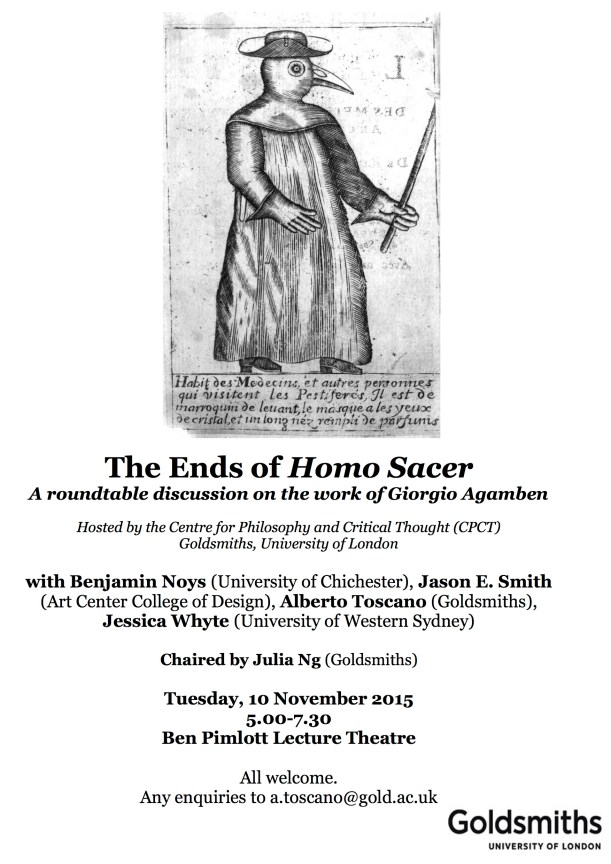
The Ends of Homo Sacer – A Roundtable Discussion on the Work of Giorgio Agamben

Nov10Agamben.jpg

Giorgio Agamben is an Italian philosopher best known for his work investigating the concepts of the state of exception, form-of-life (borrowed from Ludwig Wittgenstein) and homo sacer.

10 Nov 2015
5:00pm – 7:30pm
Lecture Theatre, Ben Pimlott Building

With the publication of L’uso dei corpi (The Use of Bodies) and the short volume Stasis, Giorgio Agamben’s Homo Sacer series, comprising 9 books, has been brought to a close – if not, by his own lights, an actual completion. This roundtable will take up the task of an initial critical assessment of this remarkably influential project by homing in on a number of salient and thorny themes across its multiple volumes, with a particular focus on the interweaving and displacement of politics, ontology and anthropology in Agamben’s work. Among the themes under consideration will be the question of “(global)civil war,” the place of slavery in Agamben’s understanding of biopolitics, the “apocalyptic tone” in his philosophy, and the figure of surplus populations.

With Benjamin Noys (University of Chichester), Jason E. Smith (Art Center College of Design), Alberto Toscano (Goldsmiths), Jessica Whyte (University of Western Sydney)

For more information on the Centre for Philosophy and Critical Thought, please visit our web page:http://www.gold.ac.uk/cpct/


Leave a comment

Werner Hamacher – “Image and Time” (Walter Benjamin London Research Network)

hamacher_poster_mail.jpg

One of the world’s seminal readers of Walter Benjamin inaugurates new philosophy research network with a workshop on Benjamin’s understanding of the image.

23 Oct 2015
10:00am – 5:00pm
Room D111, Granary Building, Central Saint Martins

The day will be split into four sessions, each devoted to a selection of short texts and excerpts. Texts under discussion will be distributed ahead of the workshop in German and English.

Participation in the workshop is limited. Please register your interest by sending a letter of intent and (in the case of PhD students) a thesis abstract by Oct 5, 2015 to j.ng [at] gold.ac.uk, j.cohen [at] gold.ac.uk, and a.benjamin [at] kingston.ac.uk.

Werner Hamacher is a professor emeritus of comparative literature at the Goethe-Universität Frankfurt am Main, and a professor of Philosophy and Literary Theory at the European Graduate School in Saas-Fee, Switzerland. (Frankfurt am Main) http://www.egs.edu/faculty/werner-hamacher/biography/

The Centre for Philosophy and Critical Thought (CPCT) at Goldsmiths, University of London collaborates with the Department of English and Comparative Literature at Goldsmiths, the London Graduate School at Kingston University, and Central Saint Martins, University of the Arts London, in a network of research and scholarly exchange related to the work of Walter Benjamin. The network brings together scholars and research students in the London area, and facilitates the exchange of advanced, philosophical and literary-theoretical research on Benjamin between the UK, other parts of Europe, and around the world. The network is co-chaired by Julia Ng (co-director of CPCT), Josh Cohen (English and Comparative Literature), and Andrew Benjamin (LGS Kingston / Monash).

The network hosts an annual lecture series; and text-based workshops that intersperse short formal presentations and close textual analysis of one or several key writings by Benjamin along a chosen theme.


The Centre for Philosophy and Critical Thought (CPCT) is a new centre for philosophical inquiry at Goldsmiths. For further information please visit http://www.gold.ac.uk/sociology/research-centres/cpct/

To sign up for announcements of upcoming events, please subscribe to our mailing list at:http://www.jiscmail.ac.uk/cpct-announce
?

www.gold.ac.uk/…/walter-benjamin/


1 Comment

Werner Hamacher: “Now: Time” (Walter Benjamin London Research Network)

hamacher_poster_mail.jpg

One of the world’s seminal readers of Walter Benjamin inaugurates new philosophy research network with a talk on Benjamin’s idea of historical time.

22 Oct 2015
5:00pm – 7:00pm
137a, Richard Hoggart Building

Werner Hamacher is a professor emeritus of comparative literature at the Goethe-Universität Frankfurt am Main, and a professor of Philosophy and Literary Theory at the European Graduate School in Saas-Fee, Switzerland. (Frankfurt am Main) http://www.egs.edu/faculty/werner-hamacher/biography/

The Centre for Philosophy and Critical Thought (CPCT) at Goldsmiths, University of London collaborates with the Department of English and Comparative Literature at Goldsmiths, the London Graduate School at Kingston University, and Central Saint Martins, University of the Arts London, in a network of research and scholarly exchange related to the work of Walter Benjamin. The network brings together scholars and research students in the London area, and facilitates the exchange of advanced, philosophical and literary-theoretical research on Benjamin between the UK, other parts of Europe, and around the world. The network is co-chaired by Julia Ng (co-director of CPCT), Josh Cohen (English and Comparative Literature), and Andrew Benjamin (LGS Kingston / Monash).

The network hosts an annual lecture series; and text-based workshops that intersperse short formal presentations and close textual analysis of one or several key writings by Benjamin along a chosen theme.

The Centre for Philosophy and Critical Thought (CPCT) is a new centre for philosophical inquiry at Goldsmiths. For further information please visit http://www.gold.ac.uk/sociology/research-centres/cpct/

To sign up for announcements of upcoming events, please subscribe to our mailing list at:http://www.jiscmail.ac.uk/cpct-announce

www.gold.ac.uk/…/walter-benjamin/


Leave a comment

Dictionary of Untranslatables: A Philosophical Lexicon

June 26.gif

A discussion and launch of Dictionary of Untranslatables: A Philosophical Lexicon, edited by Barbara Cassin (Princeton University Press, 2014)

26 Jun 2015
5:00pm – 8:00pm
137a, Richard Hoggart Building

Barbara Cassin
Étienne Balibar (Kingston)
Lucie Campos (Institut Français)
Jacques Lezra (NYU, co-editor of the English translation)

The Dictionary of Untranslatables is an encyclopedic dictionary of close to 400 important philosophical, literary, and political terms and concepts that defy easy—or any—translation from one language and culture to another. Drawn from more than a dozen languages, terms such as Dasein (German), pravda (Russian), saudade (Portuguese), and stato (Italian) are thoroughly examined in all their cross-linguistic and cross-cultural complexities. Spanning the classical, medieval, early modern, modern, and contemporary periods, these are terms that influence thinking across the humanities. The entries, written by more than 150 distinguished scholars, describe the origins and meanings of each term, the history and context of its usage, its translations into other languages, and its use in notable texts. The dictionary also includes essays on the special characteristics of particular languages–English, French, German, Greek, Italian, Portuguese, Russian, and Spanish.

Originally published in French, this one-of-a-kind reference work is now available in English for the first time, with new contributions from Judith Butler, Daniel Heller-Roazen, Ben Kafka, Kevin McLaughlin, Kenneth Reinhard, Stella Sandford, Gayatri Chakravorty Spivak, Jane Tylus, Anthony Vidler, Susan Wolfson, Robert J. C. Young, and many more.The result is an invaluable reference for students, scholars, and general readers interested in the multilingual lives of some of our most influential words and ideas.

Organised by Filippo Del Lucchese (Brunel) & Alberto Toscano (Co-Director, CPCT)