The Centre for Philosophy and Critical Thought, Goldsmiths University of London

Research Centre run jointly between the Departments of Sociology and English and Comparative Literature at Goldsmiths University, London


Leave a comment

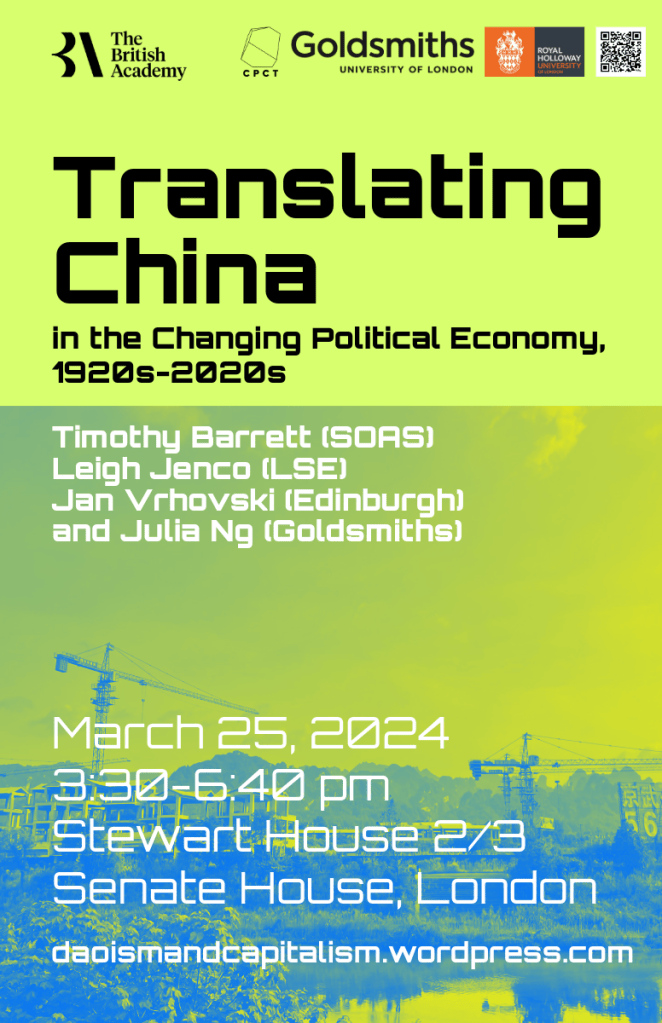
SYMPOSIUM: Translating China in the Changing Political Economy, 1920s-2020s (March 25, 2024, Senate House London)

Translating China in the Changing Political Economy, 1920s-2020s

A British Academy symposium on 100 years of China’s place in Europe’s linguistic, political, and philosophical formation.

Venue: Stewart House 2/3, Senate House London
Date: March 25, 2024 from 3:30-6:40 pm

We often hear about China in the news in connection to changes in the global political economy—concerning, for instance, the new infrastructural world order (Belt and Road Initiative), supply chains and their dependencies, and rebalances in the relation of law and traditional culture (tianxia or ‘Chinese’ universalism; ‘civilisational’ harmony). Yet much less consideration has been given to the direct impact that cultural translations broadly conceived and moving in multiple directions have on the fashioning of ‘China’ as a new global political and economic actor. Drawing examples from the British-German-Chinese 1920s for the 2020s, this public symposium and roundtable will explore the links between: (i) the teaching of modern non-European languages and the setting up of institutions to facilitate this teaching (e.g., SOAS) in support of British and German trade interests abroad; (ii) the specific role that philosophical and literary translations play in constructing the image of China as a political and economic counterpart during times of shifting geopolitical relations; (iii) the contribution of public intellectuals such as Bertrand Russell and Richard Wilhelm; and (iv) reinventions of Confucian and Daoist traditions by public intellectuals seeking to legitimise or criticise policy in China. How might a consideration of these moments in the translative process help us more deeply understand and critically analyze the pictures of political economy given to us in times of seemingly unprecedented change?

Free and open to the public, though registration is required. Registered attendees will receive (via the registration confirmation email) a booklet containing a collection of ‘artefacts’ selected by the speakers for consideration ahead of the event as well as an opportunity to submit a question for possible inclusion in the roundtable discussion.

To register, please visit: https://www.eventbrite.co.uk/e/translating-china-in-the-changing-political-economy-1920s-2020s-tickets-804851200607.

This event is the first of three associated with Dr. Julia Ng’s British Academy Mid-Career Fellowship project Daoism and Capitalism: Early Critical Theory and the Global South (MCFSS23\230039). Thanks also go to Goldsmiths’ Centre for Philosophy and Critical Thought and Royal Holloway’s Centre for Continental Philosophy for their generous support.

Programme

3:30-3:45 pm
Welcome and Introduction: Translation as Political-Economic Communication? 
Dr. Julia Ng (Goldsmiths)

How might translation, broadly conceived, serve as a mode of political-economic communication? In these opening remarks, I will outline a constellation of texts, institutions and ideas associated in particular with the German Sinologist and translator Richard Wilhelm, a constellation that intersects with British and Chinese counterparts to suggest an altogether distinct and crucial way of picturing multilinear political economic transformations.

3:45-4:25 pm
Laozi: The Story So Far
Professor Timothy Barrett (SOAS)

Daoist thought in Europe in the interwar period looked back on a history of translation stretching back at least a century.  In 1934 Arthur Waley prefaced his own attempt at situating Laozi in his historical context by contrast with all earlier translators with an assertion that his predecessors had been ‘scriptural’, treating the Chinese text of the Daode jing as an authoritative statement of Daoism to be interpreted as it was, not viewed as a product of a certain time and place.  While this may be so, the assumptions behind these earlier translations had their own times and places that are in themselves worth recapitulating.  Perhaps the diversity of approaches that a quick background survey reveals may help in situating 1920s and later European responses.

4:30-5:10 pm
China’s Russell Paradox: On the Historical Significance of ‘Misunderstanding’ between Russell and China
Dr. Jan Vrhovski (Edinburgh)

Between 1920 and 1921, the British philosopher and logician Bertrand Russell embarked on a significant journey to China, leaving a significant mark on the country’s intellectual landscape. Russell’s visit and lectures in China catalysed various developments within Chinese academia, intellectual circles, and socio-political discourse. However, even after more than a century, the precise impact of Russell’s philosophy on China remains somewhat enigmatic. Historiographical gaps and ideological paradigms obscure a comprehensive understanding of this encounter, exacerbated by fundamental disparities between Chinese interpretations of Russell’s ideas and his perception of China. In my presentation, I aim to shed light on the historical lineage and intellectual significance of the enduring “misunderstanding” of Russell’s philosophy in early Republican China. This misunderstanding critically shaped the boundaries of Chinese intellectual discourse on science, materialism, and modernity. Conversely, I will explore Russell’s portrayal of China in the years following his return to Europe, during the period of his life which Ray Monk (2000) somewhat provocatively titled “the ghost of madness.” Of particular interest is Russell’s anthology The Problem of China, which offers insight into his perceptions of the country and its intellectual past, present, and future. Special attention will be given to the two decades following Russell’s visit to China, providing a nuanced exploration of the complexities inherent in this paradoxical relationship.

5:15-5:55 pm 
Global China, or Chinese Global Orders? 1920s-2020s
Professor Leigh Jenco (LSE)

In this paper, I will examine the idea of canons, how they are formed, and what political work they do. I will focus on the so-called “Great Books” curricula that were developing starting in the 1920s as a way to discuss what “Great Books” should be and the difficulties of incorporating the Chinese classics into this curriculum, with a comparative look at the canon-formation around the Five Classics (especially the Shangshu and Mandate of Heaven). I will then connect this with Xi Jinping’s “Global Civilization Initiative” to explore its relationship to how we think about cultural appropriation, now and in the past.

6:00-6:30 pm 
Roundtable

6:30-6:40 pm
Q&A

About the speakers

Timothy Barrett is professor emeritus of East Asian History at SOAS, University of London, where he taught from 1986 to 2013, primarily covering Chinese religious history, on which he has published several books, besides some further publications on the reception of the Chinese tradition in Europe. A graduate of Cambridge with a doctorate in Religious Studies from Yale, he had earlier taught in Chinese Studies at Cambridge for over a decade.

Jan Vrhovski is a research fellow at the department of Science, Technology, and Innovation Studies, School of Social and Political Science at the University of Edinburgh. His research interests include intellectual history of modern China, history of analytic philosophy, mathematical logic, history and philosophy of science in China, and international history of mathematics. His current book projects include the Science and Metaphysics Debate (Brill, 2024) and Palgrave Handbook of the History of Analytic Philosophy in China (2025-).

Leigh Jenco (PhD, Chicago) is Professor of Political Theory at the London School of Economics, specializing in Chinese and comparative political theory. She has served as editor of the American Political Science Review (2016-2020) and currently stands as member of the APSA Council. She has received numerous major grants, most recently the Chinese Global Orders global convening programme funded by the British Academy. Her publications include Making the Political: Founding and Action in the Political Theory of Zhang Shizhao (Cambridge UP, 2010) and Changing Referents: Learning Across Space and Time in China and the West (Oxford UP, 2015) as well as articles in American Political Science Review, Political Theory, Modern China, and T’oung Pao.

Julia Ng is Reader in Critical Theory and founding Co-Director of the Centre for Philosophy and Critical Thought at Goldsmiths, University of London. She specialises in philosophical approaches to literature, modern German-Jewish thought, early 20th-century Germanophone literatures in their transnational contexts, and history of critical theory. Recent publications include her translation and critical edition of Walter Benjamin’s “Toward the Critique of Violence” (with P. Fenves; Stanford UP, 2021) and articles in Theory Culture & Society, Paragraph, CR: New Centennial Review, Modern Language Notes, diacritics, and Critical Times. Funded by a British Academy Mid-Career Fellowship, she is currently completing a book on Daoism and Capitalism, which has also received support from the Leverhulme Trust, the Center for Jewish History (NYC), and the British Society for the History of Philosophy.


Leave a comment

RECORDING of Asia Theories Network – “Field Report” (14 Dec 2023)

A recording of Asia Theory Network – ‘Field Report’ presented by Li-Chun Hsiao, Oscar V. Campomanes, Alex Taek-Gwang Lee, Hung-chiung Li as part of the 2023/24 CPCT research seminar on ‘What is Global Critical Theory? (Pt.3)’.


Leave a comment

Recordings of Bruno Bosteels’ 2023 Annual Philosophy Lectures


Leave a comment

RECORDING of Yuji Nishiyama: The Trials of Untranslatable: Derrida in Japan & The Association for Deconstruction (23 November 2023)

A recording of Yuji Nishiyama presenting on ‘The Trials of Untranslatable: Derrida in Japan & The Association for Deconstruction’ as part of the 2023/24 CPCT research seminar on ‘What is Global Critical Theory? (Pt.3)’. 


Leave a comment

RECORDING of Safieddine & Giordani – ‘Reflections on Translating Arab Marxism’ (18 January 2023)

A recording of Hicham Safieddine and Angela Giordani presenting on ‘Reflections on Translating Arab Marxism’ as part of the 2022/23 CPCT research seminar on ‘Translating Global Critical Theory’. See their related book publication Hicham Safieddine (ed.), Angela Giordani (trans.), Arab Marxism and National Liberation: Selected Writings of Mahdi Amel (Brill, 2020).


Leave a comment

RECORDING of Kawashima and Walker – Theory & Crisis: Translating Marxism in Japan (8 Dec 2022)

A recording of Ken Kawashima and Gavin Walker presenting on ‘Theory & Crisis: Translating Marxism in Japan’ as part of the 2022/23 CPCT research seminar on ‘Translating Global Critical Theory’. This session stages a dialogue with Kawashima and Walker on their work editing, translating, interpreting and creatively applying the work of Tosaka Jun, Uno Kōzō and Kōjin Karatani to our current theoretical conjuncture.


Leave a comment

CPCT Research Seminar: Matthieu Renault, ‘Rewriting the “Decline of the West” in the Black Atlantic’ (17 Jan, 4pm, online)

Rewriting the “Decline of the West” in the Black Atlantic

Matthieu Renault, Université Toulouse – Jean Jaurès (France)

17 January 2024
16:00 – 17:30 GMT
Online

REGISTER HERE to get the zoom link

Contact: s.bromberg[@] gold.ac.uk

This seminar is part of the 23/24 CPCT research seminar series on ‘What is Global Critical Theory? Pt.3’ [link]. 

About the talk 

What happens, from both theoretical and political viewpoints, when intra-Western notions and laments on the “decline of the West” – pessimistic, conservative, and sometimes openly fascist – are taken up, translated and transformed from a non-Western perspective – with emancipatory or even revolutionary aims? My talk will begin to explore this question by examining Caribbean and African-American rewritings of this theme as it found its inaugural formula in Oswald Spengler’s (in)famous The Decline of the West (1918-1922). After briefly tracing back the massive transatlantic circulations of Spengler’s philosophy in the interwar period, I will focus on the writings of key figures in twentieth-century black radical thought: W.E.B. Du Bois, C.L.R. James, Suzanne and Aimé Césaire, George Schuyler, and Malcolm X.

About the speaker 

Matthieu Renault is Professor in “Critical history of philosophy” at the Université Toulouse – Jean Jaurès (France), and a member of the Research Team on Philosophical Rationalities and Knowledge (ERRaPhiS). His research focuses on the relationships between philosophy and non-European societies, the (post)imperial history of knowledge and its minority rewritings (class-gender-race). He is the author of: Frantz Fanon. De l’anticolonialisme à la critique postcoloniale (Éditions Amsterdam, 2011) ; L’Amérique de John Locke. L’expansion coloniale de la philosophie européenne (Éditions Amsterdam, 2014) ; C.L.R. James. La vie révolutionnaire d’un « Platon noir » (La Découverte, 2016) ; L’empire de la révolution. Lénine et les musulmans de Russie (Syllepse, 2017) ; W.E.B. Du Bois. Double conscience et condition raciale, with Magali Bessone (Éditions Amsterdam, 2021,) ; and, forthcoming, Maîtres et esclaves. Archives du Laboratoire d’analyse des Mythologiques de la modernité (Les Presses du réel, 2024) Kollontaï. Défaire la famille, refaire l’amour (La Fabrique, 2024), with Olga Bronnikova.


Leave a comment

CPCT Research Seminar: Asia Theories Network – “Field Report” (14 Dec, 12 noon, online seminar)

Asia Theories Network – “Field Report” 

Li-Chun Hsiao, Oscar V. Campomanes, Alex Taek-Gwang Lee, Hung-chiung Li 

14 December 2023
12-1.30pm
Online
 

As part of our series, ‘What is Global Critical Theory?’, Goldsmiths Centre for Philosophy and Critical Thought (CPCT) hosts a roundtable with colleagues from the Asia Theories Network (ATN) surveying their work and critical theory in Asia. 

REGISTER HERE to get the zoom link! 

Contact: jacob.mcguinn[@] gold.ac.uk 

About the talk 

The series of short presentations we put together here can be considered, to a necessarily limited extent (yet one that, we hope, still warrants critical attention), a “state of the field” report on the studies of “critical theory” based in Asia, in conjunction with the studies of the epistemological, cultural, and socio-political changes and possibilities of Asia undertaken by scholars of Asia Theories Network (ATN) or those we connect with or know of through ATN. Acutely cognizant of the malleability of the umbrella term “critical theory” as well as the variety of existing schools of thought (Deleuzian, postcolonialist, etc.) and disciplines we may be associated with (or the lack of neatly fit categories), we proceed with no more than a loosely conceived (critical) “theory” as our common denominator, on the basis of which we seek to push the envelope of the productions of theoretical knowledge about and around Asia by means of connecting with, and learning from, multiple sites or nodal points of theoretical interventions. The aforementioned practices and vision(s) of theoretical inquiry can be illustrated by Critical Asia Archives: Events and Theories, which is a bi-annual online publication platform created in 2020 by ATN and co-edited by Li-Chun Hsiao and Hung-chiung Li, with members of the editorial board or guest editors outside ATN taking turns to curate special topics focused on one specific site of theoretical engagement (e.g. Taiwan, Japan, etc.). In the first presentation, Hsiao and/or Li will elaborate, in light of the Hong Kong topics, on how new horizons of critical thought not only can be precipitated by monumental events, as is usually the case, but also by the end of any prospect of such events.

As the coordinator of ATN’s participation in this Global Critical Theory Seminar at Goldsmiths, Hsiao will introduce and reflect on the contexts in which the local groundwork of ATN was laid, and through the lends of which two iterations of our recent work can be understood: The first is the historical “moment of critical theory” in these parts of Asia that coincided with the waves of democratization movements sweeping across South Korea, the Philippines, and Taiwan in the 1980s. The second context didn’t emerge until after a time lapse in which critical theory evolved as a branch of institutionalized knowledge; to many of us, it is this keen awareness of and the discontent with critical theory’s status as “just another specialty” that brought us together and formed Asia Theories Network in the first place. The second presentation, by Alex Taek-Gwang Lee, will discuss the ideas around the June 2023 “Global Authoritarianism” conference he organized, in collaboration with ATN and other organizations, which explored, among other things, the specter of authoritarianism that can serve as both enabler and disabler of critical-theoretical inquiries and interventions. In the third presentation, Oscar Compomanes, who is the chief organizer of the ATN workshop on “the University,” held in Manilla on December 4-7 this year, will report and reflect on the visceral double threats of shrinking thought horizons inside the university as well as the eroded freedoms outside it, particularly in the Philippines. Finally, in the context of the intellectual endeavors by ATN outlined above, Li will introduce and discuss an edited volume of critical essays, titled Entangled Waterscapes in Asia, which, featuring contributions from a number of ATN members, is co-edited by Li and Kwai-Cheung Lo. 

About the speakers

Li-Chun Hsiao (Ph.D. in Comparative Literature, SUNY Buffalo) is Professor at Waseda University in Tokyo, specializing in postcolonial studies, literary and cultural theories, Taiwan literature and culture, and Anglophone Caribbean literatures. He was the Editor-in-Chief of the journal Chung Wai Literary Quarterly from 2015 to 2017, and current serves as co-editor-in-chief of Critical Asia Archives. Having been a visiting scholar at Hitotsubashi University (2017-18) and UCLA (2011-12), Hsiao is the author of the monographs The Soldier-Writer, the Expatriate, and Cold War Modernism in Taiwan: Freedom in the Trenches. (Lexington Books, 2022) and The Indivisible Globe, the Indissoluble Nation: Universality, Postcoloniality, and Nationalism in the Age of Globalization (ibidem, 2021). He has book chapters collected in the edited volumes Keywords of Taiwan Theory (Unitas 2019), Comparatizing Taiwan (Routledge 2015) and Representing Humanity in an Age of Terror (Purdue UP 2010), and his papers have been published by Critical Arts (2020), Chungwai Literary Quarterly (2014), Concentric: Literary and Cultural Studies (2010), CLCWeb: Comparative Literature and Culture (2009), and M/MLA Journal (2008), among other journals. 

Oscar V. Campomanes (PhD in American Civilization from Brown University) is Associate Professor of Literary and Cultural Studies, the Department of English, and holds the Rev. James F. Donelan SJ Professorial Chair in the Humanities, the Loyola Schools, Ateneo de Manila University. He was ASEAN University Network (AUN) Distinguished Visiting Professor in American Studies at Vietnam National University-Hanoi in 2001-02, and Visiting Scholar in the Division of Cultural Studies, Department of Religious and Cultural Studies, The Chinese University of Hong Kong, in 2020, Term 2. Recent publications include the essay on Filipino visual arts for SANGHAYA: Philippine Culture and the Arts Yearbook 2020 (Cultural Center of the Philippines, 2021), and an extended essay on the Filipino American Marxist writer Carlos Bulosan in Mari Jo Buhle et al., Eds., Encyclopedia of the American Left (Verso, 2022). The book he co-edited with the Filipinist economic historian Yoshiko Nagano and anthropologist Nobutaka Suzuki, Colonialism and Modernity: Re-Mapping Philippine Histories, has just been published by Ateneo de Naga University Press (2022).

Alex Taek-Gwang Lee is a professor of cultural studies and a founding director of the Center for Technology in Humanities at Kyung Hee University, Korea. He is a visiting professor at the University of Brighton and was invited as a visiting professor at the Centre for Culture Media and Governance, Jamia Millia Islamia University, India. He served as an academic adviser for Gwangju Biennale in 2017 and as a program manager for the Venice Biennale of Architecture in 2021. He is a board member of The International Consortium of Critical Theory Programs (ICCTP) and Asia Theories Network (ATN). He edited the third volume of The Idea of Communism (2016) and Deleuze, Guattari and the Schizoanalysis of Postmedia (2023). He published articles in journals such as Telos, Deleuze and Guattari Studies and Philosophy Today, and chapters in The Bloomsbury Handbook of World Theory (2021), Thinking with Animation (2021), Back to the ’30s?: Recurring Crises of Capitalism, Liberalism and Democracy (2020) and Balibar/Wallerstein’s “Race, Nation, Class”: Rereading a Dialogue for Our Times (2018).

Hung-chiung Li is Associate Professor in the Department of Foreign Languages and Literatures at National Taiwan University, Taiwan. He is also Co-Coordinator of the Asia Theories Network, and founding Co-Editor-in-Chief of Critical Asia Archives. He has been the vice president of the Comparative Literature Association of the Republic of China (Taiwan), and the editor-in-chief of Chung Wai Literary Quarterly. His research interest includes critical theory, comparative literature, and Taiwanese and East Asian cultures and thoughts. 


Leave a comment

Professor Sonja Buckel: Subjectivation and Cohesion (13 Nov, 5pm, Goldsmiths, RHB 137a)

13 Nov 2023
5-7pm
Goldsmiths, University of London
RHB Room 137a

Join Goldsmiths Unit for Global Justice and Centre for Philosophy and Critical Thought for a talk by Professor Sonja Buckel (University of Kassel) on her book Subjectivation and Cohesion: Towards the Reconstruction of a Materialist Theory of Law, followed by a Q&A session.

This event is free and open to all.

You can book your place here or just come along on the day

Contact: s.bromberg[@] gold.ac.uk

About the talk

Marx initially studied law and, in his early writings in particular, he was sharply critical of the law of his time. However, he did not develop a legal theory in the strict sense. His main interest was in combining philosophy and economics to analyse capitalist societies. It was mainly the critical scholars following Marx who attempted to develop such a materialist theory of law.

In her talk, Sonja Buckel will present these different approaches and develop her own legal-theoretical approach in confrontation with them. To this end, the works of Franz Neumann, Otto Kirchheimer, Evgeny Pashukanis, Oskar Negt, Isaac D. Balbus, the so-called ‘State-derivation School’, Antonio Gramsci, Nicos Poulantzas and Michel Foucault are first analysed for their strengths and weaknesses, and then combined to form something new and much needed: a materialist legal theory that is fit for the present and which avoids the shortcomings of existing theories – above all their disregard for gender relations and the reductive consequences of functionalist, economistic or politicist approaches to law.

The result was published in German in 2007 and in English in 2020 (Subjectivation and Cohesion. Towards the Reconstruction of a Materialist Theory of Law, Brill, Historical Materialism Book Series).

About the speaker

Sonja Buckel, Ph.D. (1969), Kassel University, is Professor of Political Theory and member of the faculty of the Institute for Social Research, Frankfurt. She is a lawyer and political scientist and has published on legal theory, European migration policy and critical social theory. Since 2021, she has also been Vice-President of the University of Kassel.


Leave a comment

RECORDING of Babette Babich: Apocalyptic Thinking after Günther Anders (19 June 2023, 4pm, Senate House)

A recording of Babette Babich’s lecture on “Apocalyptic Thinking after Günther Anders” (19 June 2023), which was co-hosted by Royal Holloway University of London’s Centre for Continental Philosophy, is now available via RHUL’s Youtube channel.