The Centre for Philosophy and Critical Thought, Goldsmiths University of London

Research Centre run jointly between the Departments of Sociology and English and Comparative Literature at Goldsmiths University, London


Leave a comment

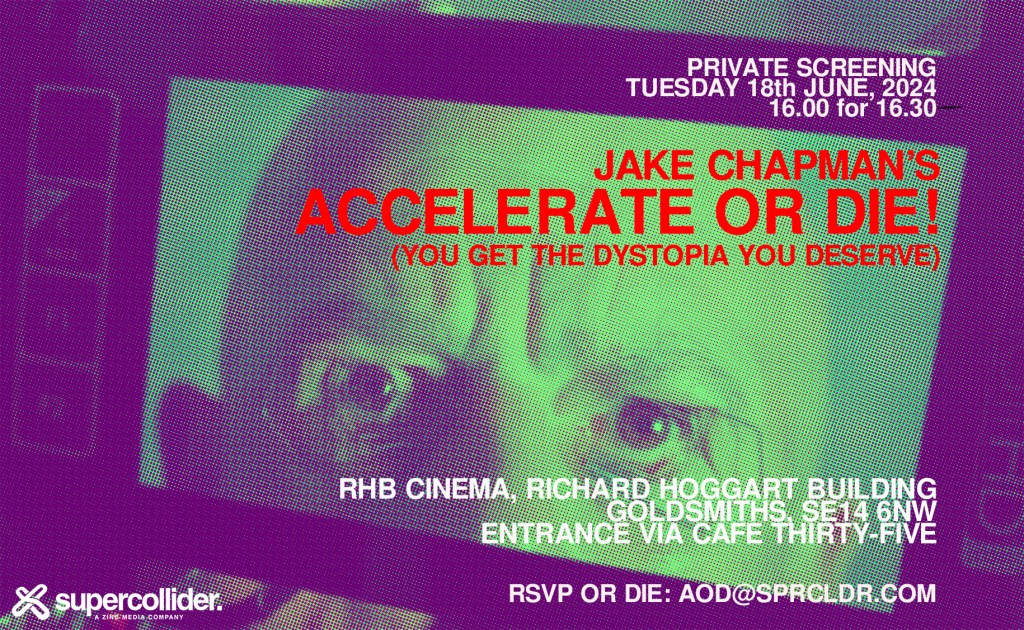
PRIVATE SCREENING: Jake Chapman’s “Accelerate or Die!” (2022) — Tuesday, 18 June 2024 @ 16:20 — POSTPONED

The Centre for Philosophy and Critical Thought and the Department of English and Creative Writing’s MA Literary Studies: Pathway in Critical Theory would like to cordially invite you to a private screening of Jake Chapman’s “Accelerate or Die!” (2022).

Where? RHB Cinema
When? Tuesday 18th June from 16:20 – 17:50 ** THIS SCREENING HAS BEEN POSTPONED. WE APOLOGISE FOR ANY INCONVENIENCE.

Event Description

Modernity is collapsing. Extinction is one turn away. The future is not our friend – and it isn’t ours to choose. 

In this context, internationally acclaimed artist, Jake Chapman – of ‘The Chapman Brothers’ – asks the question: Why is it easier to imagine the end of the world than the end of capitalism?

This dynamic, distinctive film will address the current merging of technology, capitalism, and climate crisis through the lens of ‘Accelerationism’ – a loose set of philosophical ideas that in part emerged from Goldsmiths. 

Featuring Maya B Kronic, Amy Ireland, Will Self, Jeanette Winterson, and Goldsmiths’ own Will Davies (Politics), this unique documentary invites its audience to ‘buckle up and enjoy the ride’ in a thrilling visual assault of art, generative AI, and fresh, thought-provoking perspectives.

Trailer: https://supercollider.global/our-work/accelerate-or-die/

Free and open to Goldsmiths students, staff, alumni/ae, and friends and affiliates of CPCT. Please RSVP to AOD@SPRCLDR.com.

Event Schedule

Short intro – 16:20 – 16:30
Screening – 16:30 – 17:30.
Q&A – 17:30-17:50.

The event will be introduced by and feature a Q&A with Mungo Dodd, a 2021 Goldsmiths alumnus of the Department of English and Creative Writing’s MA Literary Studies: Pathway in Critical Theory, who worked on the film and will be happy to talk with any students who are looking to get into film and television as a career path.

Contact: mungo.dodd [at] supercollider.global


Leave a comment

Recordings of British Academy Symposium “Chinese Modernity in German Jewish Thought” (May 3, 2024)

The recordings for the British Academy symposium “Chinese Modernity in German Jewish Thought” (May 3, 2024) are now available on our YouTube channel here:

Continue reading →


Leave a comment

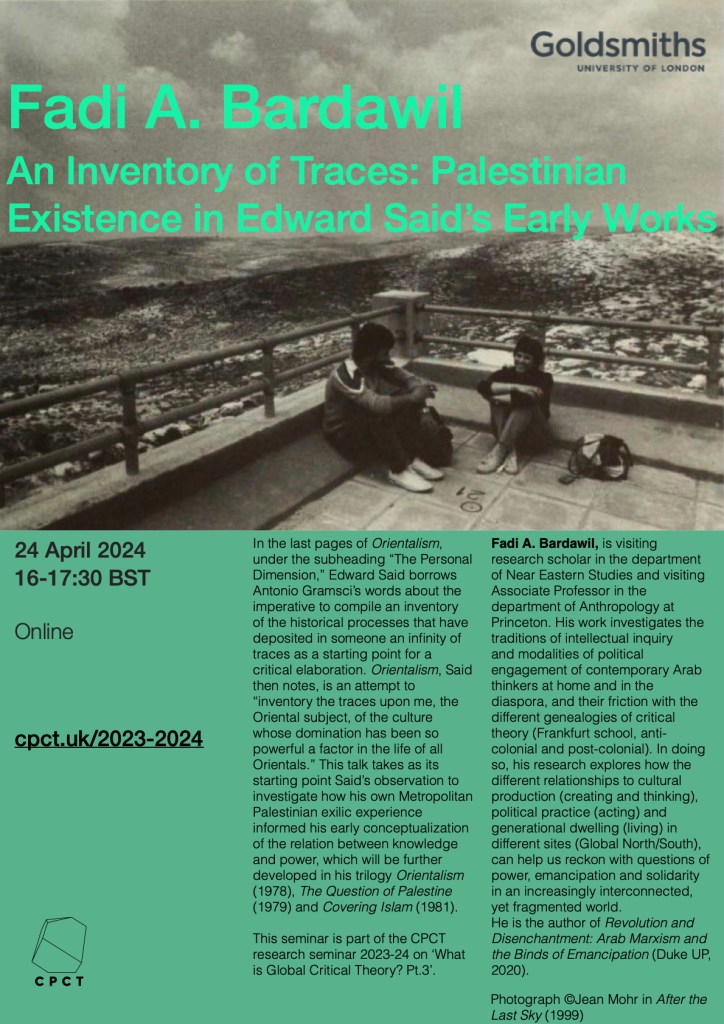
CPCT Research Seminar: Fadi A. Bardawil, ‘An Inventory of Traces: Palestinian Existence in Edward Said’s Early Works’ (24 April, 4pm BST, online)

An Inventory of Traces:
Palestinian Existence in Edward Said’s Early Works

Fadi A. Bardawil (Princeton University)

24 April 2024
16:00 – 17:30 BST
Online

REGISTER HERE for the zoom link

Contact: s.bromberg[@] gold.ac.uk

This seminar is part of the 23/24 CPCT research seminar series on ‘What is Global Critical Theory? Pt.3’ [link]. 

About the talk 

In the last pages of Orientalism, under the subheading “The Personal Dimension,” Edward Said borrows Antonio Gramsci’s words about the imperative to compile an inventory of the historical processes that have deposited in someone an infinity of traces as a starting point for a critical elaboration. Orientalism, Said then notes, is an attempt to “inventory the traces upon me, the Oriental subject, of the culture whose domination has been so powerful a factor in the life of all Orientals.” This talk takes as its starting point Said’s observation to investigate how his own Metropolitan Palestinian exilic experience informed his early conceptualization of the relation between knowledge and power, which will be further developed in his trilogy Orientalism (1978), The Question of Palestine (1979) and Covering Islam (1981). 

About the speaker 

Fadi A. Bardawil, is visiting research scholar in the department of Near Eastern Studies and visiting Associate Professor in the department of Anthropology at Princeton. 
His work investigates the traditions of intellectual inquiry and modalities of political engagement of contemporary Arab thinkers at home and in the diaspora, and their friction with the different genealogies of critical theory (Frankfurt school, anti-colonial and post-colonial). In doing so, his research explores how the different relationships to cultural production (creating and thinking), political practice (acting) and generational dwelling (living) in different sites (Global North/South), can help us reckon with questions of power, emancipation and solidarity in an increasingly interconnected, yet fragmented world. 
His recent Arabic and English writings have appeared in American Ethnologist,  boundary 2; Comparative Studies of South Asia, Africa and the Middle East; The Journal for Palestine Studies (Arabic edition); al-Jumhuriya; The Immanent Frame; Megaphone;  Political and Legal Anthropology Review Online; South Atlantic Quarterly; and World Records Journal. 
He is the author of Revolution and Disenchantment: Arab Marxism and the Binds of Emancipation (Duke UP, 2020). 


Leave a comment

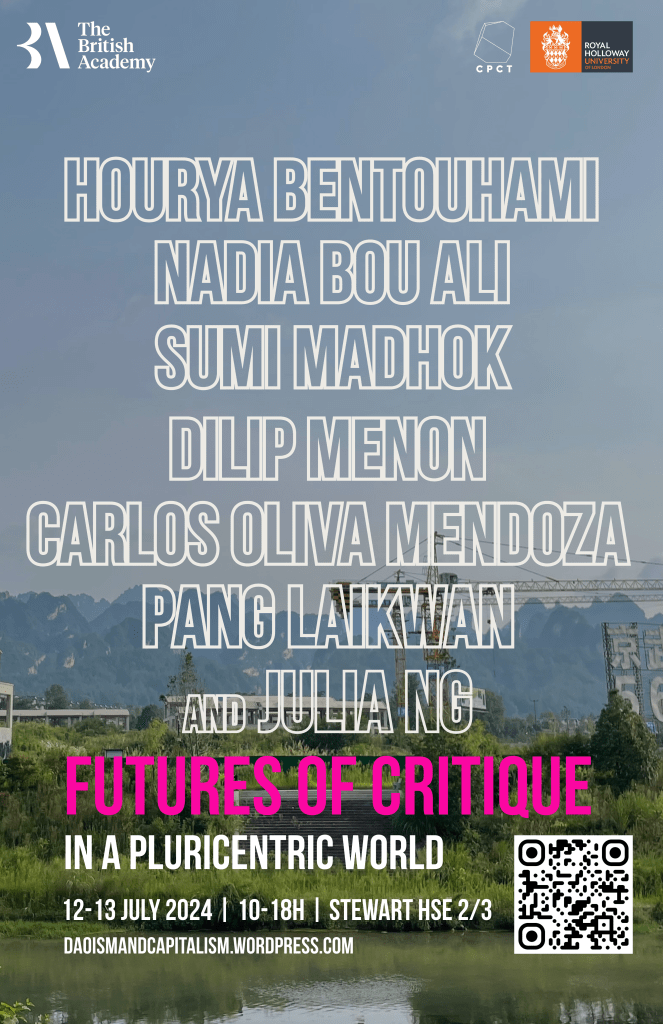
BRITISH ACADEMY SYMPOSIUM: Chinese Modernity in German Jewish Thought (May 3, 2024; Senate House London)


Chinese Modernity in German Jewish Thought

A British Academy symposium on the circulation of images of China in German Jewish letters of the early 20th century.

Venue: Stewart House 2/3, Senate House London
Date: May 3, 2024 from 3:30-6:40 pm

Too often, critical discussions around antisemitism and anticolonialism seem completely at odds with one another. This workshop asks whether a consideration of the images of ‘China’ that circulated amongst German Jewish thinkers might help complicate or resolve this impasse by suggesting a different orientation to both the Christian-colonial project and the racialisation of work. How were these images of China used to imagine different ways of organising social, political, and economic life in a context of intensifying antisemitism, capital-critical sentiment, and ambivalence towards the European legacies of imperialism and colonialism in the ‘Orient’?

Free and open to the public, though registration is required. 

To register, please visit: https://www.eventbrite.co.uk/e/chinese-modernity-in-german-jewish-thought-tickets-805024077687 

For more information, please visit https://daoismandcapitalism.wordpress.com/. 

This event is the second of three associated with Dr. Julia Ng’s British Academy Mid-Career Fellowship project Daoism and Capitalism: Early Critical Theory and the Global South (MCFSS23\230039). Thanks also go to Goldsmiths’ Centre for Philosophy and Critical Thought and Royal Holloway’s Centre for Continental Philosophy for their generous support.

Programme

3:30-3:45 pm
Welcome and Introduction: Daoism, Capitalism, and German Jewish Thought
Dr. Julia Ng (Goldsmiths)

Ideas circulated from a modernizing China in the 1910s and 1920s amongst major German Jewish thinkers as they grappled with their own modernity and contemporaneity. How useful or limited is “Orientalism” as an interpretive framework for grasping the career of these ideas, and might competing “Orientalisms”—that of Buber, for instance, referring to quite a different “Orient” altogether, or Marx, which points towards China as a historical entity—complicate the picture in illuminating ways?

3:45-4:25 pm
Rosenzweig, Hegel, and ‘Oriental Messianism’
Dr. Daniel Weiss (Cambridge)

Hegel famously portrayed Jewish messianism as characterized by an ‘Oriental’ orientation that fails to produce effective agency in history.  By contrast, Franz Rosenzweig reaffirmed key elements of Jewish messianism criticized by Hegel, including elements that could outwardly appear linked to passivity or non-action.  However, Rosenzweig treats the Jewish orientation not as weak or ineffective, but as a committed stance that will lead the world to messianic redemption and to the overthrow of ‘illusory’ power-claims.  We will see that, although Rosenzweig himself criticizes various aspects of Daoism, his account of Judaism shares elements in common with various nineteenth and early-twentieth German portrayals of Daoism.  As such, we can understand him as calling into question dominant Christian portrayals of both Judaism and Daoism, and seeking to reclaim the supposedly ‘Oriental’ characteristics criticized by others.  Rosenzweig’s development of a modern, challenging account of Judaism can thus be understood parallelling the ways in which European writers contended with ways in which China’s modernizing developments likewise presented a challenge to dominant Western preconceptions.

4:30-5:10 pm
Ex Oriente Lux: Martin Buber’s Dao-Hasidic Mysticism of the Worldly
Professor Agata Bielik-Robson (Nottingham)

Martin Buber’s interest in Chinese Daoism begins very early in his intellectual career and coincides – not at all accidentally – with his interest in Hasidism: both are treated by him as the cases of “spiritually rich” Orientalism which he opposes to the disenchanted West. Between 1906-1909, he writes The Tales of Rabbi Nachman, The Legend of the Baal Shem, and the Hasidism inspired Ecstatic Confessions, but he also, under the influence of Wang Qingdao, the visiting lecturer at the Berlin Seminar for Oriental Languages, publishes Talks and Parables of Zhuangzi (1910) and  Chinese Ghost and Love Stories (1911) which offer a partial translation of Liaozhai Zhiyu, an early eighteenth century compilation of folktales done by Pu Songling. From this time on, Daoism – interpreted in close comparative relation to Hasidism – will never leave Buber, although he will modify his attitude towards its main concept, the Dao, over time. While in Buber’s early phase, Dao is most of all a notion of a “mystical unity” connecting the sage with the essential oneness of the world, in the later dialogic phase (beginning with his 1923 I and Thou), Dao emerges rather as the Path: the dynamic way into and through the world appreciated in its concreteness and multiplicity. Thus, in his Ascona lecture on Daoism, delivered in 1924, Buber repudiates his earlier “escapist” mysticism of the One, which now transforms into a “intraworldly” mysticism of the Two, strongly focused on the ultimate realness of the particulars, never again to be considered as an ontological “illusion.” Just as before Dao represented for him a transcendental oneness underlying all, closely corresponding with the Hasidic understanding of God as the ehad, the One pervading all creation – now it represents for him a Path into the World, where creation is to be conceived as “individuation of all things,” this time corresponding with the other meaning of ehad: not simply one, but strictly singular and unique. In my paper, I will present this trajectory in close parallel with Buber’s changing views on Hassidism, but will also juxtapose Buber’s use of the Chinese motifs with Martin Heidegger’s turn towards Daoism as instrumental for his post-war Kehre which redefined the relation between Being and beings in favour of the latter. In both thinkers, the Dao conceived as a Path into (and of) the World plays an important role in their turn towards the worldly.  

5:15-5:55 pm
Kafka’s Dao and the Reverse of Possession
Dr. Julia Ng (Goldsmiths) 

Reading, inter alia, Kafka’s Zürauer Aphorisms and the fragment “Workforce without Possession” alongside works of Daoism and on contemporaneous China that were consulted by Kafka, this paper explores how Kafka’s treatment of figures of ancestrality, nonhuman animation, and reversion opens up questions of ‘race,’ community, and political-economic organisation. 

6:00-6:30 pm
Roundtable

6:30-6:40 pm
Q&A 

About the speakers

Agata Bielik-Robson is Professor of Jewish Studies in the Department of Theology and Religious Studies at the University of Nottingham. She has published widely on all areas of Jewish philosophy with special emphasis paid on modern Jewish thought, from Spinoza to Derrida. She is the author of Another Finitude: Messianic Vitalism and Philosophy (Bloomsbury 2019), Jewish Cryptotheologies of Late Modernity: Philosophical Marranos (Routledge 2014), and co-editor of Judaism in Contemporary Thought: Traces and Influences (Routledge 2014) and Tsimtsum and Modernity (2021).

Daniel H. Weiss is is Polonsky-Coexist Senior Lecturer in Jewish Studies, Faculty of Divinity, University of Cambridge. He is author of Paradox and the Prophets: Hermann Cohen and the Indirect Communication of Religion (2012) and Modern Jewish Philosophy and the Politics of Divine Violence (2023), among other publications, and co-editor of multiple books, including Scripture and Violence (2020) and Tsimtsum and Modernity (2021). Actively involved in the Cambridge Interfaith Programme, he is a recent recipient of a Humboldt Research Fellowship for Experienced Researchers.

Julia Ng is Reader in Critical Theory and founding Co-Director of the Centre for Philosophy and Critical Thought at Goldsmiths, University of London. She specialises in philosophical approaches to literature, modern German-Jewish thought, early 20th-century Germanophone literatures in their transnational contexts, and history of critical theory. Recent publications include her translation and critical edition of Walter Benjamin’s “Toward the Critique of Violence” (with P. Fenves; Stanford UP, 2021) and articles in Theory Culture & Society, Paragraph, CR: New Centennial Review, Modern Language Notes, diacritics, and Critical Times. Funded by a British Academy Mid-Career Fellowship, she is currently completing a book on Daoism and Capitalism, which has also received support from the Leverhulme Trust, the Center for Jewish History (NYC), and the British Society for the History of Philosophy.
Leave a comment

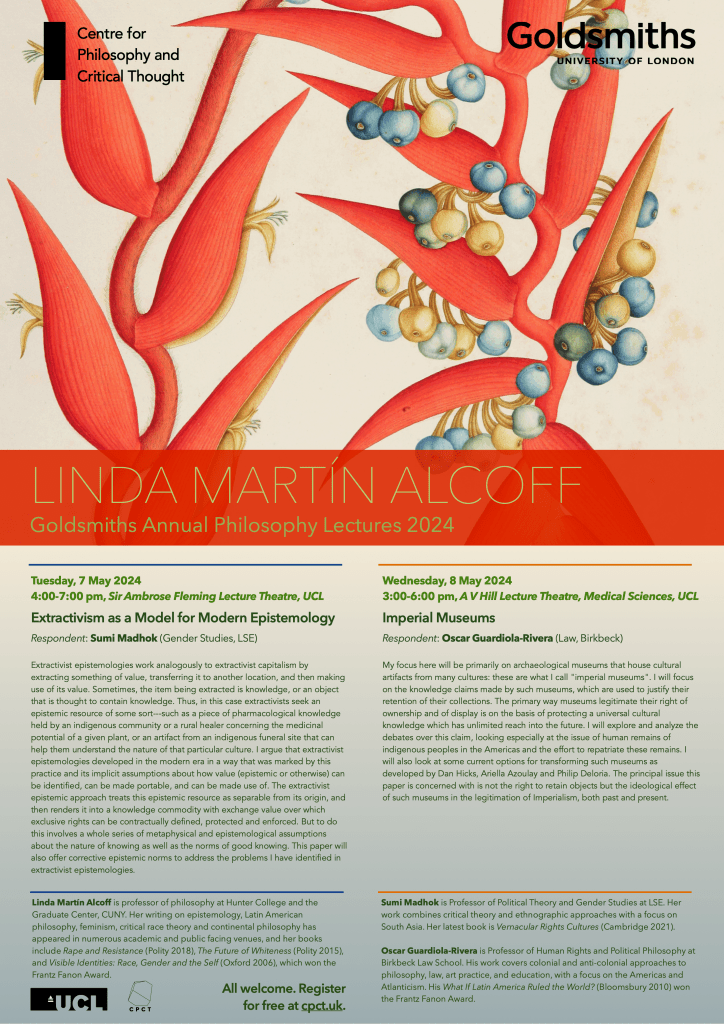
Goldsmiths Annual Philosophy Lectures 2024: Linda Martín Alcoff (CUNY), 7-8 May in person


The Centre for Philosophy and Critical Thought at Goldsmiths, University of London cordially invites you to the 5th Goldsmiths Annual Philosophy Lectures 2024

Professor Linda Martín Alcoff (Hunter College, CUNY)

Lecture 1: “Extractivism as a Model for Modern Epistemology”

Respondent: Professor Sumi Madhok (LSE)

Tuesday, 7 May 2024
4-7pm
Sir Ambrose Fleming Lecture Theatre G06, Roberts Building, UCL
(https://www.accessable.co.uk/venues/roberts-building-sir-ambrose-fleming-lecture-theatre-g06)

REGISTER FOR FREE: https://bit.ly/49uxCgB 

Extractivist epistemologies work analogously to extractivist capitalism by extracting something of value, transferring it to another location, and then making use of its value. Sometimes, the item being extracted is knowledge, or an object that is thought to contain knowledge. Thus, in this case extractivists seek an epistemic resource of some sort—such as a piece of pharmacological knowledge held by an indigenous community or a rural healer concerning the medicinal potential of a given plant, or an artifact from an indigenous funeral site that can help them understand the nature of that particular culture. I argue that extractivist epistemologies developed in the modern era in a way that was marked by this practice and its implicit assumptions about how value (epistemic or otherwise) can be identified, can be made portable, and can be made use of. The extractivist epistemic approach treats this epistemic resource as separable from its origin, and then renders it into a knowledge commodity with exchange value over which exclusive rights can be contractually defined, protected and enforced. But to do this involves a whole series of metaphysical and epistemological assumptions about the nature of knowing as well as the norms of good knowing. This paper will also offer corrective epistemic norms to address the problems I have identified in extractivist epistemologies.

Lecture 2: “Imperial Museums”

Respondent: Professor Oscar Guardiola-Rivera (Birkbeck)

Wednesday, 8 May 2024
3-6pm
A V Hill Lecture Theatre, Medical Sciences, UCL
(https://www.accessable.co.uk/ucl/access-guides/medical-sciences-a-v-hill-lecture-theatre-131)

REGISTER FOR FREE: https://bit.ly/49uxCgB 

My focus here will be primarily on archaeological museums that house cultural artifacts from many cultures: these are what I call “imperial museums”. I will focus on the knowledge claims made by such museums, which are used to justify their retention of their collections. The primary way museums legitimate their right of ownership and of display is on the basis of protecting a universal cultural knowledge which has unlimited reach into the future. I will explore and analyze the debates over this claim, looking especially at the issue of human remains of indigenous peoples in the Americas and the effort to repatriate these remains. I will also look at some current options for transforming such museums as developed by Dan Hicks, Ariella Azoulay and Philip Deloria. The principal issue this paper is concerned with is not the right to retain objects but the ideological effect of such museums in the legitimation of Imperialism, both past and present.

About the speakers

Linda Martín Alcoff is professor of philosophy at Hunter College and the Graduate Center, CUNY, and Co-Director of the Mellon Public Humanities and Social Justice Program. Her work bridges political and philosophical topics, on epistemology, Latin American philosophy, feminism, critical race theory and continental philosophy. As well as writing numerous academic and public facing pieces in philosophy, her books include Rape and Resistance (Polity 2018), The Future of Whiteness (Polity 2015), and Visible Identities: Race, Gender and the Self (Oxford 2006), which won the Frantz Fanon Award. She has also edited eleven books and published over 100 articles and book chapters. She is past president of the American Philosophical Association, and is originally from Panama.

Sumi Madhok is Professor of Political Theory and Gender Studies and Head of the Department of Gender Studies at LSE. Her work combines critical theory and ethnographic approaches with a focus on South Asia and is interested in social sciences focused on epistemic interventions from the Global South. Her latest book is Vernacular Rights Cultures: The Politics of Origins, Human Rights and Gendered Struggle for Justice (Cambridge, 2021), winner of the 2022 Susan Strange book award.

Oscar Guardiola-Rivera is Professor of Human Rights and Political Philosophy at Birkbeck Law School. His work covers decolonial and anti-colonial approaches to philosophy, law, art practice, and education, with a focus on the Americas and Atlanticism, emphasising decolonial and visual methodologies, political economy, and racial justice. His What If Latin America Ruled the World? (Bloomsbury, 2010) won the Frantz Fanon Award.

Co-sponsored by the Department of English, UCL.

Free and open to all; register at https://www.eventbrite.co.uk/e/goldsmiths-annual-philosophy-lectures-2024-linda-martin-alcoff-cuny-tickets-815560662897.

Contact: j.ng [at] gold.ac.uk or s.bromberg [at] gold.ac.uk


Leave a comment

Recordings of British Academy Symposium “Translating China in the Changing Political Economy, 1920s-2020s” (March 25, 2024)

The recordings for the British Academy symposium “Translating China in the Changing Political Economy, 1920s-2020s” (March 25, 2024) are now available on our YouTube channel here:

Continue reading →


Leave a comment

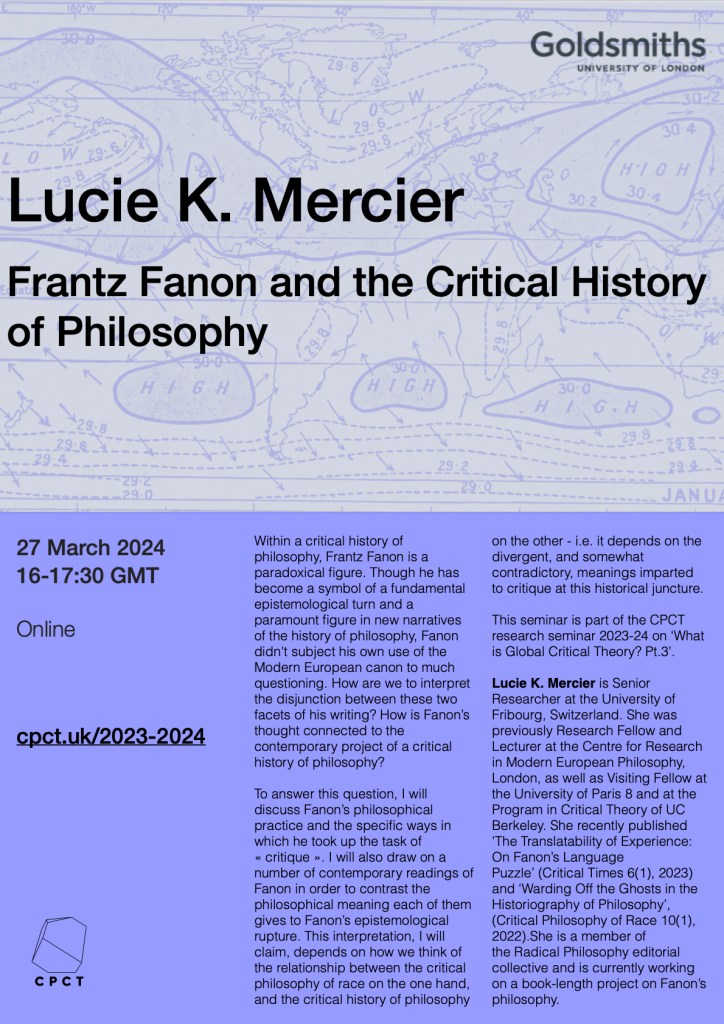
CPCT Research Seminar: Lucie K. Mercier, ‘Frantz Fanon and the Critical History of Philosophy’ (27 March, 4pm GMT, online)

Frantz Fanon and the Critical History of Philosophy

Lucie K. Mercier (University of Fribourg)

27 March 2024
16:00 – 17:30 GMT
Online

REGISTER HERE for the zoom link

Contact: s.bromberg [@] gold.ac.uk

This seminar is part of the 23/24 CPCT research seminar series on ‘What is Global Critical Theory? Pt.3’ [link]. 

About the talk 

Within a critical history of philosophy, Frantz Fanon is a paradoxical figure. Though he has become a symbol of a fundamental epistemological turn and a paramount figure in new narratives of the history of philosophy, Fanon didn’t subject his own use of the Modern European canon to much questioning. How are we to interpret the disjunction between these two facets of his writing? How is Fanon’s thought connected to the contemporary project of a critical history of philosophy? 

To answer this question, I will discuss Fanon’s philosophical practice and the specific ways in which he took up the task of « critique ». I will also draw on a number of contemporary readings of Fanon in order to contrast the philosophical meaning each of them gives to Fanon’s epistemological rupture. This interpretation, I will claim, depends on how we think of the relationship between the critical philosophy of race on the one hand, and the critical history of philosophy on the other – i.e. it depends on the divergent, and somewhat contradictory, meanings imparted to critique at this historical juncture. 

About the speaker 

Lucie K. Mercier is Senior Researcher at the University of Fribourg, Switzerland. She was previously Research Fellow and Lecturer at the Centre for Research in Modern European Philosophy, London, as well as Visiting Fellow at the University of Paris 8 and at the Program in Critical Theory of UC Berkeley. She recently published ‘The Translatability of Experience: On Fanon’s Language Puzzle’ (Critical Times 6(1), 2023) and ‘Warding Off the Ghosts in the Historiography of Philosophy’, (Critical Philosophy of Race 10(1), 2022).She is a member of the Radical Philosophy editorial collective and is currently working on a book-length project on Fanon’s philosophy.


Leave a comment

RECORDING – Nick Nesbitt – Marx’s Critique of Capitalist Slavery (21 Feb 24)

A recording of Nick Nesbitt on ‘Marx’s Critique of Capitalist Slavery’ as part of the 2023/24 CPCT research seminar on ‘What is Global Critical Theory? (Pt.3)’.


Leave a comment

RECORDING – Matthieu Renault – Rewriting the “Decline of the West” in the Black Atlantic (17 Jan 2024)

A recording of Matthieu Renault on ‘Rewriting the “Decline of the West” in the Black Atlantic’ as part of the 2023/24 CPCT research seminar on ‘What is Global Critical Theory? (Pt.3)’.


Leave a comment

CPCT Research Seminar: Nick Nesbitt, ‘Marx’s Critique of Capitalist Slavery’ (21 Feb, 4pm GMT, online)

Marx’s Critique of Capitalist Slavery

Nick Nesbitt (Princeton University)

21 February 2024
16:00 – 17:30 GMT
Online

REGISTER HERE for the zoom link

Contact: s.bromberg[@] gold.ac.uk

This seminar is part of the 23/24 CPCT research seminar series on ‘What is Global Critical Theory? Pt.3’ [link]. 

About the talk 

The historicist debate on capitalism and slavery since Eric Williams has largely either ignored Marx entirely while denying the need to define its object (capitalism), or tended to cherry pick random passages from his ouevre that mention slavery. In this talk I will argue in contrast that Marx’s critique of political economy offers the only adequate means to theorise capitalist slavery as a social form, and furthermore, that the construction of this concept (capitalist slavery) must proceed not at random, but in systematic relation to the many relevant concepts in Marx’s critique: profit vs. surplus value, labor vs. labor power, constant vs. variable capital, etc.

About the speaker 

Nick Nesbitt is Professor in the Department of French and Italian at Princeton University. He received his PhD in Romance Languages and Literatures (French) with a Minor in Brazilian Portuguese from Harvard University. He has previously taught at the University of Aberdeen (Scotland) and at Miami University (Ohio), and in 2003-4 he was a Mellon Fellow at the Cornell University Society for the Humanities. He is the author of Caribbean Critique: Antillean Critical Theory from Toussaint to Glissant (Liverpool 2013); Universal Emancipation: The Haitian Revolution and the Radical Enlightenment (Virginia 2008); and Voicing Memory: History and Subjectivity in French Caribbean Literature (Virginia 2003). He is also the editor of The Concept in Crisis: Reading Capital Today (Duke 2017), Toussaint Louverture: The Haitian Revolution (Verso, 2008); co-editor of Revolutions for the Future: May ’68 and the Prague Spring (Suture 2020); and co-editor (with Brian Hulse) of Sounding the Virtual: Gilles Deleuze and the Philosophy of Music (Ashgate 2010). His most recent book is entitled The Price of Slavery: Capitalism and Revolution in the Caribbean (Virginia, 2022).