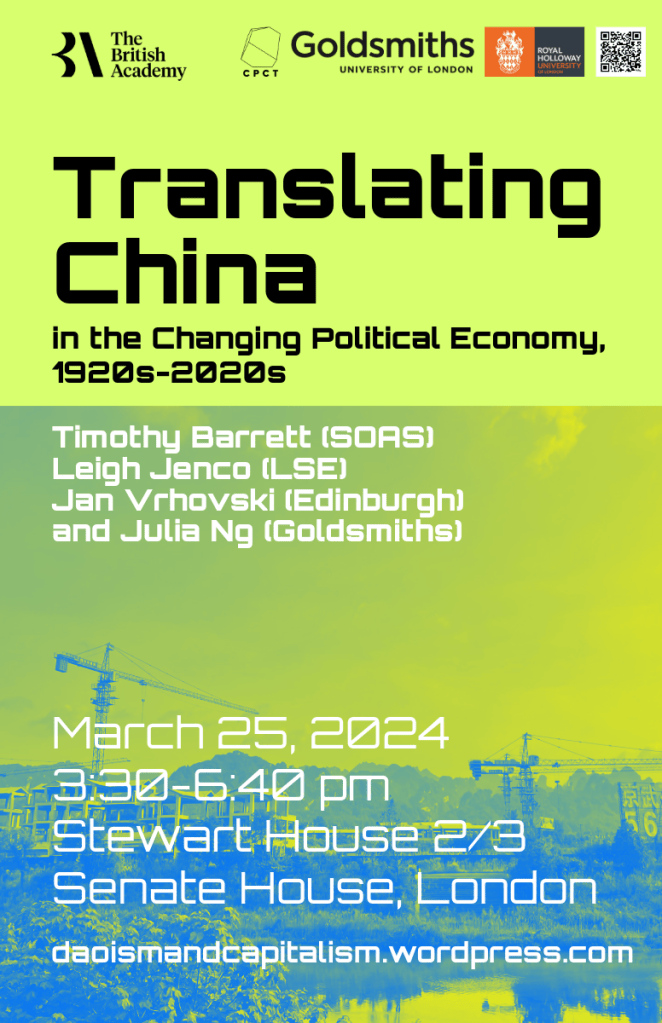
Translating China in the Changing Political Economy, 1920s-2020s
A British Academy symposium on 100 years of China’s place in Europe’s linguistic, political, and philosophical formation.
Venue: Stewart House 2/3, Senate House London
Date: March 25, 2024 from 3:30-6:40 pm
We often hear about China in the news in connection to changes in the global political economy—concerning, for instance, the new infrastructural world order (Belt and Road Initiative), supply chains and their dependencies, and rebalances in the relation of law and traditional culture (tianxia or ‘Chinese’ universalism; ‘civilisational’ harmony). Yet much less consideration has been given to the direct impact that cultural translations broadly conceived and moving in multiple directions have on the fashioning of ‘China’ as a new global political and economic actor. Drawing examples from the British-German-Chinese 1920s for the 2020s, this public symposium and roundtable will explore the links between: (i) the teaching of modern non-European languages and the setting up of institutions to facilitate this teaching (e.g., SOAS) in support of British and German trade interests abroad; (ii) the specific role that philosophical and literary translations play in constructing the image of China as a political and economic counterpart during times of shifting geopolitical relations; (iii) the contribution of public intellectuals such as Bertrand Russell and Richard Wilhelm; and (iv) reinventions of Confucian and Daoist traditions by public intellectuals seeking to legitimise or criticise policy in China. How might a consideration of these moments in the translative process help us more deeply understand and critically analyze the pictures of political economy given to us in times of seemingly unprecedented change?
Free and open to the public, though registration is required. Registered attendees will receive (via the registration confirmation email) a booklet containing a collection of ‘artefacts’ selected by the speakers for consideration ahead of the event as well as an opportunity to submit a question for possible inclusion in the roundtable discussion.
To register, please visit: https://www.eventbrite.co.uk/e/translating-china-in-the-changing-political-economy-1920s-2020s-tickets-804851200607.
This event is the first of three associated with Dr. Julia Ng’s British Academy Mid-Career Fellowship project Daoism and Capitalism: Early Critical Theory and the Global South (MCFSS23\230039). Thanks also go to Goldsmiths’ Centre for Philosophy and Critical Thought and Royal Holloway’s Centre for Continental Philosophy for their generous support.
Programme
3:30-3:45 pm
Welcome and Introduction: Translation as Political-Economic Communication?
Dr. Julia Ng (Goldsmiths)
How might translation, broadly conceived, serve as a mode of political-economic communication? In these opening remarks, I will outline a constellation of texts, institutions and ideas associated in particular with the German Sinologist and translator Richard Wilhelm, a constellation that intersects with British and Chinese counterparts to suggest an altogether distinct and crucial way of picturing multilinear political economic transformations.
3:45-4:25 pm
Laozi: The Story So Far
Professor Timothy Barrett (SOAS)
Daoist thought in Europe in the interwar period looked back on a history of translation stretching back at least a century. In 1934 Arthur Waley prefaced his own attempt at situating Laozi in his historical context by contrast with all earlier translators with an assertion that his predecessors had been ‘scriptural’, treating the Chinese text of the Daode jing as an authoritative statement of Daoism to be interpreted as it was, not viewed as a product of a certain time and place. While this may be so, the assumptions behind these earlier translations had their own times and places that are in themselves worth recapitulating. Perhaps the diversity of approaches that a quick background survey reveals may help in situating 1920s and later European responses.
4:30-5:10 pm
China’s Russell Paradox: On the Historical Significance of ‘Misunderstanding’ between Russell and China
Dr. Jan Vrhovski (Edinburgh)
Between 1920 and 1921, the British philosopher and logician Bertrand Russell embarked on a significant journey to China, leaving a significant mark on the country’s intellectual landscape. Russell’s visit and lectures in China catalysed various developments within Chinese academia, intellectual circles, and socio-political discourse. However, even after more than a century, the precise impact of Russell’s philosophy on China remains somewhat enigmatic. Historiographical gaps and ideological paradigms obscure a comprehensive understanding of this encounter, exacerbated by fundamental disparities between Chinese interpretations of Russell’s ideas and his perception of China. In my presentation, I aim to shed light on the historical lineage and intellectual significance of the enduring “misunderstanding” of Russell’s philosophy in early Republican China. This misunderstanding critically shaped the boundaries of Chinese intellectual discourse on science, materialism, and modernity. Conversely, I will explore Russell’s portrayal of China in the years following his return to Europe, during the period of his life which Ray Monk (2000) somewhat provocatively titled “the ghost of madness.” Of particular interest is Russell’s anthology The Problem of China, which offers insight into his perceptions of the country and its intellectual past, present, and future. Special attention will be given to the two decades following Russell’s visit to China, providing a nuanced exploration of the complexities inherent in this paradoxical relationship.
5:15-5:55 pm
Global China, or Chinese Global Orders? 1920s-2020s
Professor Leigh Jenco (LSE)
In this paper, I will examine the idea of canons, how they are formed, and what political work they do. I will focus on the so-called “Great Books” curricula that were developing starting in the 1920s as a way to discuss what “Great Books” should be and the difficulties of incorporating the Chinese classics into this curriculum, with a comparative look at the canon-formation around the Five Classics (especially the Shangshu and Mandate of Heaven). I will then connect this with Xi Jinping’s “Global Civilization Initiative” to explore its relationship to how we think about cultural appropriation, now and in the past.
6:00-6:30 pm
Roundtable
6:30-6:40 pm
Q&A
About the speakers
Timothy Barrett is professor emeritus of East Asian History at SOAS, University of London, where he taught from 1986 to 2013, primarily covering Chinese religious history, on which he has published several books, besides some further publications on the reception of the Chinese tradition in Europe. A graduate of Cambridge with a doctorate in Religious Studies from Yale, he had earlier taught in Chinese Studies at Cambridge for over a decade.
Jan Vrhovski is a research fellow at the department of Science, Technology, and Innovation Studies, School of Social and Political Science at the University of Edinburgh. His research interests include intellectual history of modern China, history of analytic philosophy, mathematical logic, history and philosophy of science in China, and international history of mathematics. His current book projects include the Science and Metaphysics Debate (Brill, 2024) and Palgrave Handbook of the History of Analytic Philosophy in China (2025-).
Leigh Jenco (PhD, Chicago) is Professor of Political Theory at the London School of Economics, specializing in Chinese and comparative political theory. She has served as editor of the American Political Science Review (2016-2020) and currently stands as member of the APSA Council. She has received numerous major grants, most recently the Chinese Global Orders global convening programme funded by the British Academy. Her publications include Making the Political: Founding and Action in the Political Theory of Zhang Shizhao (Cambridge UP, 2010) and Changing Referents: Learning Across Space and Time in China and the West (Oxford UP, 2015) as well as articles in American Political Science Review, Political Theory, Modern China, and T’oung Pao.
Julia Ng is Reader in Critical Theory and founding Co-Director of the Centre for Philosophy and Critical Thought at Goldsmiths, University of London. She specialises in philosophical approaches to literature, modern German-Jewish thought, early 20th-century Germanophone literatures in their transnational contexts, and history of critical theory. Recent publications include her translation and critical edition of Walter Benjamin’s “Toward the Critique of Violence” (with P. Fenves; Stanford UP, 2021) and articles in Theory Culture & Society, Paragraph, CR: New Centennial Review, Modern Language Notes, diacritics, and Critical Times. Funded by a British Academy Mid-Career Fellowship, she is currently completing a book on Daoism and Capitalism, which has also received support from the Leverhulme Trust, the Center for Jewish History (NYC), and the British Society for the History of Philosophy.


 The Centre for Philosophy and Critical Thought, Goldsmiths University of London