The Centre for Philosophy and Critical Thought, Goldsmiths University of London

Research Centre run jointly between the Departments of Sociology and English and Comparative Literature at Goldsmiths University, London


Leave a comment

Welcome to our new site

We’re pleased to announce that CPCT has launched a new website. We will be continually adding new text and audio content to its pages, as well as regular updates on upcoming events and news on our other activities.


Leave a comment

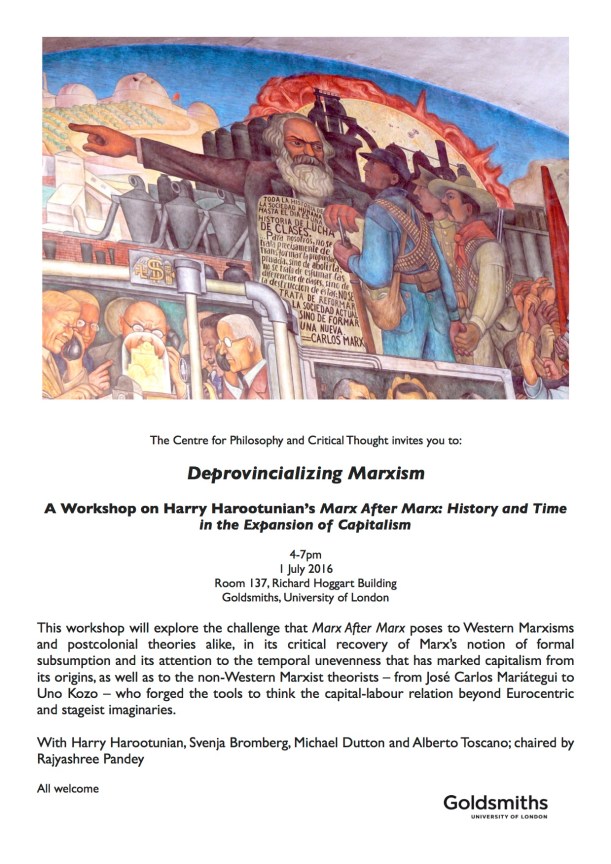
Deprovincialising Marxism

Harootunian poster.jpgA Workshop on Harry Harootunian’s Marx After Marx:

History and Time in the Expansion of Capitalism

1 Jul 2016
4:00pm – 7:00pm
137, Richard Hoggart Building

In the author’s own words, Harootunian’s new book presents us with “a Marx who was able to expand his own angle of vision from the 1860s on and widen his perspective to envisage a global arena marked by the formation of the world market.

We can perceive in this epochal shift that Marx had moved toward envisioning the multiple possibilities for radical transformation among the world’s societies that no longer depended on their capacity to replicate a singular model offered by a European nation-state or bypass the colonial experience, and which, as his views on Russia showed, could utilize the residues of a prior modes of production to create either a new register of formal subsumption or bypass capital altogether”.

This workshop will explore the challenge that Marx After Marx poses to Western Marxisms and postcolonial theories alike, in its critical recovery of Marx’s notion of formal subsumption and its attention to the temporal unevenness that has marked capitalism from its origins, as well as to the non-Western Marxist theorists – from José Carlos Mariátegui to Uno Kozo – who forged the tools to think the capital-labour relation beyond Eurocentric and stageist imaginaries.

With Harry Harootunian, Svenja Bromberg, Michael Dutton and Alberto Toscano
Chaired by Rajyashree Pandey

All welcome.


Leave a comment

Gerald Raunig, Dividuum: Machinic Capitalism and Molecular Revolution

Raunig.jpeg

Join us to celebrate the launch of Gerald Raunig’s new book – Dividuum: Machinic Capitalism and Molecular Revolution

Gerald Raunig in conversation with Stefan Nowotny

Monday 20th June, 6.00-8.00pm
Richard Hoggart Building, Room 309

The animal of the molecular revolution will be neither mole nor snake, but a drone-animal-thing that is solid, liquid, and a gas.
—from Dividuum

As the philosophical, religious, and historical systems that have produced the “individual” (and its counterparts, society and community) over the years continue to break down, the age of “dividuality” is now upon us. Gerald Raunig charts a genealogy of the concept and develops a philosophy of dividuality as a way of addressing contemporary modes of production and forms of life. Through its components of dispersion, subsistence, and similarity, dividuality becomes a hidden principle of obedience and conformity, but it also brings with it the potential to realize disobedience and noncompliant con/dividualities.

Organised by the Department of Visual Cultures and the Centre for Philosophy and Critical Thought

The event is free and no booking is required. All welcome!


Leave a comment

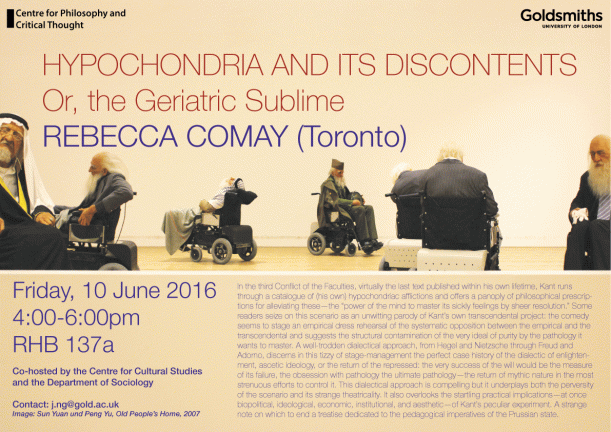
Rebecca Comay (Toronto) on Hypochondria and its Discontents, or, the Geriatric Sublime

Comay-2016-6-web.gif

Rebecca Comay (Toronto) discusses Kant’s presentation of hypochondria as a revealing parody of his own transcendental programme.

10 Jun 2016
4:00pm – 6:00pm
137a, Richard Hoggart Building

In the third Conflict of the Faculties, virtually the last text published within his own lifetime, Kant runs through a catalogue of (his own) hypochondriac afflictions and offers a panoply of philosophical prescriptions for alleviating these — the “power of the mind to master its sickly feelings by sheer resolution.”  Some readers seize on this scenario as an unwitting parody of Kant’s own transcendental project: the comedy seems to stage an empirical dress rehearsal of the systematic opposition between the empirical and the transcendental and suggests the structural contamination of the very ideal of purity by the pathology it wants to master. A well-trodden dialectical approach, from Hegel and Nietzsche through Freud and Adorno, discerns in this tizzy of stage-management the perfect case history of the dialectic of enlightenment, ascetic ideology, or the return of the repressed: the very success of the will would be the measure of its failure, the obsession with pathology the ultimate pathology — the return of mythic nature in the most strenuous efforts to control it.  This dialectical approach is compelling but it underplays both the perversity of the scenario and its strange theatricality.  It also overlooks the startling practical implications — at once biopolitical, ideological, economic, institutional, and aesthetic — of Kant’s peculiar experiment.  A strange note on which to end a treatise dedicated to the pedagogical imperatives of the Prussian state.

Rebecca Comay is Professor of Philosophy and Comparative Literature at the University of Toronto. She is the author of Mourning Sickness: Hegel and the French Revolution (Stanford 2011), editor of Lost in the Archives (2002) and co-editor of Endings: Questions of Memory in Hegel and Heidegger (with John McCumber, 1999), as well as the author of numerous articles on 19th century German philosophy, Marx, Benjamin and Adorno, psychoanalysis, contemporary French philosophy, and contemporary art and art criticism.


Leave a comment

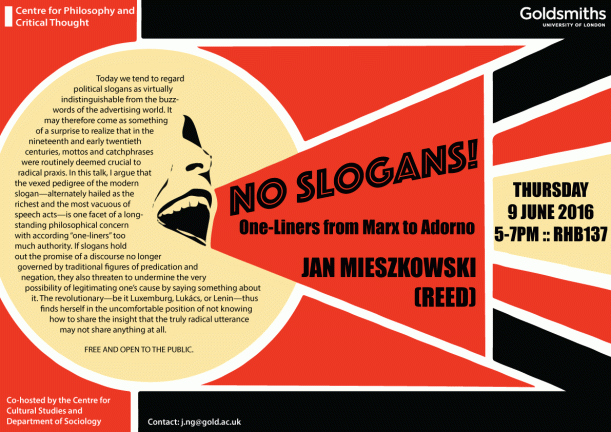
Jan Mieszkowski: No Slogans! One-Liners from Marx to Adorno

Jan-2016-9-web.gif

Jan Mieszkowski (Reed) discusses the political promise held–and betrayed–by the radical utterance par excellence: the slogan.

9 Jun 2016
5:00pm – 7:00pm
137, Richard Hoggart Building

Today we tend to regard political slogans as virtually indistinguishable from the buzzwords of the advertising world. It may therefore come as something of a surprise to realize that in the nineteenth and early twentieth centuries, mottos and catchphrases were routinely deemed crucial to radical praxis. In this talk, I argue that the vexed pedigree of the modern slogan—alternately hailed as the richest and the most vacuous of speech acts—is one facet of a longstanding philosophical concern with according “one-liners” too much authority. If slogans hold out the promise of a discourse no longer governed by traditional figures of predication and negation, they also threaten to undermine the very possibility of legitimating one’s cause by saying something about it. The revolutionary—be it Luxemburg, Lukács, or Lenin—thus finds herself in the uncomfortable position of not knowing how to share the insight that the truly radical utterance may not share anything at all.

Jan Mieszkowski is Professor of German and Humanities at Reed College, USA. His first book, Labors of Imagination: Aesthetics and Political Economy from Kant to Althusser (Fordham University Press, 2006), explores the doctrine of human productivity that emerges at the intersection of the traditions inaugurated by Immanuel Kant’s Critique of Judgment and Adam Smith’s The Wealth of Nations. His second book, Watching War (Stanford University Press, 2012), offers a new theory of battlefield spectatorship since the Napoleonic era. He is currently completing a new book called Crises of the Sentence.


Leave a comment

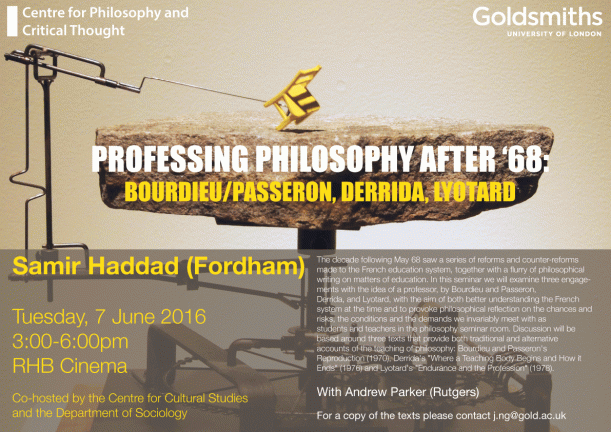
Samir Haddad (Fordham) on Professing Philosophy after ’68: Bourdieu/Passeron, Derrida, Lyotard

Haddad-2016-6-web.gif

A seminar with Prof. Samir Haddad (Fordham) on what it means — intellectually, institutionally, politically — to “do philosophy” in the classroom after May 1968 and today.

7 Jun 2016
3:00pm – 6:00pm
Cinema, Richard Hoggart Building

A CPCT special seminar with Samir Haddad (Fordham), in conversation with Andrew Parker (Rutgers).

The decade following May 68 saw a series of reforms and counter-reforms made to the French education system, together with a flurry of philosophical writing on matters of education. In this seminar we will examine three engagements with the idea of a professor, by Bourdieu and Passeron, Derrida, and Lyotard, with the aim of both better understanding the French system at the time and provoking philosophical reflection on the chances and risks, the conditions and the demands we invariably meet with as students and teachers in the philosophy seminar room.

Discussion will be based around three texts that provide both traditional and alternative accounts of the teaching of philosophy: Bourdieu and Passeron’s Reproduction (1970), Derrida’s “Where a Teaching Body Begins and How it Ends” (1976) and Lyotard’s “Endurance and the Profession” (1978).

For copies of the texts please contact j.ng@gold.ac.uk or visit the link below.

Click here for copies of the texts under discussion.


Leave a comment

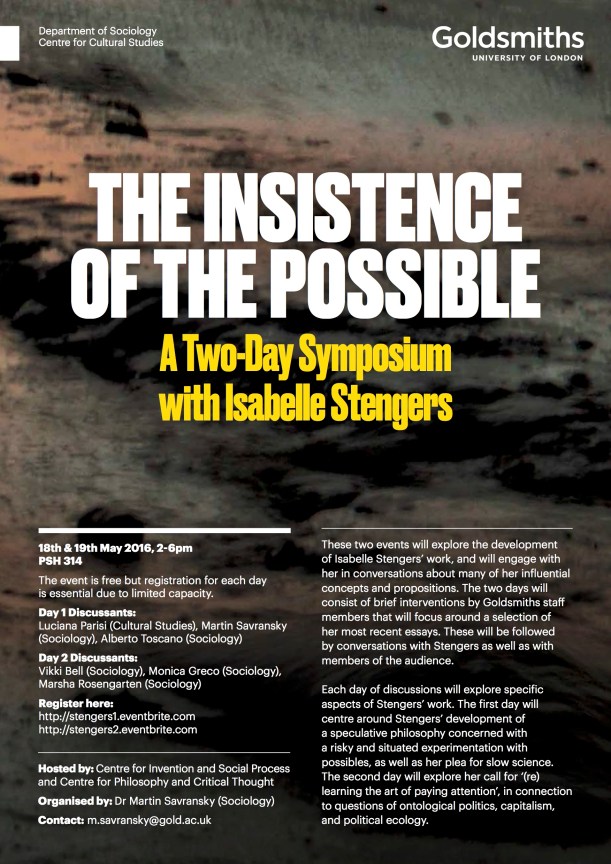
The Insistence of the Possible: Symposium with Isabelle Stengers (Day 2)

Stengers-Sociology_Event_Poster_Final_A3_updated.jpgA two-day Symposium with Isabelle Stengers and Goldsmiths academics

19 May 2016
2:00pm – 6:00pm
PSH 314, Professor Stuart Hall Building

These two symposia will explore the development of Isabelle Stengers’ most recent work, and will engage with her and the audience in conversations about many of her influential concepts and propositions. The two days will consist of brief interventions by Goldsmiths staff members that will focus around a selection of her most recent essays. These will be followed by conversations with Stengers as well as with members of the audience.
The second day will explore her call for ‘(re)learning the art of paying attention’, in connection to questions of ontological politics, capitalism, and political ecology.

Discussants: Vikki Bell (Sociology), Monica Greco (Sociology) and Marsha Rosengarten (Sociology)

Register Here


Leave a comment

The Insistence of the Possible: Symposium with Isabelle Stengers (Day 1)

Stengers-Sociology_Event_Poster_Final_A3_updated.jpg

A two-day Symposium with Isabelle Stengers and Goldsmiths academics

18 May 2016
2:00pm – 6:00pm
PSH 314, Professor Stuart Hall Building

These two events will explore the development of Isabelle Stengers’ work, and will engage with her in conversations about many of her influential concepts and propositions. The two days will consist of brief interventions by Goldsmiths staff members that will focus around a selection of her most recent essays. These will be followed by conversations with Stengers as well as with members of the audience.

Each day of discussions will explore specific aspects of Stengers’ work. The first day will centre around Stengers’ development of a speculative philosophy concerned with a risky and situated experimentation with possibles, as well as her plea for slow science.

Discussants: Luciana Parisi (Cultural Studies), Martin Savransky (Sociology), and Alberto Toscano (Sociology)

Register Here


Leave a comment

On Justice: Variations On a Theme Borrowed From Benjamin in 1916 (II)

Justice 2 poster w logo.jpg

Variation Two: Massimiliano Tomba (Padova) reconsiders Benjamin’s idea of justice as a transformative form of anticipation that carries its own criterion of its rightness.

28 Apr 2016
1:00pm – 6:00pm
LG01, Professor Stuart Hall Building

In the second of this two-part event, Massimiliano Tomba will reconsider Benjamin’s idea of divine violence—made famous in the essay “Towards the Critique of Violence”—as a form of anticipation that might be politically transformative because it carries its own criterion of its rightness.

Massimiliano Tomba is Professor of Political Philosophy at the University of Padova. His research focuses mainly on modern German philosophy, critical theory and globalization. He is co-organizer of an initiative titled ‘Next Generation Global Studies (NGGS)’ which aims at reconsidering predominant schemes of interpretation of global societies in order to overcome prevailing Eurocentric perspectives of political space and time. His work has involved theorists such as Kant, Hegel and post-Hegelian thought, Marx, Walter Benjamin, and Theodor Adorno. Among his  publications are Krise und Kritik bei Bruno Bauer. Kategorien des Politischen im nachhegelschen Denken, Frankfurt am Main, Peter Lang, 2005; La vera politica. Kant e Benjamin: la possibilità della giustizia, Macerata, Quodlibet, 2006; Marx’s Temporalities, Leiden, Brill, 2013.


In October 1916, Gershom Scholem copied into his diary a passage “from a notebook Walter Benjamin lent [him]” under the heading, “Notes Toward a Work on the Category of Justice.” Never included in either the two-volume or the seven-volume collected works and only reappearing upon publication of Scholem’s diaries, these “Notes” nonetheless represent a crucial juncture in the development of Benjamin’s thinking on the political. From one direction, the “Notes” are the culmination of intense discussions between Benjamin and Scholem on the concept of historical time, which issued into a number of important reflections on tragedy, time-reckoning, and language. In the other direction, the “Notes” inaugurated a series of objections and responses between the two friends that include Scholem’s own set of theses on the category of justice from 1919 and 1925, Scholem’s writings on Jonah, and texts surrounding Benjamin’s discussion of law and violence that come to a head with a number of fragments on lying circa 1923.

Using the “Notes Toward a Work on the Category of Justice” as its point of departure, this two-part event takes up the invitation to read together a “convolute” of shorter or lesser-known texts that contribute to a larger theme that Benjamin did not perhaps execute fully, but therefore provides a new context for understanding better known writings such as the Language essay or “Towards the Critique of Violence.” Each day will pivot around a variation on the theme, with presentations and seminar-style discussion based on pre-circulated texts.

For more information on the schedule and for a copy of the texts please visit https://benjaminonjustice.wordpress.com/


Leave a comment

Whither Topology. On structure and order in Homo Sacer.

A Contribution by Peter Fenves (external affiliate and recent guest at CPCT in April 2016) to Homo Sacer: A Blog Series at Stanford University Press. 


Read the full article here

Excerpt: As Agamben “abandons” the Homo Sacer project with the publication of The Use of Bodies, there arise a number of questions concerning the former’s seriality. What, for instance, governs the order and numbering of the volumes? And is the series ultimately convergent or divergent? Questions of this kind extend beyond the Homo Sacer project. As early as his first book, Stanzas, Agamben launches an inquiry into certain “zones of indetermination” that he would specify and develop under the “homo sacer” rubric. What first emerges from a retrospective glance at Stanzas, however, is not so much the intimation of a more expansive series as the surprising importance Agamben attributes to another term of mathematical modernity, namely topology, for, from the perspective of topology, the opening sections of the Homo Sacer project can be seen as a repetition of the Introduction to Stanzas.